



| HEADLINE |

|

Credit card boom hides growing debt trap
Published : Saturday, 29 August, 2026 at 12:00 AM
Shamsul Huda


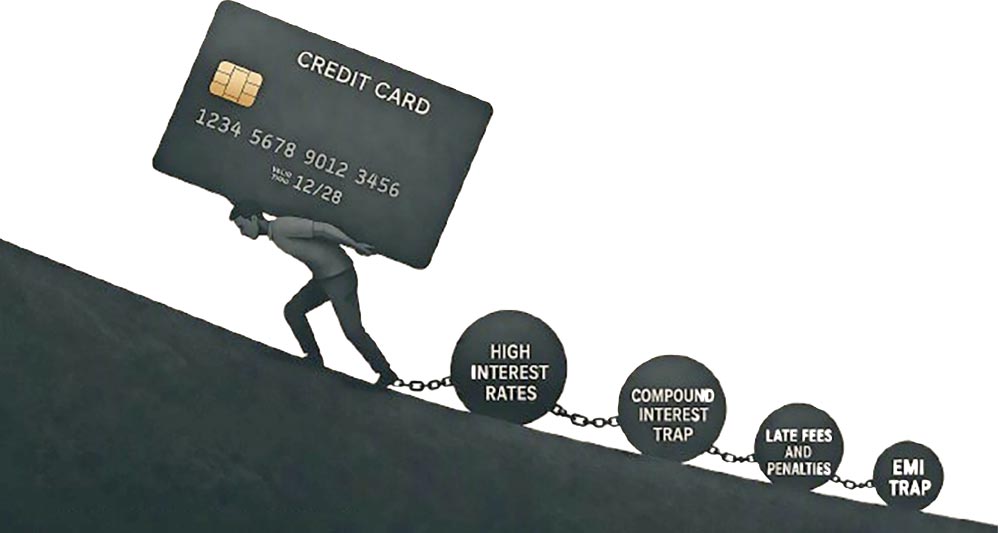 The credit card market booming in the country, with consumers increasingly using cards for payments abroad, household expenses and shopping.
But behind its impressive growth is a harder reality: as spending rises, so does the amount of money owed to banks, leaving many card users tied to monthly repayments and interestcosts.
According to Bangladesh Bank latest data credit card transactions jumped 43.25 per cent year-on-year to Tk44.61billion in June 2026, up from Tk31.14 billion a year earlier.The number of such cards also rose to 2.8 million in June, from about 1.74 million in July 2021.
More people are moving from cash to digital payments,merchants are accepting cards more widely and banks are pushing cards withcashback, discounts and Equated Monthly Installment (EMI) facilities.That is the positive side of the story.
But the second lead tells a different story. Outstanding credit-card receivables stood at Tk143.65billion at the end of May, against an approved credit limit of Tk420.01billion.
In other words, card users owed banks about 34.2 per cent of the total sanctioned limit.Put another way, Bangladesh had around 2.7 million credit cards in May, while outstandingreceivables were Tk143.65 billion.
Dividing the outstanding amount by the number of cards gives an average outstanding of roughly Tk53,204 per card. This is not the average debt of an individual borrower because one person may hold more than one card, and not every card has an unpaid balance. But it shows how large the credit burden has become.
The real trap is that consumers cannot simply walk away from these expenses.A credit card may make a Tk10,000 purchase feel painless at the checkout counter.
The pressure comes later, when the bill arrives. If the full balance is not cleared, the unpaidamount can continue to generate interest and charges under the card's terms.
Interest rates make that pressure considerably heavier. Published card rates in 2026 show that an annual interest rate of 25 per cent is common among major cards.
National Bank lists its credit-card rate at 25 per cent, while BRAC Bank's published schedule shows annual rates of 22 per cent for some cards and 25 per cent for several others. City Bank's American Express credit-card information also shows a 25 per cent annual purchase and cash-advance rate, while EBL cards are listed at 25 per cent.
At 25 per cent a year, a Tk100,000 unpaid balance represents roughly Tk25,000 in annual interest before taking account of the way a bank calculates interest, repayments, fees or other charges. On a simple monthly basis, that is about Tk2,083 in interest for every Tk100,000 outstanding.
For a household already struggling with rising living costs, that can turn a manageable purchase into a much more expensive liability.
Minimum-payment arrangements may reduce the immediate pressure but can keep the borrower inside a cycle of repayment for much longer.
Some cards allow customers to pay only a small percentage of the principal outstanding along with fees, charges and EMI amounts; Standard Chartered, for example, states a minimum payment of 1 per cent of principal outstanding plus applicable fees, charges and EMI, or Tk500, whichever is applicable.
Domestic credit-card transactions reached Tk42.88 billion in May, up 10.85 per cent from April and 33.15 per cent from May 2025. Nearly half of domestic credit-card spending was made at department stores, suggesting that cards are increasingly being used for ordinary household and retail purchases rather than only for occasional luxury spending.
Bangladeshis spent Tk5.52 billion abroad through credit cards in June, up from about Tk4.25 billion in May. Across credit, debit and prepaid cards, Bangladeshi cardholders spent Tk10.37 billion abroad in June, 27.55 per cent more than the Tk8.13 billion spent in May.
That compares sharply with foreign cardholders' spending in Bangladesh. In May, foreign nationals spent Tk3.12 billion through cards here, while Bangladeshi cardholders spent Tk8.13 billion abroad-about 2.6 times more.
The five-year comparison makes the transformation even clearer. Credit cards increased from 1.74 million in July 2021 to 2.8 million in June 2026, a rise of about 58 per cent.
Over the same period, debit cards rose from 23.6 million to 40 million, while prepaid cards expanded dramatically from 955 thousands to 8.7 million.
Bangladesh is clearly becoming more card-based, but increasingly dependent on borrowed money to sustain consumption.
The numbers tell two stories. Digital payments are expanding, giving consumers greater convenience. Yet when card spending grows faster than disposable income, convenience can quietly become debt.
For banks, rising card use means higher fee and interest income and stronger customer engagement. For consumers already struggling with high living costs, however, the monthly statement can turn yesterday’s convenience into today’s financial burden.
The human side of Bangladesh’s card boom is simple. The swipe is instant, but the repayment can last for months.
Loading...
Loading...



Editor : Iqbal Sobhan Chowdhury
Published by the Editor on behalf of the Observer Ltd. from Globe Printers, 24/A, New Eskaton Road, Ramna, Dhaka.
Editorial, News and Commercial Offices : Aziz Bhaban (2nd floor), 93, Motijheel C/A, Dhaka-1000.
Phone: PABX- 41053001-06; Advertisement: 41053012; 01793317829, 01550707291, E-mail: [email protected], [email protected] Online: email: [email protected] 41053014; 01550707297 Advertisement: 01550707296
Published by the Editor on behalf of the Observer Ltd. from Globe Printers, 24/A, New Eskaton Road, Ramna, Dhaka.
Editorial, News and Commercial Offices : Aziz Bhaban (2nd floor), 93, Motijheel C/A, Dhaka-1000.
Phone: PABX- 41053001-06; Advertisement: 41053012; 01793317829, 01550707291, E-mail: [email protected], [email protected] Online: email: [email protected] 41053014; 01550707297 Advertisement: 01550707296


