



| HEADLINE |

|

What We Can Learn from Disasters in Nepal and Tibet
Published : Sunday, 30 August, 2026 at 12:00 AM
AL Sharia


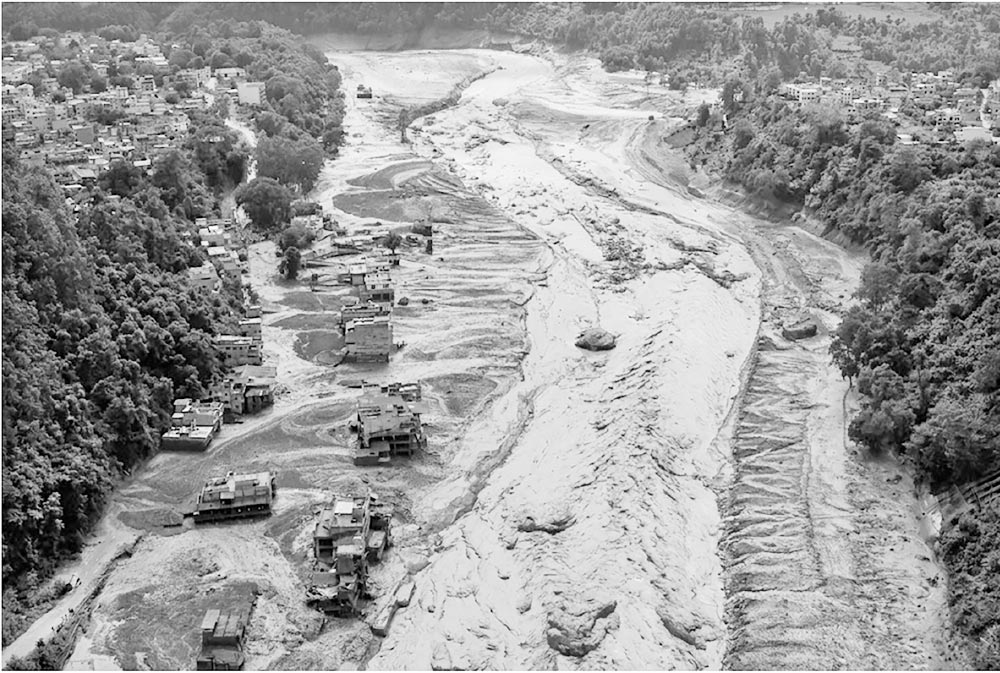
 The recent catastrophic flooding and landslides on the Nepal-Tibet border have created an opportunity to rethink overall disaster preparedness in South Asia. Sudden floods caused by a glacier collapse along with a strong flow of mud and stones have instantly washed away many settlements, habitats, bridges and national highways. The US Geological Survey (USGS) confirmed that the cause was not an earthquake but a piece of a glacier collapsing on sediment saturated with monsoon water. Going beyond normal flooding, that destructive stream of massive mud and stones has left many people homeless and completely severed communication systems. At the time of writing, the death toll has crossed several hundred, while more than a thousand people remain missing. However, the figures are changing by the day as rescue operations continue. This tragic incident in the lap of the Himalayas is a warning for every neighbouring country. Naturally, a question arises as to whether Bangladesh is completely safe from the risk of such sudden disasters in hilly areas.
In answering this question, spreading baseless panic is as inappropriate as suffering from complacency. In terms of geographical structure, the hilly regions of Bangladesh are not like the towering Himalayan Mountains of Nepal and Tibet. Therefore, the chances of an exact repetition of the geological events of Nepal or Tibet occurring on the plains of Bangladesh are low. However, the idea that intense flash floods, landslides and mud-mixed water flows cannot occur in our hilly regions is completely unfounded. Despite the difference in geographical structure, the natural and man-made processes of creating disasters are equally relevant and dangerous for Bangladesh.
The southeastern territory of Bangladesh is right at the forefront of this risk. The hilly settlements of Rangamati, Bandarban, Khagrachhari, Chattogram and Cox’s Bazar are geographically very sensitive. The hills in this region are mainly composed of soft sandstone and silt. When rainwater descends rapidly through hilly streams, small rivers and narrow valleys, it washes away the surrounding loose soil and vegetation. When that muddy stream of water crashes down into the settlements below at high speed through narrow mountain paths, it brings about a major disaster.
 In recent times, the direct impact of global climate change has been added to this natural process. A warmer atmosphere can hold relatively more water vapour. As a result, instead of normal continuous rain, extreme heavy rainfall or cloudburst-like situations are being created in a very short time. When there is an abnormal amount of rain in a short period, the soil of the hills quickly absorbs water and becomes saturated. Once the holding capacity of the soil is exhausted, its bond loosens and landslides occur. Even though climate change is not the sole cause of any single event, it is multiplying the intensity and risk of extreme rainfall.
Unplanned human activities are creating a bigger danger than this extreme form of nature. The tendency of indiscriminate hill cutting, deforestation and building settlements on steep slopes of hills over the years has increased the risk manifold. Houses are being built dangerously at the foot of the hills and the normal path of water flow is being blocked by occupying natural streams and drains. Moreover, rainwater gets trapped and creates artificial waterlogging because the natural drainage system of the hills is ignored during the construction of roads and infrastructure. When that water breaks the pressure of the soil and suddenly comes down, it crushes the settlements below. Man-made vulnerabilities combined with adverse natural behaviour are turning ordinary rain into terrible humanitarian disasters.
Before seeing the recent scenes in Nepal and Tibet, the past history of Bangladesh has also given us this warning repeatedly. The memories of the terrible landslides in Chattogram and the Chittagong Hill Tracts in 2007 and 2017 are still fresh today. Loss of life and disruption of road communication due to hill slopes and mud streams every monsoon have now become regular occurrences. These experiences make it clear that we have witnessed the footsteps of potential danger in the past as well.
There are also major limitations in our current preparedness. The forecast of the meteorological department remains general and there is no specific information on exactly which slope might collapse or through which stream the flood will descend. Early warning systems and rapid message delivery mechanisms at the local level are still absent. Although hazard maps are created in geological research, their application in urban planning or rehabilitation policies is almost nonexistent. Research cannot save lives if it remains stuck only in documents.
Transformation is also needed in disaster management policy. Leaving behind the conventional concept of rescue and relief, risk reduction-oriented preventive policies must be adopted such as proper land use, strict prohibition of hill cutting, modern forecasting and sustainable drainage systems. The tendency to consider hills merely as tourist or commercial spots is suicidal because development carried out by destroying their natural drainage systems ultimately becomes the cause of destruction itself.
The main lesson for Bangladesh from the incidents on the Nepal-Tibet border is that there is no scope to sit idle assuming any extreme natural behaviour is impossible. It must be realised that even a slight failure of water drainage in hilly areas can bring about a catastrophe. At the same time, introducing potential impact-based warnings instead of just general weather messages and controlling human settlements in vulnerable places is now the demand of the time.
The hills of Nepal and Tibet are not our hills and their rivers are not our rivers. But Bangladesh has the opportunity to be cautious beforehand by recognizing the signals of disaster. The time for theoretical debate on whether devastating events like the mud floods of Nepal and Tibet will happen in Bangladesh is over. We should look for practical solutions to the question of how ready our own hilly settlements are to face such extreme disasters and taking swift action is most urgent right now.
The writer is a student in the Department of Disaster Science and Management at Begum Rokeya University, Rangpur

Loading...
Loading...
Also read



Editor : Iqbal Sobhan Chowdhury
Published by the Editor on behalf of the Observer Ltd. from Globe Printers, 24/A, New Eskaton Road, Ramna, Dhaka.
Editorial, News and Commercial Offices : Aziz Bhaban (2nd floor), 93, Motijheel C/A, Dhaka-1000.
Phone: PABX- 41053001-06; Advertisement: 41053012; 01793317829, 01550707291, E-mail: [email protected], [email protected] Online: email: [email protected] 41053014; 01550707297 Advertisement: 01550707296
Published by the Editor on behalf of the Observer Ltd. from Globe Printers, 24/A, New Eskaton Road, Ramna, Dhaka.
Editorial, News and Commercial Offices : Aziz Bhaban (2nd floor), 93, Motijheel C/A, Dhaka-1000.
Phone: PABX- 41053001-06; Advertisement: 41053012; 01793317829, 01550707291, E-mail: [email protected], [email protected] Online: email: [email protected] 41053014; 01550707297 Advertisement: 01550707296


