



| HEADLINE |

|

The Mecca Pact and the Potential Malignant Achilles Heel of Bangladesh
Published : Thursday, 3 September, 2026 at 12:00 AM
Rajeev Ahmed


 Bangladesh is turning to the Mecca Pact out of economic panic. The country needs foreign direct investment and cash transfers from overseas workers because its main economic driver, the garment industry, is hitting a wall. Saudi Arabia and the UAE have dangled big investment promises, but those checks always come with political strings attached. Saudi leaders want food security for their own citizens, so they view Bangladeshi farmland and cheap labour as resources to exploit.
The financial logic behind this alliance falls apart fast. Saudi Arabia and Turkey do not offer trade deals that help Bangladesh. They compete for the exact same markets. Turkish factories produce textiles that directly compete with Bangladeshi exports across Europe. Signing a strategic pact with Ankara means giving political favours to a country actively trying to steal Bangladesh’s main source of export income.
Saudi Arabia’s money comes with heavy political demands. Riyadh expects absolute obedience and cultural alignment in exchange for capital. This is not development assistance. It is cash bought with national independence. Joining this pact forces Bangladesh to take sides in Saudi rivalries against Iran and Qatar. That creates immediate danger for Dhaka, which maintains trade connections with Doha and holds a distinct domestic population. Joining the alliance hands control of Bangladeshi foreign policy to the OPEC oil cartel.
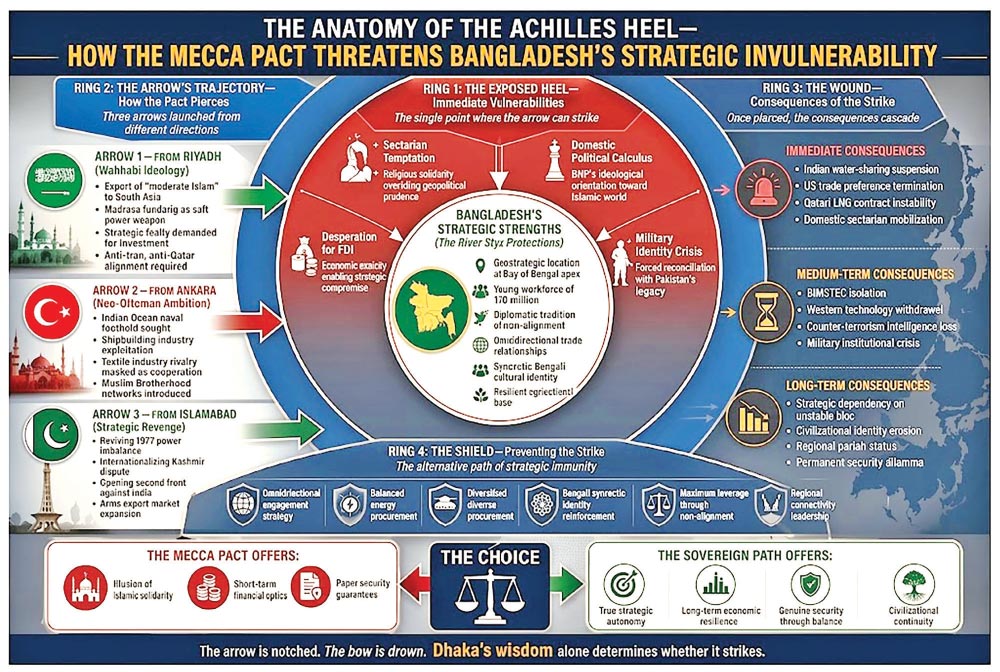 The impact on migrant workers is even worse. Bangladeshi workers send home roughly $22 billion every year, mainly from Gulf states like Saudi Arabia, the UAE, Qatar, Oman, and Kuwait. Joining a military alliance puts those workers in the crosshairs of regional politics. Qatar hosts over 400,000 Bangladeshi labourers and will not tolerate Dhaka aligning with its regional rivals. Bangladesh cannot survive without income from the Gulf, but joining this pact forces the government to pick a side and put its own citizens at risk.
The Indian Factor and the Strategic Entrapment
The biggest flaw in Bangladesh joining the Mecca Pact is that it ignores basic geography and the reality of Indian power. India dominates South Asia. The political shift in Dhaka that brought Tarique Rahman to power has already strained relations with New Delhi. Bringing Pakistan into the Bay of Bengal through a defence alliance is a massive strategic mistake. It forces a hostile reaction from the country that controls Bangladesh's river waters and surrounds its land borders.
New Delhi will react quickly. Negotiations over the Teesta River water-sharing deal will stop completely. Cross-border trade will face endless delays and friction. India will likely support opposition political groups inside Bangladesh that oppose Rahman’s foreign policy. On top of that, the Indian military will build up its presence along the border, pushing Bangladesh into a security crisis it cannot win.
Foreign Ministry State Minister Humayun Kabir claimed Dhaka is only viewing the proposal positively subject to legal scrutiny, showing some awareness of these dangers. But just expressing interest has already damaged relations. Indian military planners will now treat Bangladesh as a potential partner of Pakistan and Turkey, whether a treaty gets signed or not.
The alliance also lacks any real power because it does not have a single military command. Turkey has advanced drones, but its navy cannot project force into the Bay of Bengal against India. Saudi Arabia's military failed against Houthi fighters in Yemen. Pakistan's army is stretched thin and relies on global loans from institutions where India holds major influence. The pact looks big on paper, but it offers zero actual security when real conflicts start.
The US, China, and the Russian Chessboard
You cannot analyze the Mecca Pact without looking at how the US and China fight for control over global trade routes and military access. Washington hates this alliance. American strategy used to rely on Saudi Arabia and Pakistan as reliable regional partners. That arrangement fell apart when China brokered the diplomatic deal between Riyadh and Tehran. A new bloc connecting Saudi Arabia, Turkey, Pakistan, and Bangladesh strips away American leverage and gives Beijing more room to operate.
Turkey makes the situation even worse for Washington. Ankara holds NATO membership, but buying Russian S-400 missile systems and launching military operations in Syria showed American officials that Turkish leaders will ignore NATO priorities whenever it suits them. Tying Bangladeshi defence policy to Turkey puts trade access to the US market at risk. Washington already hit Turkey’s defence sector with targeted sanctions, and American lawmakers can easily cut trade privileges for any government that builds close military ties with Ankara.
China’s position is just as complicated. Beijing buys massive amounts of Saudi crude and supplies weapons to Pakistan, but Chinese leaders hate Turkey’s efforts to influence Turkic populations in Central Asia and Xinjiang. An aggressive Islamic military pact near China’s southern trade corridors threatens Chinese state security. Beijing will tolerate this deal only if it stays limited to business contracts under Chinese oversight. Bangladesh risks getting caught in a direct fight between its Western export markets and its Chinese infrastructure creditors.
Russia wants to keep Turkey out of South Asia too. Moscow sells weapons to Ankara, but the two nations fight proxy conflicts in Ukraine, Syria, and the Caucasus. Turkish expansion into the Bay of Bengal disrupts the trade routes Russia wants to build through Iran to India. Aligning with a Turkish-led military alliance turns Moscow into an opponent. That destroys Bangladesh's long-standing relationship with a veto-holding power on the UN Security Council.
The Illusion of the Turkish Shield
Proponents overstate the military capability of the Mecca Pact. Turkish Bayraktar TB2 drones performed well in limited conflicts in Libya and Nagorno-Karabakh, but they cannot replace a real air defence network against a major power like India. The Bangladeshi military operates as a professional force, but its actual design focuses on internal security, disaster relief, and basic territorial defence.
Working directly with the Pakistani military poses severe risks for Dhaka. The Bangladeshi armed forces trace their identity back to the 1971 Liberation War fought against Pakistan. Forcing Bangladeshi officers to conduct joint military exercises with the same institution they fought against damages internal morale. This move creates friction inside the armed forces and risks reviving extremist networks that Bangladesh spent years suppressing.
Pakistan promotes this pact to drag the Kashmir dispute into the Bay of Bengal. By opening a second strategic front on India's eastern flank, Pakistan hopes to reduce military pressure on its own borders. Pakistani generals do not view Bangladesh as an equal partner. They view the country as a tool to use against India. Pakistani officials treated East Pakistan like a colony before 1971, and Dhaka needs to remember that history.
The intelligence aspect creates immediate operational danger. Bangladesh built an effective counter-terrorism system by working directly with Indian and Western intelligence agencies to track militant networks. Entering a defence arrangement with Pakistan, a state that routinely shelters terrorist groups, damages those working relationships. Bangladesh's intelligence services will lose access to vital tracking data that currently stops terrorism inside the country. (To be continued)
The writer is a strategic thinker and the Editor of Geopolits.com

Loading...
Loading...
Also read



Editor : Iqbal Sobhan Chowdhury
Published by the Editor on behalf of the Observer Ltd. from Globe Printers, 24/A, New Eskaton Road, Ramna, Dhaka.
Editorial, News and Commercial Offices : Aziz Bhaban (2nd floor), 93, Motijheel C/A, Dhaka-1000.
Phone: PABX- 41053001-06; Advertisement: 41053012; 01793317829, 01550707291, E-mail: [email protected], [email protected] Online: email: [email protected] 41053014; 01550707297 Advertisement: 01550707296
Published by the Editor on behalf of the Observer Ltd. from Globe Printers, 24/A, New Eskaton Road, Ramna, Dhaka.
Editorial, News and Commercial Offices : Aziz Bhaban (2nd floor), 93, Motijheel C/A, Dhaka-1000.
Phone: PABX- 41053001-06; Advertisement: 41053012; 01793317829, 01550707291, E-mail: [email protected], [email protected] Online: email: [email protected] 41053014; 01550707297 Advertisement: 01550707296


