



| HEADLINE |

|

Police Reform Is a Must
Turn the 'Fearful Force' into a Force for the People



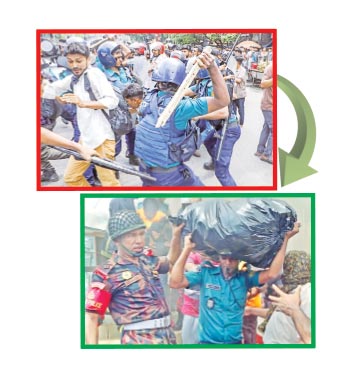
A mother waits outside a thana, not for justice, but to learn whether money will decide her son’s fate. This is the daily grammar of policing in Bangladesh �" a force meant to serve citizens that has, for generations, too often served whoever sat in power.
Crimes committed by police
The charge sheet is long: custodial torture, excessive force against protesters, enforced disappearance, extrajudicial “crossfire” killings and fabricated “ghost” cases, sometimes filed even against the dead.
Bribery can become the price of a legitimate FIR, while extortion masquerades as investigation. The poor and powerless suffer most, while influence can buy an escape. A national daily recently found little fundamental change in the force’s criminal mindset. The old trade in transfers persists, leaked audio has exposed financial corruption, and officers have been implicated in dacoity, mugging and narcotics trafficking, alongside “arrest trading” and intimidation for cash.
The killing of retired Major Sinha Mohammad Rashed Khan in Cox’s Bazar and the beating death of a young man at a Sylhet outpost remain among the starkest scars on the force’s image. More recently, cricketer Naeem Hasan was allegedly beaten after being dragged from a rickshaw, while a Jubo League activist died in custody.
Abuse of power takes familiar forms �" disproportionate force during arrest, warrantless searches, false cases arising from personal grudges or political favour, and the routine weaponisation of the police for whoever governs.
Beyond brute force lies moral policing. Officers have at times assumed authority over whom citizens may marry, what dialogue a film may contain and even the colour of a citizen’s hair. The makers of Nabab LLBwere jailed on pornography charges for allegedly portraying police unfavourably. At Suhrawardy Udyan, a purported anti-narcotics raid degenerated into baton charges on ordinary pedestrians; a student and a journalist were among those injured for asking questions.
This is social control wearing a badge.
Effects of such crimes and the necessity of reform
Police conduct is the state’s most visible face �" a basic test of whether the rule of law exists beyond paper. Citizens turn to the police in crisis, yet the uniform often breeds fear rather than reassurance.
No infrastructure or development can compensate for a citizen humiliated at a thana or told that money is needed to move a case. Once that trust disappears, citizens cease to regard the state as their own.
After Sheikh Hasina’s fall, police themselves faced attacks. Officers returned to duty in plain clothes, fearful and aggrieved. Yet their conduct has barely shifted, suggesting that the uprising taught the institution little.
A repressive culture dating to 1930 needs to be uprooted, and depoliticisation is essential. Former IGP Nurul Huda admitted that the force had been turned into “a monstrous entity”.
Nigeria, Pakistan, Iraq and Kenya each required UN-backed reform after comparable crises of politicisation and public distrust. Bangladesh is not unique; it is overdue.
New Zealand’s Independent Police Conduct Authority, Ontario’s Special Investigations Unit and Northern Ireland’s Police Ombudsman demonstrate that oversight answerable to citizens, rather than to the chain of command being scrutinised, can restore trust where self-policing cannot.
Why police remain unaccountable
The central flaw is structural: police investigating police creates an unavoidable conflict of interest, allowing evidence to be buried, witnesses influenced and institutional solidarity to prevail. Even custodial deaths may result in little more than a transfer.
The rot, however, runs deeper. Recruitment, transfer and promotion are widely reported to depend on political loyalty and bribery rather than merit. Postings are bought or politically distributed, while officers serving the ruling party can advance over those serving the public.
Whichever party holds power has treated the force as its instrument �" deploying it against opponents and rewarding compliance. The patronage that installs an officer can also keep him beyond disciplinary reach.
Offences become woven into the institution’s machinery: some officers participate, others remain silent. Dhaka’s transport chaos is one illustration. When disorder becomes profitable for those meant to police it, disorder acquires protection from within.
History of failed reform initiatives
Uniforms have changed repeatedly since British rule �" in 2004, 2009 and twice more recently within months. But cloth cannot launder culture.
The legal framework remains largely colonial: the Police Act of 1861, CrPC of 1898, Evidence Act of 1872 and Police Regulations of 1943.
Reform has been attempted three times. The Police Ordinance 2007, drafted with UN assistance after One-Eleven, proposed an 11-member National Police Commission empowered to appoint the police chief, merit-based promotion and a Police Tribunal for errant officers.
A 2013 revision strengthened accountability but inserted a controversial good-faith immunity clause, condemned by civil society as a licence for impunity. Both initiatives stalled amid political indecision.
The interim government’s Police Reform Commission produced the most detailed blueprint yet, covering 13 areas. It proposed a five-member independent commission led by a retired Supreme Court judge to recommend the IGP’s appointment and investigate citizen complaints; a UN-aligned five-stage use-of-force doctrine; immediate enforcement of Appellate Division directives on arrest, search and interrogation; glass-walled interrogation rooms; mandatory women officers for women detainees; a 999 hotline extension; a standalone witness-protection law; re-evaluation of RAB; thana-level all-party watchdog committees; a dedicated anti-corruption task force; and an end to political or financial influence over transfers and promotions.
None became binding law before the interim administration’s tenure ended in February. The file passed, largely unlegislated, to an elected parliament that has yet to act.
What people expect from this government?
Asurveyby police refom commission during the Interim Government found 89.5 per cent want a force free from political interference, 74.9 per cent demand accountability, 95 per cent want an end to fabricated cases and 58.9 per cent favour an independent oversight commission.The message is difficult to misread.
An investigative body genuinely independent of the police and Home Ministry, with citizen representation and real subpoena powers, should be established. Criminal offences should no longer be treated merely as departmental infractions.
CrPC Section 54 on warrantless arrest and Section 167 on remand interrogation should be amended. The witness-protection law should be enacted, and the state should withdraw its review petition against the Appellate Division’s directives.
Recruitment, transfer and promotion must become transparent and merit-based, breaking the link between political loyalty, bribery and career advancement. Body cameras and video-recorded interrogations should be mandatory, with unedited footage preserved and handed over immediately.
Every citizen must have an unqualified right to file a GD, officers who stall FIRs should face sanctions, and political-loyalty screening of citizens must end.
Lethal weapons should remain available for legitimate self-defence and deterrence, but policing must also rely on public-health and criminal-justice approaches rather than force alone.
Above all, reform requires a cultural shift �" training in humanity and ethics as rigorous as drill.
The file left by the interim government is not obsolete. It is unfinished business. The elected government now has the responsibility to complete it, because reforming the police ultimately means restoring a simple proposition: the badge belongs to the law, not to power.

Loading...
Loading...




Editor : Iqbal Sobhan Chowdhury
Published by the Editor on behalf of the Observer Ltd. from Globe Printers, 24/A, New Eskaton Road, Ramna, Dhaka.
Editorial, News and Commercial Offices : Aziz Bhaban (2nd floor), 93, Motijheel C/A, Dhaka-1000.
Phone: PABX- 41053001-06; Advertisement: 41053012; 01793317829, 01550707291, E-mail: [email protected], [email protected] Online: email: [email protected] 41053014; 01550707297 Advertisement: 01550707296
Published by the Editor on behalf of the Observer Ltd. from Globe Printers, 24/A, New Eskaton Road, Ramna, Dhaka.
Editorial, News and Commercial Offices : Aziz Bhaban (2nd floor), 93, Motijheel C/A, Dhaka-1000.
Phone: PABX- 41053001-06; Advertisement: 41053012; 01793317829, 01550707291, E-mail: [email protected], [email protected] Online: email: [email protected] 41053014; 01550707297 Advertisement: 01550707296


