



| HEADLINE |

|

Rising killings spark law and order concerns
Nearly 10 people killed every day this year
Published : Saturday, 5 September, 2026 at 12:00 AM
Arifur Rahman Rabbi


 The recovery of four bodies from a house in Rangpur last month has left more questions than answers, fuelling fresh concerns over the country’s deteriorating law and order situation and the effectiveness of police investigations.
Retired teacher Ganapati Chakraborty and three other members of his family were found dead at their home in Machuapara on the night of August 22. Two people were later arrested in connection with the killings, but questions remain over the motive and the theory presented by police.
The Rangpur killings are far from an isolated incident. Murders and other forms of violence have increased across the country in recent months, with political rivalry, extortion, land grabbing, personal disputes, local dominance, underworld turf wars, drug trafficking and family and social conflicts among the factors cited for the rise.
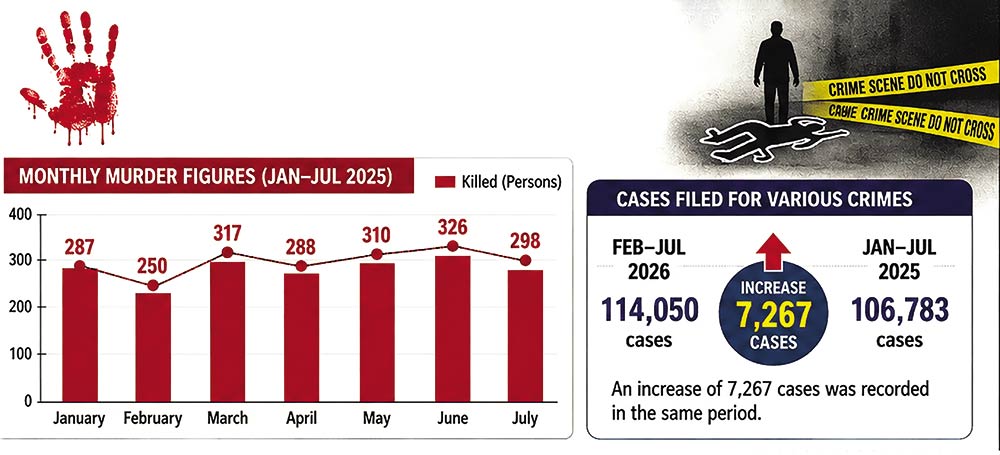
According to Police Headquarters statistics, 2,076 people were killed across the country, including Dhaka, between January and July this year, an average of nearly 10 killings a day. Dhaka recorded the highest number of killings both as a metropolitan area and as a division.
The monthly figures show that 287 people were killed in January, 250 in February, 317 in March, 288 in April, 310 in May, 326 in June and 298 in July.
Police data also show that 114,050 cases involving various crimes were filed between February and July 2026, compared with 106,783 cases between January and July 2025, an increase
of 7,267.
Responding to lawmakers’ concerns over law and order on August 27, Home Minister Salahuddin Ahmed said the overall situation had improved. He said law enforcement agencies were swiftly arresting offenders and taking prompt action in incidents that caused widespread public concern.
Police Headquarters Assistant Inspector General (Media and Public Relations) AHM Shahadat Hossain said immediate legal action was being taken against attempts to take the law into one's own hands.
He said the crime situation was being regularly reviewed at district and metropolitan levels, with strategies and security measures adjusted as necessary.
However, experts say a culture of impunity and delays in the justice process are contributing to the rise in killings. They also point to the release of several criminals on bail following the July mass uprising, the return of some others to the country and attempts by criminals who had remained inactive abroad to re-establish their influence through followers in Bangladesh.
Underworld conflicts have also increasingly spilled into the open.
The family of top criminal Khandaker Naim Ahmed Titon claimed he was killed over a dispute concerning the lease of a cattle market in Basila, Mohammadpur. They said Titon had been involved in a conflict with another top criminal, Imam ul Hasan Helal, also known as Pichchi Helal. Police said Titon was ranked second on a list of 23 top criminals published in 2001. He had spent a long time in prison before being released on bail after August 5, 2024.
Human rights organisation Human Rights Support Society (HRSS) reported that 56 people were killed in political and election-related violence between January and June this year, while more than 5,246 political activists and ordinary people were injured. During the same period, 133 people were killed and 256 injured in mob violence and lynching incidents.
Dr Omar Faruk, Professor of Criminology and Police Science at Mawlana Bhashani Science and Technology University, identified economic pressure, high population density, slums and crime-prone areas, inadequate monitoring of professional criminals, easy and quick bail, and limitations in the capacity and efficiency of law enforcement agencies as major factors behind the trend.
Human rights activist and Bangladesh Human Rights Foundation (BHRF) Chairperson Advocate Alena Khan also attributed the rise in killings to impunity and delays in the justice process. Criminals are taking advantage of laxity or delays in law enforcement activities, she said.
With killings and other crimes increasingly taking place in public, concerns over personal safety are growing. Mezbahul Alam, a Mohammadpur resident, said people no longer felt safe amid killings, gunfights and snatching.
Experts and human rights activists say offenders must be brought to justice swiftly and given exemplary punishment, regardless of their political or other affiliations.

Loading...
Loading...
Also read



Editor : Iqbal Sobhan Chowdhury
Published by the Editor on behalf of the Observer Ltd. from Globe Printers, 24/A, New Eskaton Road, Ramna, Dhaka.
Editorial, News and Commercial Offices : Aziz Bhaban (2nd floor), 93, Motijheel C/A, Dhaka-1000.
Phone: PABX- 41053001-06; Advertisement: 41053012; 01793317829, 01550707291, E-mail: [email protected], [email protected] Online: email: [email protected] 41053014; 01550707297 Advertisement: 01550707296
Published by the Editor on behalf of the Observer Ltd. from Globe Printers, 24/A, New Eskaton Road, Ramna, Dhaka.
Editorial, News and Commercial Offices : Aziz Bhaban (2nd floor), 93, Motijheel C/A, Dhaka-1000.
Phone: PABX- 41053001-06; Advertisement: 41053012; 01793317829, 01550707291, E-mail: [email protected], [email protected] Online: email: [email protected] 41053014; 01550707297 Advertisement: 01550707296


