



| HEADLINE |

|

RMG exports to US drops by 6.5pc
Published : Tuesday, 8 September, 2026 at 12:00 AM
Mizanur Rahman


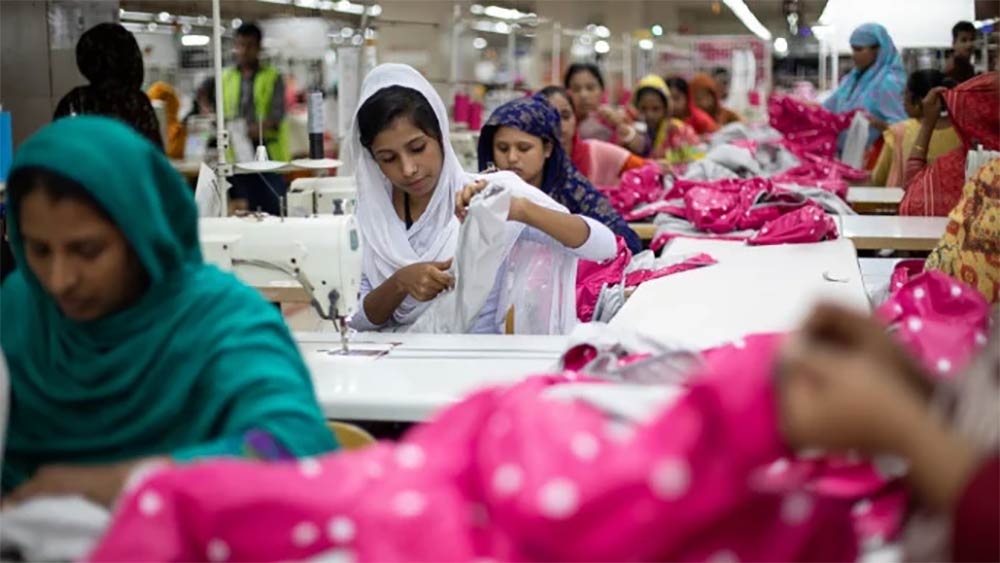 The US apparel market is sliding into a broad-based slowdown, with total clothing imports plunging 8.65 per cent year-on-year to US$41.83 billion in January-July 2026, heightening concerns for Bangladesh’s readymade garment (RMG) industry, one of the largest suppliers to the American market.
Data compiled from the US Office of Textiles and Apparel (OTEXA) show that apparel import volume fell 9.41 per cent during the seven-month period, while the average unit price edged up just 0.84 per cent.
Bangladesh’s apparel exports to the US stood at $4.66 billion, down 6.50 percent from the corresponding period of 2025. More worrying for exporters, shipments in July alone declined by 10.73 percent, indicating that the slowdown may be gaining momentum.
The latest figures show that the contraction is not confined to Bangladesh. China, the largest supplier to the US apparel market, recorded the sharpest decline in value at 34.21 per cent, followed by India at 25.77 per cent. Pakistan’s exports fell 5.60 per cent and Vietnam’s 1.03 per cent.
In contrast, Indonesia and Cambodia registered growth of 2.76 percent and 10.48 percent respectively.

Industry insiders say the figures point to a combination of weaker US demand, inventory adjustments and changing sourcing patterns among global buyers.
Mohiuddin Rubel, Founder and CEO of Bangladesh Apparel Voice (BAV) and former BGMEA director, said Bangladesh’s relatively smaller decline compared with China and India shows that the country remains competitive in the US market. His earlier analysis of OTEXA data also showed Bangladesh outperforming China and India despite the overall contraction in US apparel imports.
“China’s sharp decline and the continued growth of Cambodia and Indonesia indicate that buyers are actively diversifying their sourcing,” Rubel said in an earlier assessment of the US market. He also stressed that Bangladesh needs to improve competitiveness, reduce lead times and increase productivity to capture a larger share of the shifting orders.
The volume data, however, presents a more challenging picture. Bangladesh’s shipment volume declined 4.34 percent, while China and India recorded much steeper falls of 24.17 percent and 24.02 percent respectively. Meanwhile, Vietnam, Indonesia and Cambodia increased their shipment volumes.
Unit prices also declined for major suppliers. Bangladesh’s average unit price fell by 2.26 percent, compared with a much sharper 13.24 percent decline for China.
BGMEA President Mahmud Hasan Khan has repeatedly warned that weakness in the US market is a major concern for Bangladesh because the United States remains the country’s single largest apparel export destination. In May, he said US retaliatory tariffs, geopolitical tensions, the Middle East conflict, the energy crisis and domestic political instability were putting increasing pressure on exporters. He also noted that buyers were shifting from large orders to smaller and shorter-term orders.
He has also stressed that Bangladesh must take advantage of opportunities created by changing sourcing patterns. In February, Khan said lower tariffs could help Bangladesh increase its supply to the US market as American buyers would have greater incentive to purchase Bangladeshi apparel.
BGMEA Vice-President Sheheb Udduza Chowdhury has pointed out another structural challenge: Bangladesh has yet to fully capture the market share being lost by China. He said China remains particularly strong in man-made fibre apparel, while Vietnam, Indonesia and Cambodia have developed strong manufacturing capabilities in the segment, partly backed by Chinese investment.
The latest OTEXA figures therefore present both a challenge and an opportunity for Bangladesh. While the US market itself is contracting, China and India are losing substantially more ground than Bangladesh.
But the sharper decline in Bangladesh’s exports in July suggests that maintaining market share will require greater competitiveness, faster delivery, product diversification and stronger pricing strategies.
With the US market accounting for a significant portion of Bangladesh’s garment exports, industry leaders believe the coming months will be crucial. The ability to turn global sourcing shifts into new orders-while protecting existing business-could determine whether Bangladesh can withstand the current slowdown and regain growth in the US market.

Loading...
Loading...
Also read



Editor : Iqbal Sobhan Chowdhury
Published by the Editor on behalf of the Observer Ltd. from Globe Printers, 24/A, New Eskaton Road, Ramna, Dhaka.
Editorial, News and Commercial Offices : Aziz Bhaban (2nd floor), 93, Motijheel C/A, Dhaka-1000.
Phone: PABX- 41053001-06; Advertisement: 41053012; 01793317829, 01550707291, E-mail: [email protected], [email protected] Online: email: [email protected] 41053014; 01550707297 Advertisement: 01550707296
Published by the Editor on behalf of the Observer Ltd. from Globe Printers, 24/A, New Eskaton Road, Ramna, Dhaka.
Editorial, News and Commercial Offices : Aziz Bhaban (2nd floor), 93, Motijheel C/A, Dhaka-1000.
Phone: PABX- 41053001-06; Advertisement: 41053012; 01793317829, 01550707291, E-mail: [email protected], [email protected] Online: email: [email protected] 41053014; 01550707297 Advertisement: 01550707296


