



| HEADLINE |

|
Measles kills over 1,000 in B’desh: Outbreak or systemic failure?
Published : Thursday, 10 September, 2026 at 5:01 PM
Observer Special Report


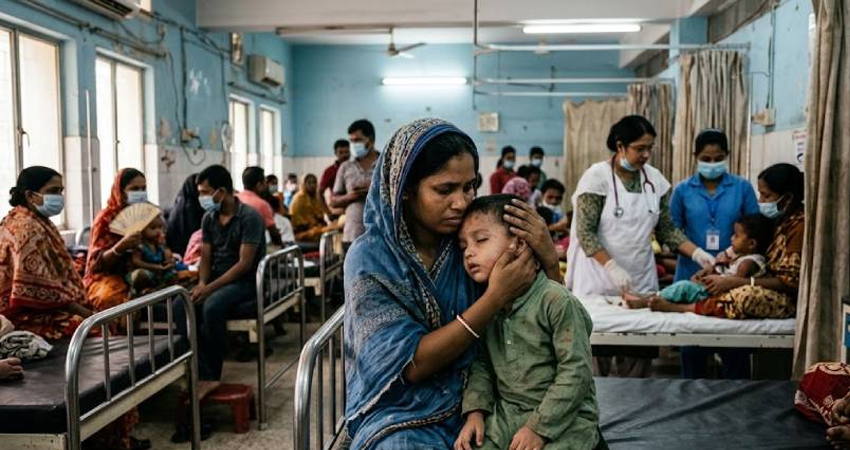
Collected Photo
A devastating measles outbreak in Bangladesh claimed over 1,000 lives and infected more than 166,000 people, raising profound questions regarding the nation's public health management, vaccine supply chains, and administrative preparedness.
For a family, a child's death is never a mere statistic; it represents an irreplaceable personal loss and an enduring silence that no official tally can capture.
However, when the state evaluates a health crisis, individual lives are inevitably aggregated into numbers.
As of September 10, international news agencies and health reports confirm that 1,009 people died from confirmed or suspected measles, alongside more than 166,000 suspected cases across the country.
This alarming figure poses an uncomfortable challenge because measles is neither an unknown nor an untreatable disease.
It is fully preventable through safe, effective vaccines that have enabled countries worldwide to control transmission for decades.
Bangladesh previously stood near the brink of eliminating measles entirely.
Yet, the 2026 outbreak severely compromised these past achievements.
The surge in infections that began in March spread across almost every district, overwhelming pediatric wards, increasing workloads for healthcare personnel, and forcing desperate parents to seek emergency care from hospital to hospital.
The crisis serves as a critical test of Bangladesh's health infrastructure, routine immunization coverage, logistics, and administrative responsiveness.
According to the World Health Organization (WHO), a primary factor driving the current transmission is a widening "immunity gap" among children.
Shortages in the supply of measles-rubella (MR) vaccines during 2024-2025, disruptions to routine immunization schedules, and the absence of supplementary national campaigns increased vulnerability across communities.
Initial cases were concentrated predominantly among unvaccinated or under-vaccinated children, with infants under five years facing the highest risks.
A child missing a vaccine dose is not always a result of parental negligence.
It frequently stems from systemic hurdles, including lack of information, distant health centers, stockouts, or irregular scheduling.
Therefore, immunization gaps reflect institutional capacity as much as individual choices, raising crucial questions about accountability. Recent reports citing health officials indicate that changes in vaccine procurement policies created severe supply chain bottlenecks.
Furthermore, a scheduled vaccination drive was postponed in 2024, and the subsequent year's national MR campaign was canceled.
These factors raise fundamental public health questions: if vaccine shortages and immunization gaps were known, why were proactive measures not implemented earlier, and why did initial interventions fail to prevent significant mortality?
Behind the official death toll are thousands of families facing real-world hardships.
A mother sitting in a crowded hospital with a feverish, gasping child focuses on her infant's survival rather than policy concepts like "immunity gaps." A father navigating hospital corridors remains unaware of where vaccine procurement stalled in administrative channels.
Media reports from pediatric facilities in Dhaka illustrate the distress of families traveling from remote regions to secure specialized care, reflecting a widespread national reality.
Measles presents severe medical risks beyond fever and skin rashes. Complications can lead to life-threatening conditions, including pneumonia, severe diarrhea, malnutrition, blindness, and encephalitis (brain inflammation).
Managing the disease requires rapid case identification, dedicated pediatric care, ready supplies of oxygen and essential medicines, nutritional support for vulnerable children, strict infection control in hospitals, and targeted catch-up vaccination drives.
The situation is further complicated by a concurrent dengue outbreak. Simultaneous pressure from both diseases has exposed limitations in hospital beds, medical staff, oxygen supplies, and critical care facilities.
Debates may persist regarding administrative performance, but from a public health perspective, the central concern remains why a preventable disease resulted in such high mortality.
While no government can eliminate all health risks, high vaccination coverage effectively prevents widespread measles outbreaks.
Each life lost represents a critical query regarding timely intervention. Halting active transmission remains the immediate imperative.
UNICEF states that maintaining at least 95 per cent two-dose vaccination coverage is necessary to achieve herd immunity and prevent outbreaks.
In response, the government launched an emergency vaccination campaign with support from WHO, UNICEF, and Gavi, targeting approximately 20 million children.
While essential, emergency drives primarily address existing gaps rather than replacing a robust routine system.
Long-term security requires comprehensive tracking of un-vaccinated children, early warning systems for vaccine stock depletion, equal healthcare access for rural populations, and proactive epidemic preparedness.
Bangladesh's health system previously demonstrated substantial progress in controlling preventable diseases.
Preventing future crises requires a thorough review of vaccine procurement processes, identification of routine immunization breakdowns, and administrative commitment to correcting systemic vulnerabilities.
Ultimately, a health system's success is measured not only by its capacity to treat the sick, but by its ability to protect lives before illness takes hold.
-SA
Loading...
Loading...
Also read








Editor : Iqbal Sobhan Chowdhury
Published by the Editor on behalf of the Observer Ltd. from Globe Printers, 24/A, New Eskaton Road, Ramna, Dhaka.
Editorial, News and Commercial Offices : Aziz Bhaban (2nd floor), 93, Motijheel C/A, Dhaka-1000.
Phone: PABX- 41053001-06; Advertisement: 41053012; 01793317829, 01550707291, E-mail: [email protected], [email protected] Online: email: [email protected] 41053014; 01550707297 Advertisement: 01550707296
Published by the Editor on behalf of the Observer Ltd. from Globe Printers, 24/A, New Eskaton Road, Ramna, Dhaka.
Editorial, News and Commercial Offices : Aziz Bhaban (2nd floor), 93, Motijheel C/A, Dhaka-1000.
Phone: PABX- 41053001-06; Advertisement: 41053012; 01793317829, 01550707291, E-mail: [email protected], [email protected] Online: email: [email protected] 41053014; 01550707297 Advertisement: 01550707296


