



| HEADLINE |

|

Car Sales Hit 13-year Low, Imports Fall
BARVIDA calls 500-showroom shutdown Thursday over EV import ban
Published : Wednesday, 16 September, 2026 at 12:00 AM
Nurul Amin


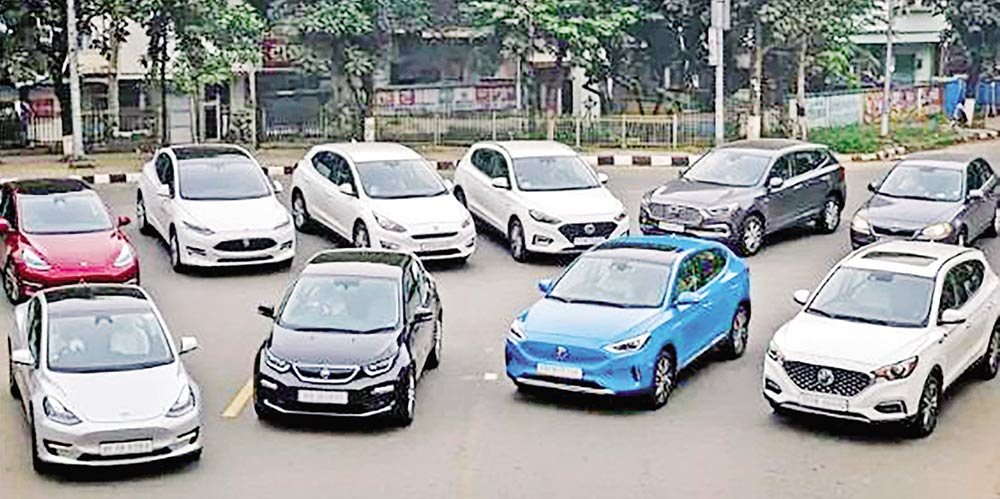 CHATTOGRAM Sep 15: Sales of new and reconditioned cars in Bangladesh have fallen sharply, with fresh private passenger car registrations dropping to 9,387 units in 2025, the lowest in 13 years, according to Bangladesh Road Transport Authority (BRTA) data.
The decline has continued since 2022, following a brief post-pandemic rebound. In 2020, around 20,093 passenger vehicles, including microbuses and SUVs, were registered, of which about 12,403 were cars. In 2021, the market grew 6.67 per cent as economic activity resumed after lockdowns, while imports rose to around 25,000 units.
SUV sales crossed 30,000 units in 2022, said Abdul Huq, president of the Bangladesh Reconditioned Vehicles Importers and Dealers Association (BARVIDA). He said overall vehicle registrations reached nearly 578,000 that year, with car registrations crossing 10,000 units for the first time.
The market plunged in 2023 amid high inflation, liquidity shortages and a sharp rise in the US dollar exchange rate. In 2024, private passenger car registrations fell below 10,000, while overall vehicle registrations hit a decade low amid political uncertainty, according to BARVIDA.
Registrations fell further in 2025, driven by rising vehicle prices, high import duties and depreciation of the Taka.
Industry insiders attributed the decline to high inflation, liquidity constraints, political change and consumers’ reduced purchasing capacity. The market is showing signs of cautious stabilisation in 2026, with the used-car market estimated at $1.65 billion. Bangladesh Bank’s reduction of LC cash margins for car imports from 100 per cent to 50 per cent has also eased liquidity for reconditioned vehicle importers.
Pre-owned and reconditioned vehicles dominate the market, with petrol cars accounting for nearly 79 per cent. Demand has shifted towards SUVs and crossovers over traditional sedans due to road conditions, with Toyota leading registrations. Electric and hybrid vehicles are also gaining ground amid tax incentives and eased import restrictions.
“I have sold 30 cars so far in the current year. But I sold a total of 120 cars in 2025,” said Habibur Rahman Khan, owner of Habib Brothers in Chattogram.
“Consumers are reluctant to spend large amounts of cash. Buying a car worth Tk40 lakh to Tk60 lakh ties up significant funds, while taking a loan creates repayment pressure,” he said. “When business is slow, customers worry about how they will service instalments. This financial strain is a key factor.”
Jasimuddin, a Chattogram businessman, said, “I had planned to own a private car this year. But due to the dull situation in the business sector, I have dropped the plan.”
Industry leaders cited political uncertainty, economic sluggishness and inadequate policy support as major causes. The sector contributes around Tk6,000 crore in annual government revenue and supports a large network of jobs and investments. BARVIDA has urged the government to introduce a rational long-term tax structure, remove customs valuation disparities and provide duty benefits for eco-friendly hybrid vehicles.
Meanwhile, reconditioned vehicle imports fell 6.42 per cent in FY2025-26 to 19,968 units from 21,337 in FY2024-25, according to BARVIDA data. The association said the decline was not normal, adversely affecting the local market and depriving the government of revenue.
Ban on reconditioned EV imports
The government has banned imports of reconditioned or used EVs, despite their inclusion in the Import Policy Order 2026-2029 published on August 24.
“All of a sudden, the ban has been imposed on us,” BARVIDA president Abdul Huq told the press. He said discussions had agreed to allow seven-year-old reconditioned EVs, although BARVIDA had proposed a 10-year limit, citing the higher standards and quality of Japanese EVs.
Huq said BARVIDA members had helped develop Bangladesh’s automobile market through technological shifts from VVT-1 to hybrid and plug-in hybrid technology, but had repeatedly faced discrimination under previous policies. He said the ban would deprive buyers of affordable, quality vehicles and affect the economy.
He noted that the UK allows imports of up to 10-year-old EVs, while New Zealand permits them under certain conditions. Some 29,349 reconditioned EVs were exported from Japan to 71 countries in 2025 after inspection, battery-health certification and safety checks, with Sri Lanka the largest destination. New Zealand and Sri Lanka imported 4,512 reconditioned vehicles from Japan, including 3,743 by New Zealand.
Terming Japanese used EVs greener, reliable, high-quality and affordable, Huq demanded restoration of the import provision with international standards covering safety, environmental impact, vehicle age and technical capacity.
BARVIDA leaders said reconditioned EVs could help bridge gaps in industrial expansion as the automobile sector grows around imports, servicing, spare parts, technical expertise, assembly and production. They said Japanese reconditioned vehicles generally retain 70-80 per cent battery capacity even after nearly 200,000km of use over 10-15 years.
BARVIDA has called a complete shutdown of all 500 private-car showrooms on Thursday, demanding reinstatement of the previous policy allowing reconditioned EV imports.

Loading...
Loading...
Also read



Editor : Iqbal Sobhan Chowdhury
Published by the Editor on behalf of the Observer Ltd. from Globe Printers, 24/A, New Eskaton Road, Ramna, Dhaka.
Editorial, News and Commercial Offices : Aziz Bhaban (2nd floor), 93, Motijheel C/A, Dhaka-1000.
Phone: PABX- 41053001-06; Advertisement: 41053012; 01793317829, 01550707291, E-mail: [email protected], [email protected] Online: email: [email protected] 41053014; 01550707297 Advertisement: 01550707296
Published by the Editor on behalf of the Observer Ltd. from Globe Printers, 24/A, New Eskaton Road, Ramna, Dhaka.
Editorial, News and Commercial Offices : Aziz Bhaban (2nd floor), 93, Motijheel C/A, Dhaka-1000.
Phone: PABX- 41053001-06; Advertisement: 41053012; 01793317829, 01550707291, E-mail: [email protected], [email protected] Online: email: [email protected] 41053014; 01550707297 Advertisement: 01550707296


