



| HEADLINE |

|

Fossil fuel-powered ships to come under tax regime
Published : Saturday, 10 October, 2026 at 6:38 PM
Toriqul Islam Sumon


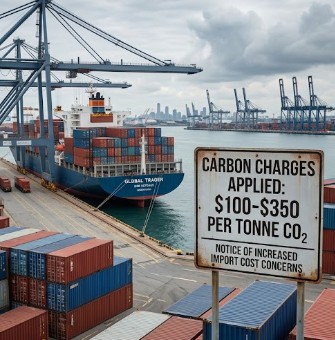
Ships using fossil fuels will face charges of $380 per tonne for emissions above the maximum limit and $100 per tonne for emissions exceeding a specified threshold. As a result, shipowners will have to switch to lower-carbon fuels or pay the fees for excess emissions. The policy was formally adopted in October 2025 and is scheduled to take effect in 2027. This is expected to increase trade costs and raise expenses for import-dependent industries.
The historic decision was taken at the 83rd session of the Marine Environment Protection Committee (MEPC), organised by the United Nations' International Maritime Organization (IMO). Under the decision, a new policy titled the ‘IMO Net-Zero by 2050 Framework’ is being introduced for container ships.
The policy states that the tax will be mandatory for ships weighing more than 5,000 tonnes, which account for around 85 per cent of total carbon emissions from the international shipping sector. The carbon tax system is expected to generate between $30 billion and $40 billion in revenue by 2030.
However, climate experts have criticised the agreement as ‘incomplete’. They argue that it sets a target of reducing emissions from the shipping sector by only 10 per cent by 2030, which is lower than the IMO's revised target for 2023.
According to an analysis by London-based think tank Transport & Environment, the framework could reduce emissions by 60 per cent by 2040 but fail to achieve the net-zero target by 2050.
Sixty-three countries, including the European Union, Japan, South Africa, Singapore, India, Brazil and China, have supported the policy. However, major oil-exporting countries such as Saudi Arabia, the United Arab Emirates, Russia and Venezuela have opposed it. Meanwhile, the United States has withdrawn from the discussions and reportedly said it is considering ‘reciprocal measures’ against fees imposed on its ships.
Experts agree that the shipping sector is responsible for around 3 per cent of global carbon emissions. They consider carbon taxation a groundbreaking step towards controlling these emissions. However, the biggest challenge is to ensure that the global economic impact does not place an additional burden on poorer countries.
The IMO's decision is an important step for the shipping industry, as the sector was not included in the Paris Climate Agreement. The key considerations now are how the proposed revenue will be redistributed and how developing countries will be supported in making a fair transition away from fossil fuels.
Khandaker Golam Moazzem, research director at the Centre for Policy Dialogue (CPD), said the private sector worldwide had expressed interest in participating in initiatives to reduce carbon emissions. He also stressed the importance of investment by developed countries and international institutions in producing electric buses and cars.
Several members of the Bangladesh Federation of Chambers of Commerce and Industry (FBCCI) said carbon emissions must be reduced as much as possible and that taxation was the most effective measure available so far. They said taxation would not only increase fuel prices but also encourage the use of renewable energy. If the government wants to import environmentally friendly renewable energy, taxes must be imposed on polluters, they added.
Abu Naser Khan, chairman of Poribesh Bachao Andolon (POBA), said the decision to impose a carbon tax under the ‘Green Tax Package’ was viewed positively. However, he stressed the need to ensure that the revenue was spent appropriately.
“If this is merely a strategy to increase government revenue, it will not be very effective. The money must be spent on environmental protection. The tax must be imposed at a high rate and renewable energy must be encouraged,” he said.
Since taking office in February 2026, the current government led by Prime Minister Tarique Rahman has taken several broad steps and outlined policies on carbon emissions and environmental taxation. Environmental protection has received particular attention in the 2026-27 national budget presented by Finance Minister Amir Khasru Mahmud Chowdhury, including measures relating to green budgeting and carbon markets.
The IMO's ongoing process to impose carbon charges on ships worldwide under the Net-Zero Framework could increase freight costs for Bangladesh's imported goods and fuel by 10 to 20 per cent, according to experts. As a trade-dependent country, Bangladesh could therefore face higher import expenses.
For this reason, the government's Ministries of Commerce and Shipping are monitoring the relevant global developments. Although the current government has not made a specific statement on directly taxing ships, it has taken domestic measures to reduce carbon emissions. In the 2026 budget, the government waived taxes on electric vehicles, electric buses and charging stations while expanding the scope of carbon taxes or duties on fossil fuel-powered vehicles.
Sources at the Ministry of Commerce said Bangladesh currently has around 101 seagoing vessels with a capacity of 5,000 tonnes or more, measured in deadweight tonnage (DWT) or gross tonnage. Most are privately owned. Just five leading companies control 77 of these vessels.
The state-owned Bangladesh Shipping Corporation (BSC) also operates several large bulk carriers and tankers with capacities exceeding 5,000 tonnes.
Many countries have introduced carbon taxes or carbon-pricing systems to reduce greenhouse gas emissions by taxing fossil fuels and making carbon-based energy more expensive. These include Canada, Sweden, Ireland, Norway, Finland, the Netherlands, Switzerland, France, Japan, New Zealand, South Africa, Colombia, Mexico, Argentina, Chile, South Korea, Singapore, the United Kingdom, Ukraine and the European Union's 27 member states.

Loading...
Loading...
Also read









Editor : Iqbal Sobhan Chowdhury
Published by the Editor on behalf of the Observer Ltd. from Globe Printers, 24/A, New Eskaton Road, Ramna, Dhaka.
Editorial, News and Commercial Offices : Aziz Bhaban (2nd floor), 93, Motijheel C/A, Dhaka-1000.
Phone: PABX- 41053001-06; Advertisement: 41053012; 01793317829, 01550707291, E-mail: [email protected], [email protected] Online: email: [email protected] 41053014; 01550707297 Advertisement: 01550707296
Published by the Editor on behalf of the Observer Ltd. from Globe Printers, 24/A, New Eskaton Road, Ramna, Dhaka.
Editorial, News and Commercial Offices : Aziz Bhaban (2nd floor), 93, Motijheel C/A, Dhaka-1000.
Phone: PABX- 41053001-06; Advertisement: 41053012; 01793317829, 01550707291, E-mail: [email protected], [email protected] Online: email: [email protected] 41053014; 01550707297 Advertisement: 01550707296


