



| HEADLINE |

|

EV Ban Sparks Nationwide Shutdown by Reconditioned Car Traders
Published : Friday, 18 September, 2026 at 12:00 AM
Business Correspondent


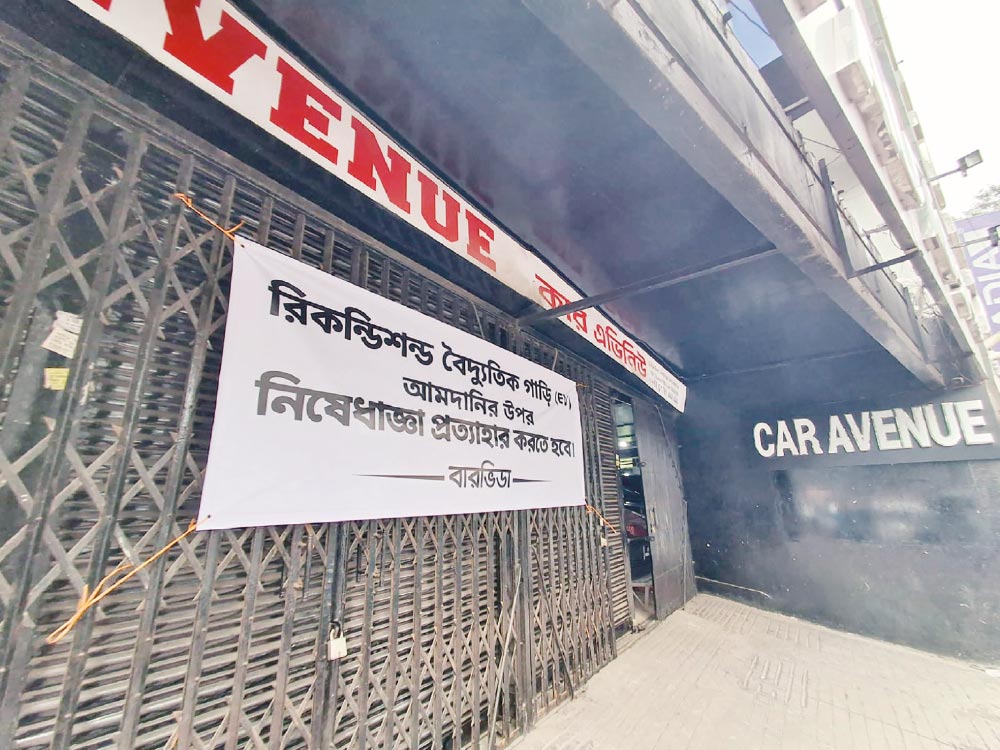 The government's blanket ban on imports of used and reconditioned electric vehicles (EVs) triggered a nationwide shutdown of the reconditioned car trade on Thursday, with thousands of businesses closing their doors in a growing confrontation over the future of affordable electric mobility in Bangladesh.
Around 1,300 businesses affiliated with the Bangladesh Reconditioned Vehicles Importers and Dealers Association (BARVIDA) shut their showrooms across Dhaka, Gazipur, Narayanganj, Chattogram, Sylhet, Cumilla, Khulna, Mymensingh, Rajshahi, Rangpur and Dinajpur in protest against the government's Import Policy Order 2026�"2029.
The association also escalated the protest by suspending vehicle registration activities at Bangladesh Road Transport Authority (BRTA) offices, withholding revenue payments and halting e-payment procedures. It further stopped the release of imported vehicles from ports through customs houses.
The unprecedented shutdown has brought a significant segment of the country's reconditioned vehicle market to a standstill and raised fresh questions over whether the government's push towards electric mobility can be reconciled with a policy that excludes lower-cost used and reconditioned EVs.
BARVIDA said the core issue was not opposition to regulation but what it described as an across-the-board prohibition imposed by the Import Policy Order issued on August 24.
The association argued that the prices of brand-new EVs remain beyond the reach of a large section of middle- and lower-middle-income consumers. Reconditioned EVs, it said, could provide a more affordable entry point into electric mobility for professionals and ordinary households.
A complete ban, BARVIDA warned, could therefore narrow consumer choice, slow the development of the domestic EV market and shut out a potentially important segment of buyers from newer vehicle technologies.
The association also linked the issue directly to the government's stated ambition of increasing the share of electric vehicles to 30 per cent of the motor vehicle sector by 2030.
BARVIDA argued that expanding the EV market through regulated imports of quality-assured reconditioned vehicles could simultaneously promote cleaner transport, broaden consumer access and generate additional government revenue.
Its demand is for regulation, not unrestricted imports.
“The core principles of Bangladesh's import policy should be safety, quality control, market competition, consumer rights protection, environmental sustainability and revenue generation,” the association said.
BARVIDA stressed that it was not seeking permission to bring unsafe, damaged or substandard vehicles into the country.
Instead, it wants a regulatory framework under which used and reconditioned EVs would be subjected to mandatory inspection, battery testing, technical certification and safety compliance before being allowed into the domestic market.
According to the association, the crucial question should be whether a vehicle is safe and compliant �" not simply whether it is new or reconditioned.
The condition of the EV battery, in particular, should be a central part of any regulatory regime, it said, given that battery performance and safety are critical to the operation and residual value of electric vehicles.
BARVIDA cited New Zealand as an example of a market where used vehicle imports are permitted under inspection and compliance requirements. Bangladesh, it argued, could develop a comparable system tailored to local conditions rather than imposing an outright ban.
The dispute has wider economic implications because the reconditioned vehicle industry supports a substantial ecosystem involving importers, dealers, workshops, mechanics, parts suppliers, transport operators, financiers, insurance companies and other service providers.
A prolonged disruption could therefore reverberate beyond vehicle showrooms, affecting businesses throughout the wider automotive supply chain.
The shutdown also puts the government under pressure to reconcile three competing objectives �" consumer affordability, environmental goals and vehicle safety.
A blanket restriction may simplify import control, but BARVIDA argues that a transparent quality-control system could achieve safety objectives without eliminating an entire category of vehicles from the market.
The association's leaders expressed hope that the government would reconsider the restriction in what they described as the broader public interest.
But they warned that Thursday's shutdown could be only the opening salvo.
“If the restriction is not withdrawn,” the association said, its members would be compelled to announce tougher programmes to protect their livelihoods and investments and safeguard the interests of consumers.
The confrontation now leaves the government facing a policy test with implications well beyond the reconditioned car trade: whether Bangladesh's transition towards electric mobility will be driven exclusively by new vehicles, or whether affordable, properly tested reconditioned EVs will also have a place on the country's roads.

Loading...
Loading...
Also read



Editor : Iqbal Sobhan Chowdhury
Published by the Editor on behalf of the Observer Ltd. from Globe Printers, 24/A, New Eskaton Road, Ramna, Dhaka.
Editorial, News and Commercial Offices : Aziz Bhaban (2nd floor), 93, Motijheel C/A, Dhaka-1000.
Phone: PABX- 41053001-06; Advertisement: 41053012; 01793317829, 01550707291, E-mail: [email protected], [email protected] Online: email: [email protected] 41053014; 01550707297 Advertisement: 01550707296
Published by the Editor on behalf of the Observer Ltd. from Globe Printers, 24/A, New Eskaton Road, Ramna, Dhaka.
Editorial, News and Commercial Offices : Aziz Bhaban (2nd floor), 93, Motijheel C/A, Dhaka-1000.
Phone: PABX- 41053001-06; Advertisement: 41053012; 01793317829, 01550707291, E-mail: [email protected], [email protected] Online: email: [email protected] 41053014; 01550707297 Advertisement: 01550707296


