



| HEADLINE |

|
Is healthcare a right or a matter of affordability?
Patient rights under strain as overcrowding puts pressure on Bangladesh’s hospitals
Published : Saturday, 19 September, 2026 at 12:00 AM
Arifur Rahman Rabbi


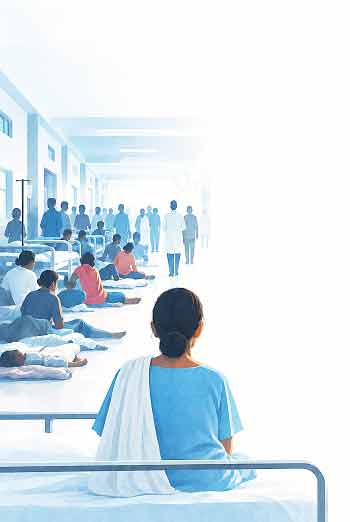 For many patients, the first question after arriving at a hospital is- “Is there a bed available?” When government hospitals run out of space, many patients have to receive treatment on floors, verandas or corridors. Some are forced to move from one hospital to another.
 For emergency patients in particular, the lack of beds can further limit access to treatment. This raises a fundamental question- Is healthcare simply a service, or is it a basic human right?
According to the World Health Organization (WHO), everyone has the right to the highest attainable standard of physical and mental health. To uphold this right, healthcare must be available, accessible, acceptable and of good quality, a framework known as “AAAQ.”
This means more than ensuring a hospital bed for every patient. There must be enough hospitals, doctors, nurses, medicines and other services to meet people’s needs. No one should be excluded from healthcare because of their economic or social status.
Treatment must be safe and based on sound medical standards, while patients’ dignity and privacy must also be protected.
The situation is particularly challenging in Bangladesh. Dhaka Medical College Hospital (DMCH), which is the largest hospital in Bangladesh, has 2,600 beds, but on average 4,000 to 4,200 patients are admitted there for treatment.
Patients say overcrowding often leaves them without beds, forcing them to receive treatment on the floor. They also complain about the quality of services, staff behaviour, shortages of medicines and long waits for diagnostic tests.
Some patients also describe being turned away from other hospitals. They say that even when they cannot get a bed at Dhaka Medical, they can at least receive treatment there. It takes time and is difficult, they say, but they cannot afford treatment at private hospitals.
Speaking to this correspondent, DMCH Director Brigadier General MdAsaduzzamansaid that patients come to the hospital from different parts of the country. The hospital has to handle 10,000 to 12,000 patients every day across its inpatient, outpatient and emergency departments.
“We cannot send a patient away just because there is no bed. That is why many have to stay on the floor,” he said.
He said ensuring all patients’ rights with limited manpower remains a constant challenge. However, ensuring treatment for patients remains the hospital’s main priority.
Doctors say that even when beds are limited, emergency patients should not be denied treatment simply because no bed is available. There should be a system of triage, initial emergency care and, when necessary, prompt referral. When resources are limited, patients should be prioritised according to medical need, without consideration of money, identity, political connections or social influence.
Public health expert Dr ZakiaFerdousiKhanom said the right to health goes beyond receiving treatment. Patients should have access to information about their illness, necessary tests, treatment options, possible risks and alternatives. Informed consent before treatment and protection of patients’ medical information are also important. Access to safe water, sanitation, nutrition, vaccination, mental healthcare and essential medicines is also part of the right to health, she said.
The government has also spoken about improving the quality and availability of healthcare. State Minister for Health Dr M A Muhith said at an event on September 7 that the safety of doctors and patients should be given priority. Health and Family Welfare Minister SardarMdSakhawat Hossain has also said long-term plans are being taken to address shortages of doctors and medicines and make healthcare more accessible.
Experts say building new hospitals alone will not be enough to ensure the right to health. Alongside beds, Bangladesh needs to strengthen doctors and nursing staff, emergency departments, intensive care units, medicines, diagnostic services, referral systems and primary healthcare in a coordinated manner.
The right to health, therefore, does not mean guaranteeing a bed at a preferred hospital at any given time. It means ensuring that people can receive safe, timely and quality treatment, information, dignity and care without discrimination when they need it.
In a country where hospitals are under heavy pressure from overcrowding, the central question remains whether a sick person can receive the healthcare and rights they are entitled to when they need them.
Loading...
Loading...
Also read



Editor : Iqbal Sobhan Chowdhury
Published by the Editor on behalf of the Observer Ltd. from Globe Printers, 24/A, New Eskaton Road, Ramna, Dhaka.
Editorial, News and Commercial Offices : Aziz Bhaban (2nd floor), 93, Motijheel C/A, Dhaka-1000.
Phone: PABX- 41053001-06; Advertisement: 41053012; 01793317829, 01550707291, E-mail: [email protected], [email protected] Online: email: [email protected] 41053014; 01550707297 Advertisement: 01550707296
Published by the Editor on behalf of the Observer Ltd. from Globe Printers, 24/A, New Eskaton Road, Ramna, Dhaka.
Editorial, News and Commercial Offices : Aziz Bhaban (2nd floor), 93, Motijheel C/A, Dhaka-1000.
Phone: PABX- 41053001-06; Advertisement: 41053012; 01793317829, 01550707291, E-mail: [email protected], [email protected] Online: email: [email protected] 41053014; 01550707297 Advertisement: 01550707296


