



| HEADLINE |

|

When Walls Speak
Graffiti Reclaims the Narrative of Justice
Published : Saturday, 17 October, 2026 at 12:00 AM
Shaon Arafat


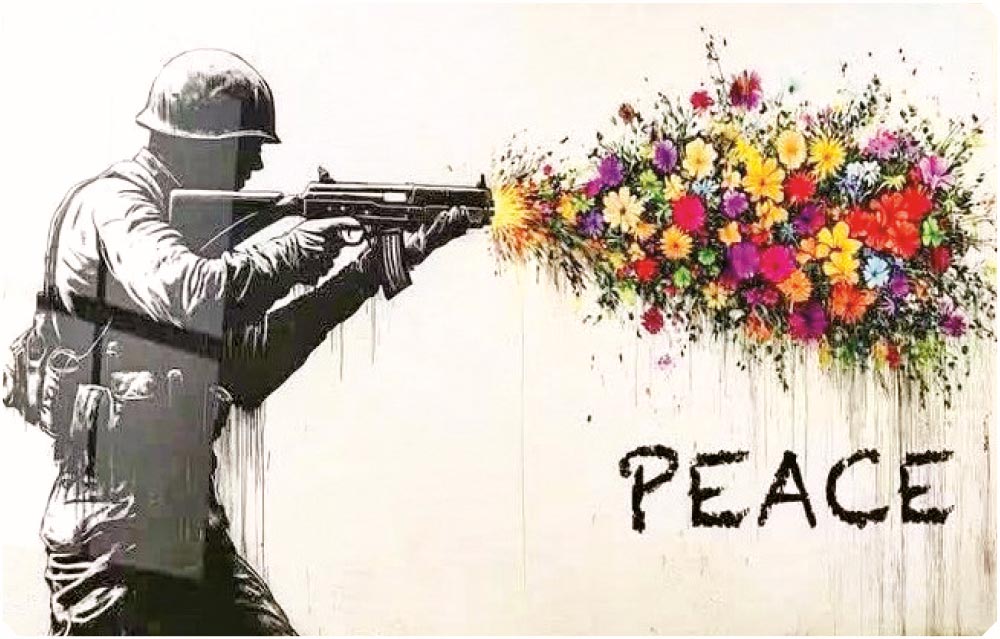 When authorities refuse to listen, one particular kind of people sometimes do not simply go quiet. Instead, they find new spaces to express what they cannot say elsewhere. They write, draw, or paint on public surfaces to communicate a message. And the message turns ordinary walls into open platforms where raw, unedited voices speak directly to the public. Walk through any city in the middle of a political storm, and you will feel that shift instantly. You will feel a blank brick wall, an overpass pillar, or a concrete bridge suddenly stops being mere infrastructure, and becomes a lively stage where anger, grief, courage and hope spill out for everyone to see. Such an act of artistic communication is widely known as graffiti.
While society often brushes off street art as simple vandalism or temporary decor, graffiti plays a much deeper role during times of unrest. It acts as a visual language of justice. When traditional channels of dissent close, a spray can or a quick brushstroke creates an immediate public square. A single striking image cuts through political doublespeak far faster than a two-hour speech.
You could feel this kinetic energy surging through the streets during the July Uprising in 2024. What began as a student protest against a government job quota system quickly grew into a nationwide rebellion against Sheikh Hasina’s regime. As police crackdown worsened, young artists took over the walls of Dhaka. They painted portraits of fallen protesters, wrote sharp demands for accountability and covered entire city blocks in calls for justice. When the then government fell on August 5, those artworks did not fade away. They even became a living archive of collective sacrifice, forcing every passerby to look history in the eye and reclaiming the narrative of justice from state power.
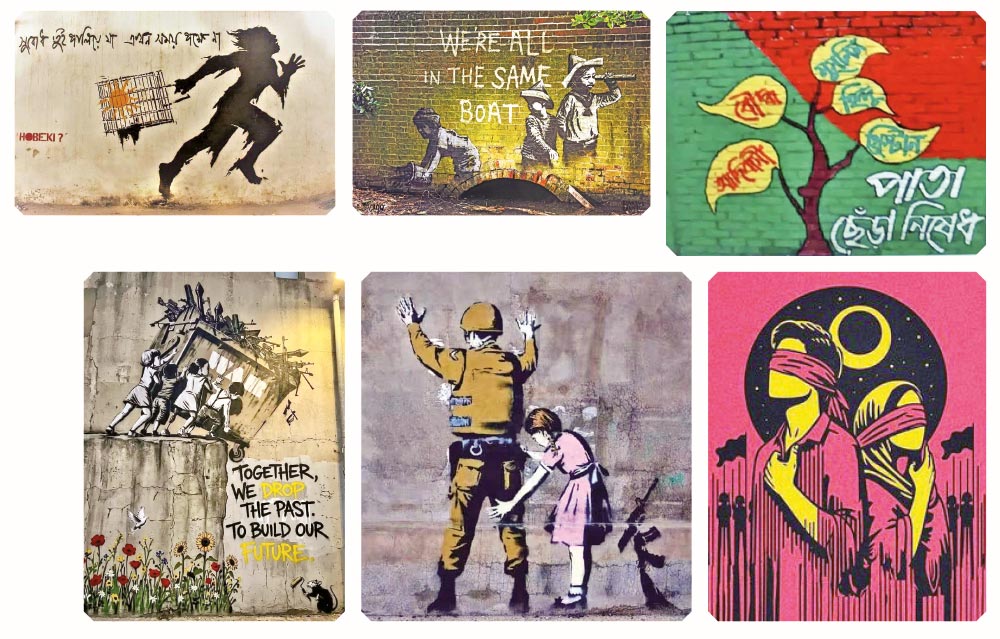 A remarkably similar story played out in India during the 2019 and 2020 protests against the Citizenship Amendment Act and the National Register of Citizens. At Jamia Millia Islamia and the women-led sit-in at Shaheen Bagh, public spaces became open-air galleries of resistance. Residents, students and artists used posters, poetry and floor art to explain what constitutional rights mean in daily life. They proved that political debate does not belong only to politicians in suits; it belongs to anyone standing on the street with a cause as well.
Yet, what makes public art uniquely dangerous to authority is often the absence of a named creator. Concealing one’s identity protects against state retaliation. At the same time, it strips away ego and hands ownership of the message straight to the public. Politically charged images challenge state power, war, consumerism and inequality precisely because they bypass traditional gatekeepers. Consider Banksy, whose satirical stencils target surveillance, military aggression and corporate greed while keeping the spotlight strictly on the political hypocrisy he exposes.
A similar phenomenon quietly took hold of Dhaka around 2017 with Subodh. This enigmatic stencil figure depicted a distressed man running away with a caged sun, alongside the words, “Subodh tui paliye ja, ekhon somoy tor pokkhe na” (“Subodh, run away, time is now not on your side”). The artist remained completely unknown, but people connected with the image right away. It captured a widespread sense of anxiety and constrained freedom that few dared to speak aloud. Anonymous art directly challenges authority by allowing a message to transcend its creator and become a shared symbol of resistance.
This blend of creative expression and liberation spans history and geography. Keith Haring used bold line art in public subways during the 1980s to break the silence around AIDS, protest apartheid and fight social inequality. Similarly, the French artist JR creates massive black-and-white portraits of marginalised citizens. He pastes them across urban structures to force society to acknowledge people who are usually kept invisible.
Beyond individuals, collective street art has also repeatedly challenged dominant narratives during pivotal global moments. During the Cold War, the western face of the Berlin Wall became an iconic canvas anticipating the barrier’s fall. Along the West Bank barrier, artists paint ladders, open windows, and doves to challenge physical separation and assert Palestinian resistance and self-determination. Likewise, in South African townships, activists painted slogans to dismantle state propaganda, condemn racial segregation and mobilise communities against systemic oppression.
Over time, localised protest art naturally evolves into a broader language of human rights advocacy. It touches on freedom of expression, gender equality, minority protection, racial justice, refugee dignity, environmental defence and opposition to war. By taking these abstract concepts out of legal books and plastering them onto everyday streets, public art makes moral arguments clear and accessible to everyone, ensuring the narrative of justice stays firmly in the hands of the people.
Street art carries immense cultural weight, but it possesses zero legal authority. A slogan cannot rewrite a law, prosecute a corrupt official, or reform a court system on its own. Once protests subside, authorities can coat walls in grey primer. Advertisers can co-opt radical imagery, and striking murals risk becoming simple backdrops for social media photos while injustice continues untouched. When civic action stalls, these artworks also risk becoming a poignant archive of unfulfilled hopes.
That limitation, however, does not make the act meaningless. Persistent street art prevents those in power from rewriting history. It serves notice to successive governments that quiet streets do not equal consent. Ultimately, graffiti is a spark. Its true political value depends on what happens after the paint dries: whether citizens continue to organise, courts protect rights and society translates those visual demands into lasting structural reform. Moreover, when walls speak, their story depends entirely on whether society listens and acts.

Loading...
Loading...
Also read



Editor : Iqbal Sobhan Chowdhury
Published by the Editor on behalf of the Observer Ltd. from Globe Printers, 24/A, New Eskaton Road, Ramna, Dhaka.
Editorial, News and Commercial Offices : Aziz Bhaban (2nd floor), 93, Motijheel C/A, Dhaka-1000.
Phone: PABX- 41053001-06; Advertisement: 41053012; 01793317829, 01550707291, E-mail: [email protected], [email protected] Online: email: [email protected] 41053014; 01550707297 Advertisement: 01550707296


