



| HEADLINE |

|
Economy Enters Financial Danger Zone as One in Three Banks Bankrupt on Capital
Published : Tuesday, 22 September, 2026 at 12:00 AM
Faruk Ahmed


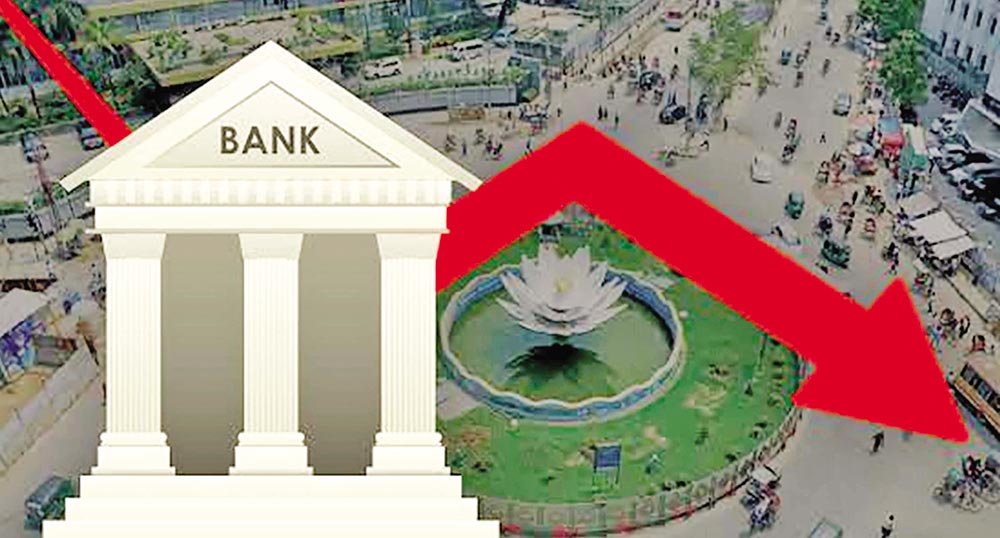 Bangladesh's economy is flashing its gravest financial warning in decades as 21 of the country's scheduled banks plunge into a combined Tk 3 lakh crore capital shortfall, raising the spectre of a nationwide credit crunch, slowing investment, weaker job creation, mounting pressure on economic growth and a dangerous loss of confidence among both domestic and international investors.
The capital hole-one of the largest in Bangladesh's banking history-means nearly one in every three banks no longer has enough capital to absorb losses, protect depositors or finance new lending.
Analysts say the shock is already spreading beyond bank balance sheets into the real economy, choking the flow of credit, weakening private investment, slowing industrial expansion, squeezing businesses and raising alarm among foreign lenders over the health of Bangladesh's financial system.
Bangladesh Bank’s latest financial stability assessment paints a deeply troubling picture. The number of banks below the minimum regulatory capital requirement rose from 20 in December 2025 to 21 in March 2026, while the combined capital shortfall widened to nearly Tk 2.94 lakh crore.
Meanwhile, the banking sector’s provision shortfall surged from Tk 1.98 lakh crore in December to Tk 2.22 lakh crore by June, signalling that financial stress is intensifying despite regulatory intervention and bank mergers.
According to Bangladesh Bank data, the crisis is rooted in an unprecedented accumulation of bad loans. Non-performing loans have exceeded Tk 5.88 lakh crore, while defaulted loans now account for more than 32 percent of total outstanding credit-a level that has severely eroded banks' profitability and capital buffers. Financial experts say years of politically protected lending, insider borrowing, loan fraud and large-scale money laundering have hollowed out the banking sector from within.
Some of the country's largest banks now appear on the capital-shortfall list. Islami Bank Bangladesh PLC, one of Bangladesh's biggest banks, has emerged among the most severely affected institutions, alongside National Bank, First Security Islami Bank, Social Islami Bank, Exim Bank, Janata Bank, Union Bank, Padma Bank, Agrani Bank, Rupali Bank, IFIC, Basic Bank and several others. Five distressed banks have already been merged as part of Bangladesh Bank's emergency restructuring programme, underscoring the scale of the sector's financial distress.
For economists, these figures represent far more than a banking statistic-they are a warning that Bangladesh's economic engine is beginning to lose power.
Banks remain the principal source of financing for Bangladesh's private sector, funding industries, exporters, agriculture, construction and small businesses. When banks lose capital, they lose their ability to lend. When lending contracts, investment slows. And when investment slows, economic growth inevitably weakens.
That cycle has already begun. The consequences are becoming increasingly visible across the economy.
Private-sector credit growth has plunged to just 4.47 percent, one of the lowest levels in recent years, reflecting the shrinking capacity of banks to inject liquidity into productive sectors. Economists say such a weak flow of credit is a serious warning for an economy that relies overwhelmingly on bank financing to sustain investment and employment.
Economists warn that a prolonged banking capital crisis could trigger a chain reaction throughout the economy. Slower credit growth means weaker private investment, fewer new factories, reduced industrial production, slower business expansion and declining job creation.
Meanwhile, household incomes come under pressure as economic activity loses momentum, while lower investment today threatens weaker productivity and slower GDP growth tomorrow.
The crisis has also exposed what economists describe as a profound collapse in banking governance over the past 17 to 18 years. High-profile scandals involving Crescent Group, Bismillah Group, AnonTex and the Basic Bank loan scam inflicted billions of taka in losses on state-owned and private banks.
Economists believe the official figures may still understate the true scale of the crisis. Bangladesh Bank has granted regulatory forbearance to several lenders, allowing additional years to maintain mandatory provisions against bad loans.
Some bankers argue that these concessions have temporarily masked the financial condition of some banks that would otherwise have fallen into capital shortfall, meaning the actual capital gap could be significantly larger than reported.
This weakens the credibility of Bangladesh's banking system and raises concerns among international lenders and investors about the country's financial governance. Foreign banks and financial institutions closely monitor the strength of Bangladesh's banking sector before extending trade finance, syndicated loans and credit lines.
A banking system where nearly one-third of institutions are undercapitalised sends a troubling signal about governance, risk management and regulatory oversight, potentially increasing Bangladesh's external borrowing costs and discouraging fresh foreign investment at a time when the economy needs capital inflows to sustain growth.
Bankers describe capital as the foundation of every financial institution. Once that foundation weakens, banks lose their ability to lend, profitability disappears and financial stability comes under threat.
Bangladesh Bank's overall Capital to Risk-Weighted Assets Ratio (CRAR) has deteriorated further in the latest quarter, underscoring the worsening health of the banking sector.
The warning from economists is unequivocal: a Tk 3 lakh crore capital black hole across 21 banks is no longer merely a banking crisis-it is a direct threat to Bangladesh's investment climate, employment, fiscal stability, financial credibility and long-term economic growth.
Without swift, credible and transparent reforms, today's banking crisis risks becoming tomorrow's full-scale economic crisis, experts say.
Loading...
Loading...
Also read



Editor : Iqbal Sobhan Chowdhury
Published by the Editor on behalf of the Observer Ltd. from Globe Printers, 24/A, New Eskaton Road, Ramna, Dhaka.
Editorial, News and Commercial Offices : Aziz Bhaban (2nd floor), 93, Motijheel C/A, Dhaka-1000.
Phone: PABX- 41053001-06; Advertisement: 41053012; 01793317829, 01550707291, E-mail: [email protected], [email protected] Online: email: [email protected] 41053014; 01550707297 Advertisement: 01550707296
Published by the Editor on behalf of the Observer Ltd. from Globe Printers, 24/A, New Eskaton Road, Ramna, Dhaka.
Editorial, News and Commercial Offices : Aziz Bhaban (2nd floor), 93, Motijheel C/A, Dhaka-1000.
Phone: PABX- 41053001-06; Advertisement: 41053012; 01793317829, 01550707291, E-mail: [email protected], [email protected] Online: email: [email protected] 41053014; 01550707297 Advertisement: 01550707296


