



| HEADLINE |

|

When the river ‘Buriganga’ was Pristine
Published : Saturday, 3 October, 2026 at 12:00 AM
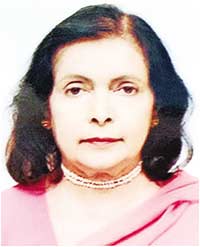
Selina Mohsin


 In 1953 my father Mr M Mohsin, PSP, was transferred to the then Dacca (Dhaka) as Superintendent of Police (SP). Dacca was the capital of East Pakistan. My father started his career as an Indian Police Service Officer (IPS) during the British Colonial period. During my father’s tenure there were only 17 districts in East Pakistan.
 In the 50s the police had far more responsibilities than they have today. They were not only in charge of law and order, for Immigration & passports, transportation of public buses and other vehicles throughout the district and since the Foreign Ministry was located in West Pakistan the police was also responsible for protocol duties especially when VIPs visited Dacca.
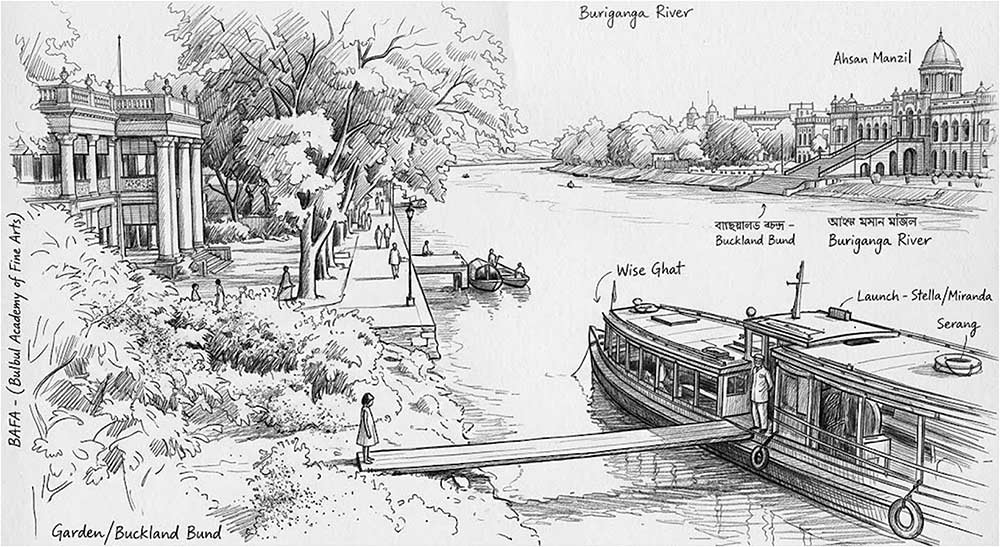
Our residence was a large house facing the Buckland Bund and the river Buriganga. The flowing river was always there and formed a pulse of our life. The Buckland Bund had green trees, spaces and a place for walking. My father said that it was built long ago by the Dacca city Commissioner, Charles Buckland to protect the town from seasonal flooding, prevent mudflats, erosion and ease the flow of passengers and cargo traffic from Sadarghat. But the traffic was so thin that the river flowed gently gleaming under sunshine.
Our house was an old colonial house. It had parquet floors and French windows from ceiling to floor. The rooms were large and the dining room was vast with three French windows. When we had visitors then after lunch card tables were laid out and my parents and guests played a card game called ‘gin rummy’ over cups of coffee. The atmosphere was pleasant and enjoyable.
The other large room was our parent’s bedroom. Our own rooms faced the opposite side with green trees.
Sometimes we walked on the Buckland Bund where city people took leisurely walks. A part of the river front had leafy green trees. My father said that it was a miniature park featuring a raised dais where visiting dignitaries were welcomed. The police band played in the afternoons while people relaxed under the trees and enjoyed the cool river breeze. He added that the band playing was discontinued unless VIPs came for visits.
On one side of our front garden was a cove where two large spacious launches were moored. My father had to visit all the police stations (thanas) of the district. Many of them were cut off from road networks and the Colonial British built spacious launches run by coal fire to visit water logged ‘thanas’. Two of these launches were moored in a cove in the corner of our front garden and there was and wide wooden plank from the launches to the garden. The launches were ‘Stella’ and ‘Miranda’. I was told not to go to the launches, but on some afternoons when all were asleep, I crossed the wooden plank and went to the launches. Life was thrilling as the Serang, a bearded elderly man, took me round the launches and told me stories of his Interesting travels. Then I would thank him and stealthily cross the plank and reach the garden. Once the gardener saw me but promised not to tell.
Near our house was a jetty known as Wise Ghat and a historic mansion. Further Down was the Nawab’s Palace ‘Ahsan Manzil’. It was a monumental palace with a grand dome and an outdoor massive staircase that cascaded from the second floor right down to the river front. The condition of the Ahsan Manzil was poor. My father said that the situation of the grand Nawabs were in a bad state. Years later, the palace was renovated by President Ershad and is now a tourist spot.
One morning while my father was having his breakfast he received a telegram. It was devastatingly bad news. His close friend and dancer Bulbul Chowdhury had passed away. In his student life, my father studied with Bulbul Chowdhury in Presidency College in Calcutta and later Bulbul was known for his dance dramas at home and abroad. Sometimes, when he did not have enough money, he would come to stay with his wife and daughter in our colonial houses. My father, with the assistance of the District Magistrate, would arrange a number of dance shows for Bulbul Chowdhury. After that when he had enough money he would leave us and with his troupe go on foreign dance trips.
Now at the death of Bulbul Chowdhury my father could not be consoled and he wanted to have a memorial for his deceased friend. He decided that the late Mr Wise’s mansion should become a musical memorial in the name of his friend. My father received the required permission from the Chief Secretary and vacated late Mr Wise’s mansion which was then a CID Police Office.
When it was empty and being renovated, my father took me to see Mr Wise’s mansion. I was breathless with excitement. It had a north south layout for cross ventilation. I was struck by the sweeping double storey verandah supported by massive columns. The rooms were huge and doors opened to the river. They vast rooms had ceilings so high that I had to tilt my head all the way back to see the heavy wooden beams.
There was a grand staircase. My father pointed out the fine carving and said the mansion was actually built by an Armenian Nicholas Pogose an influential landlord and a member of Dacca’s wealthy Armenian community. It was later sold to Patrick Wise- a prominent wealthy British indigo planter and ‘Zamindar’. I had never seen such a grand mansion. There was a jetty called ‘Wise Ghat’ after Mr Wise.
From the mansion, I walked down the lovely staircase to the garden alone as my father was busy with an engineer discussing changes. The large garden was empty and wild with no gardeners to look after it. There were some lovely flowering shrubs heavy with sweet scent. As I pushed past overgrown weeds, I walked through an arched entry to the stables and carriage house. They were dark and shadowy.
My father joined me and pointing to the stables and carriage house stating they would be demolished and large open space would be used for musical events.
In May 1995 the mansion of Mr Wise became ‘Bulbul Academy of Fine Arts’(BAFA). My father’s dream for his friend was fulfilled. Musicians, dancers, tabla players and instrumentalists congregated and students came to learn dancing and musical arts. My elder sister wanted to learn guitar and we went to Jatin & Co and bought a Hawaiian Guitar for her. Every week-end she went to learn how to play guitar. One day, I went to see my sister. She was pressing the steel bar to the strings. Her teacher Samar Das said he would show her some guitar pleasing music. As he played fantastic, liquid notes from the guitar flowed over the verandah and the river. I was enthralled.
Soon it was decided by the authorities that the Police Line where we had our large house was too old, small and congested for the numerous police force. So it was shifted in late 1955 and we moved from my beloved home and the shining Buriganga and went to live in Rajarbagh in large new house. I missed my old life, but the memory of those enjoyable time stayed with me forever.
The Writer is a former Ambassador

Loading...
Loading...
Also read



Editor : Iqbal Sobhan Chowdhury
Published by the Editor on behalf of the Observer Ltd. from Globe Printers, 24/A, New Eskaton Road, Ramna, Dhaka.
Editorial, News and Commercial Offices : Aziz Bhaban (2nd floor), 93, Motijheel C/A, Dhaka-1000.
Phone: PABX- 41053001-06; Advertisement: 41053012; 01793317829, 01550707291, E-mail: [email protected], [email protected] Online: email: [email protected] 41053014; 01550707297 Advertisement: 01550707296
Published by the Editor on behalf of the Observer Ltd. from Globe Printers, 24/A, New Eskaton Road, Ramna, Dhaka.
Editorial, News and Commercial Offices : Aziz Bhaban (2nd floor), 93, Motijheel C/A, Dhaka-1000.
Phone: PABX- 41053001-06; Advertisement: 41053012; 01793317829, 01550707291, E-mail: [email protected], [email protected] Online: email: [email protected] 41053014; 01550707297 Advertisement: 01550707296


