



| HEADLINE |

|

The Illusion of the Party: Harold Pinter and the Tyranny of Celebration
Published : Saturday, 10 October, 2026 at 12:00 AM
Sayma Sultana


 We live in a world where a birthday is universally accepted as something good. It is taken for granted that you have to be happy on that day, and that you have to be happy for others on theirs, as if a birthday is inherently the most positive thing that can happen. Living in such a world, I cannot ignore the fact that today, the 10th of October, marks the birthday of Harold Pinter. Yet this very occasion forces an uncomfortable question: if we treat a birthday, or any specific date on the calendar, as an automatic symbol of positivity, does that mean it must be celebrated, let alone over-celebrated? Is it truly mandatory that what society labels as positive must be performed and celebrated by everyone else?
This mandatory cheerfulness has become a form of toxic positivity. If an individual feels overwhelmed, financially exhausted, or simply indifferent on a given day, society offers no room for those honest emotions. Instead, the modern birthday demands a performance. Capitalism steps in to monetize this guilt, convincing us that affection and personal worth can only be verified by rented venues, decorative gimmicks, expensive gifts, and curated photos meant for public applause. We spend money we often cannot spare to satisfy an expectation that is not even our own.
When transferred to the collective and political realm, this obsession with celebrating dates becomes openly destructive. In many developing and struggling societies, the birthday of a political figure or historical icon is seized upon by the state and turned into an extravagant circus. Millions of dollars of public wealth are drained into banners, illumination, and staged rallies, while ordinary citizens lack basic civic necessities, healthcare, and honest livelihoods. Under the guise of honouring a great personality, corrupt officials and contractors siphon public funds through inflated celebration budgets. What is promoted as a national day of pride is, in reality, an act of political theft and an aggressive demand that the public applaud its own exploitation.
Beneath the commercial glitter and political hypocrisy lies an even deeper, unspoken truth: every birthday is fundamentally a countdown towards death. We treat an anniversary as though it adds a year of life, but time operates in reverse. Each passing year is a non-negotiable subtraction. A birthday is a cold, inescapable reminder that our bodies are aging and that we are one year closer to the grave. The loud music, the toasts, and the bright candles are psychological distractions, frantic attempts to drown out the reality of our own mortality.
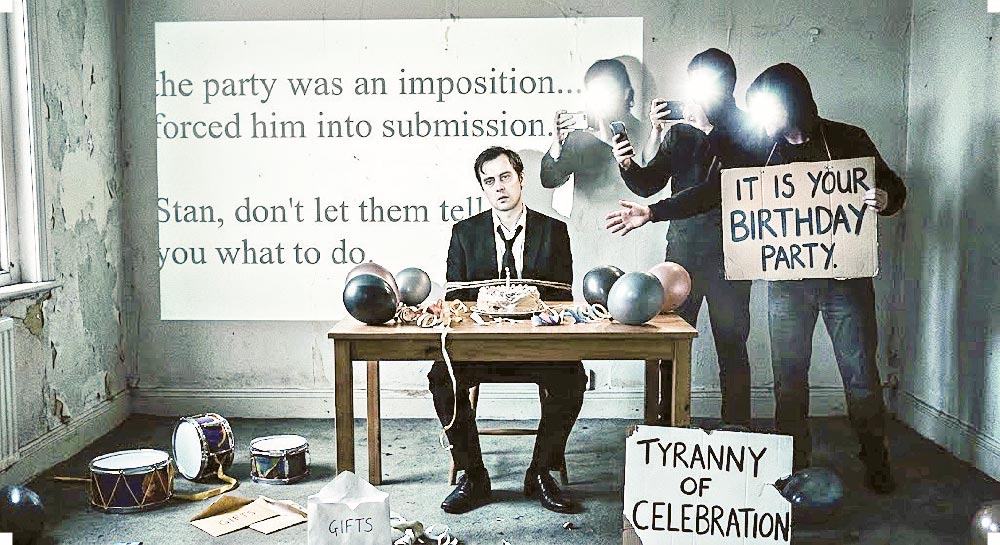
This is precisely where Harold Pinter speaks directly to our reality. In his famous 1957 play, The Birthday Party, Pinter did not depict a celebration as a joyful event; he exposed it as an act of psychological violence. Stanley Webber, an unemployed pianist living quietly in a run-down boarding house, wants nothing more than to be left alone. Yet his landlady, Meg, decides out of nowhere that it is his birthday. Stanley resists immediately and truthfully: "It’s not my birthday." Meg simply brushes aside his words and his reality: "It is. This is your birthday party."
That moment is the core of Pinter's warning. The party is an imposition. It is society deciding what a person must feel and who they must be. Meg gifts Stanley a cheap toy drum, reducing a grown adult to a helpless, obedient child. When two menacing visitors, Goldberg and McCann, arrive to lead the festivities, the domestic party quickly morphs into an interrogation. A childhood parlour game turns brutal: Stanley’s glasses are broken, leaving him disoriented and helpless. By the next morning, the celebration has broken him entirely. He is dressed in a respectable black suit, stripped of his speech, and led away into captivity. The party was not thrown to celebrate Stanley; it was staged to destroy his individuality and force him into submission.
As Stanley is dragged off, the only honest bystander, Petey, calls out a desperate piece of advice: "Stan, don’t let them tell you what to do." Pinter considered this the most important line he ever wrote, and it remains the sharpest defence of individual autonomy against social tyranny.
On this 10th of October, honouring Harold Pinter does not mean throwing him a blind, conventional salute. It means adopting his clear-eyed courage to question the spectacles around us. A date on a calendar does not give an authoritarian regime the right to waste public money, nor does it give commercial culture the right to mandate our happiness. Recognizing life means confronting both its beauty and its march toward death on our own terms, and retaining the dignity to say no when the world tries to force a celebration upon us.
The writer is a development communication professional

Loading...
Loading...



Editor : Iqbal Sobhan Chowdhury
Published by the Editor on behalf of the Observer Ltd. from Globe Printers, 24/A, New Eskaton Road, Ramna, Dhaka.
Editorial, News and Commercial Offices : Aziz Bhaban (2nd floor), 93, Motijheel C/A, Dhaka-1000.
Phone: PABX- 41053001-06; Advertisement: 41053012; 01793317829, 01550707291, E-mail: [email protected], [email protected] Online: email: [email protected] 41053014; 01550707297 Advertisement: 01550707296
Published by the Editor on behalf of the Observer Ltd. from Globe Printers, 24/A, New Eskaton Road, Ramna, Dhaka.
Editorial, News and Commercial Offices : Aziz Bhaban (2nd floor), 93, Motijheel C/A, Dhaka-1000.
Phone: PABX- 41053001-06; Advertisement: 41053012; 01793317829, 01550707291, E-mail: [email protected], [email protected] Online: email: [email protected] 41053014; 01550707297 Advertisement: 01550707296


