



| HEADLINE |

|

The High Cost of Mental Healthcare in a Traumatised Society
Published : Sunday, 11 October, 2026 at 12:00 AM
Nadia Afroze Disha and Shahrin Khan


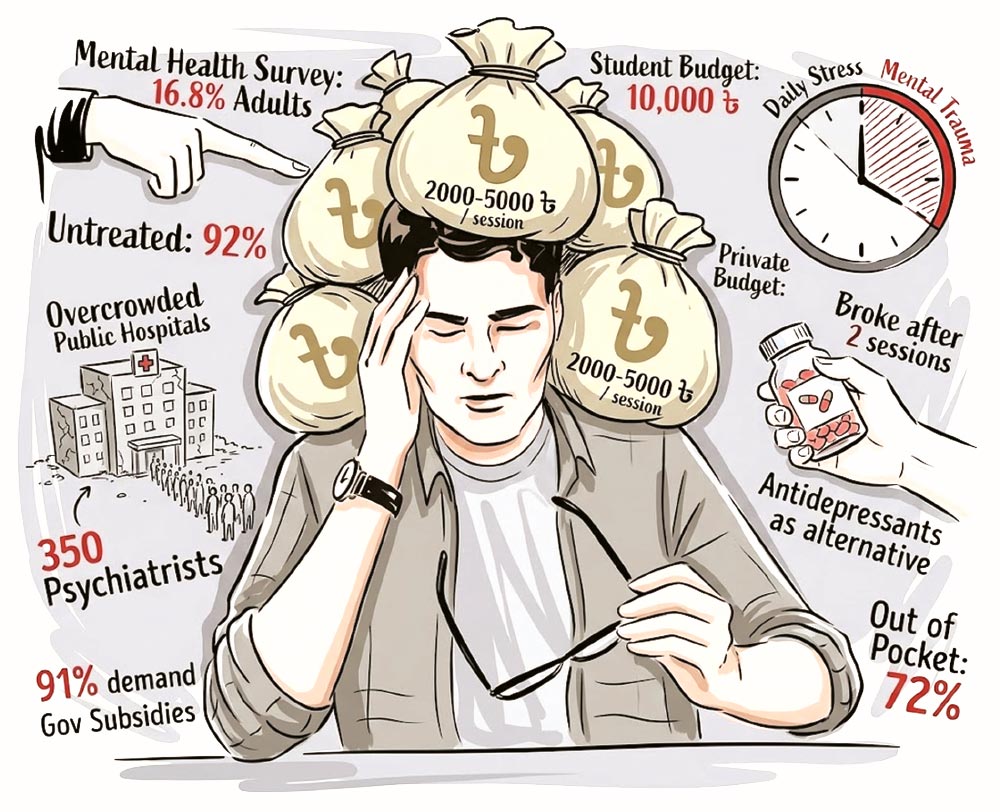 Does the high cost of therapy feel fair in Bangladesh? For a middle-class family in Dhaka earning between Tk25,000 and Tk50,000 a month, the answer is a resounding no. A single therapy session can cost between Tk2,000 and Tk5,000, taking up a significant share of a family’s monthly disposable income. At such rates, mental health support remains beyond the reach of many households, where it is often treated as a luxury rather than a necessity.
Mental illness is a growing concern worldwide and a major cause of disability. In emerging economies like Bangladesh, however, its treatment has become so cost-prohibitive that ordinary people typically seek professional mental health support only when a patient’s condition reaches a severe stage. More than 92 per cent of people afflicted with mental illnesses in the country are left untreated, according to the health minister’s statement in Parliament. The National Mental Health Survey (2018-19) found that around 16.8 per cent of adults and 12.6 per cent of children and adolescents in Bangladesh suffered from some form of mental disorder. On top of that, 1,000 to 1,400 individuals die by suicide annually, and a significant proportion of these victims belong to the youth demographic. These are only the recorded cases, but countless people continue to suffer in silence.
While private therapists rarely set affordable prices, fees often vary by location. If a clinic is located in affluent areas like Gulshan or Banani, it may charge exorbitant fees because of the lavish lifestyles of residents living in those areas. Moreover, only 350 public-sector psychiatrists are available across the country. Public hospitals such as DMCH, BSMMU and Pabna Mental Hospital are almost always overrun with patients and are severely understaffed. When doctors or proper treatment are unavailable at these overcrowded public hospitals, people end up relying on antidepressants instead of receiving proper counselling. Starved of funds, this particular sector often faces neglect and an erosion of clinician accountability. Leaving this vital sector largely to private players is thus fundamentally unfair to ordinary people.
Data reveal that Bangladeshi citizens pay 72 per cent of their healthcare costs out of pocket, while only 0.5 per cent is allocated to mental health. The crisis is much worse for young people, who comprise the majority of those suffering from mental health issues. In Bangladesh, some private universities, like North South University and BRAC University, offer students free personal counselling sessions, but demand far exceeds capacity, with too few therapists available for the massive student population. Private therapy is not always a viable option for these young students. An undergraduate student in his early 20s studying at a public university in Dhaka, who wished to remain anonymous, mentioned that he lives on Tk10,000 a month. When he needed professional support for his mental health, he visited a private clinic where one session cost him Tk4,500. After two visits, he was completely broke for the month.
An anonymous online survey of 23 young residents in Dhaka, conducted in September 2026, illustrates how individuals operate at the micro level. Only three respondents viewed private therapy as accessible for the average person; ten said they actively avoided it due to premium fees; and nearly three-quarters agreed that mental healthcare in Bangladesh is affordable only to the wealthy. Furthermore, 91 per cent of respondents demanded that the government subsidise clinical fees.
So what can be done to mitigate the crisis? The 2020-2030 National Strategic Plan Outline mentions embedding psychiatric care across primary healthcare units. The government now needs to work on an actionable framework, while prioritising mental healthcare workers and training them properly. Realistic plans must be devised and implemented to equip mental healthcare workers sufficiently with the skills to detect specific disorders in patients. The government also needs to act as an institutional bridge to connect struggling ordinary people with specialised treatment. Additionally, steps must be taken to lower medication prices and start working on long-term solutions. Providing confidential therapy through a dedicated web portal or online sessions can also lead to significant cost reductions.
Ultimately, making mental healthcare an accessible and affordable option for all is not just a policy issue; it is a fundamental test of our collective empathy and economic insights. A prosperous, future-ready Bangladesh cannot be built on the backs of a generation that is silently losing itself under the unfathomable weight of unaddressed psychological distress. When mental health is treated as a luxury that can be availed of only by the affluent, we end up ignoring the reality that mental well-being is the very foundation of a healthy, productive and happy society.
Therefore, when financial barriers are lowered, we do more than just relieve the immense burden on struggling families; we transform mental healthcare from a costly privilege into an accessible basic human right. Because when peace of mind becomes a privilege, what hope remains for this nation?
Nadia Afroze Disha is a lecturer, and Shahrin Khan is an undergraduate researcher at BRAC Business School, BRAC University

Loading...
Loading...
Also read



Editor : Iqbal Sobhan Chowdhury
Published by the Editor on behalf of the Observer Ltd. from Globe Printers, 24/A, New Eskaton Road, Ramna, Dhaka.
Editorial, News and Commercial Offices : Aziz Bhaban (2nd floor), 93, Motijheel C/A, Dhaka-1000.
Phone: PABX- 41053001-06; Advertisement: 41053012; 01793317829, 01550707291, E-mail: [email protected], [email protected] Online: email: [email protected] 41053014; 01550707297 Advertisement: 01550707296
Published by the Editor on behalf of the Observer Ltd. from Globe Printers, 24/A, New Eskaton Road, Ramna, Dhaka.
Editorial, News and Commercial Offices : Aziz Bhaban (2nd floor), 93, Motijheel C/A, Dhaka-1000.
Phone: PABX- 41053001-06; Advertisement: 41053012; 01793317829, 01550707291, E-mail: [email protected], [email protected] Online: email: [email protected] 41053014; 01550707297 Advertisement: 01550707296


