



| HEADLINE |

|

Can a Changing World Order Deliver Lasting Peace?
Published : Sunday, 11 October, 2026 at 12:00 AM
Motaher Hossain


 The world is passing through a period of profound uncertainty. The changing global order is marked by geopolitical rivalry, armed conflicts, economic disruptions and a growing erosion of trust among nations. The consequences are no longer confined to battlefields. They are affecting ordinary people, economies, national sovereignty and, in some cases, the territorial integrity and future of states.
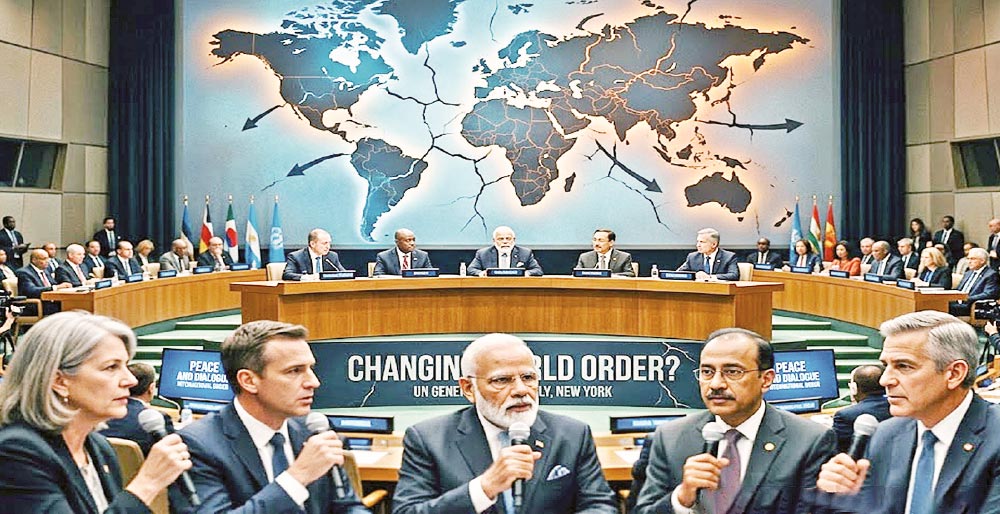
The 81st session of the United Nations General Assembly has once again brought this uncomfortable reality to the centre of global diplomacy. The UN Secretary-General warned that the world's fault lines are widening, with wars, humanitarian crises, inequality, geopolitical divisions and the climate crisis becoming increasingly interconnected. He called for de-escalation and dialogue, stressing that international law must remain central to the global order.
The latest General Assembly debate therefore raises a fundamental question: Can the existing international system deliver peace when major powers themselves disagree over the rules governing that system?
US President Donald Trump, in his September 22 address, presented American strength and national sovereignty as central to his approach to international affairs. He highlighted Iran, the war in Ukraine and conflicts in the Middle East, while arguing that his administration had taken concrete action rather than merely talking about peace. He also criticised aspects of the international institutional system and emphasised national interests and security.
Russia offered a markedly different emphasis. Foreign Minister Sergey Lavrov argued for a more multipolar international order and stressed sovereignty and equality among states. His position reflects Moscow's longstanding call for a redistribution of influence within global institutions and a greater role for countries outside the traditional Western power centres.
 India, meanwhile, has focused on the need to strengthen multilateralism while adapting it to a changing world. Foreign Minister S. Jaishankar highlighted the consequences of conflicts for fuel, food, fertiliser and finance-the interconnected pressures that increasingly affect countries far beyond conflict zones. He also argued that international law and global rules must be applied consistently if multilateral institutions are to regain credibility.
China’s broader diplomatic position has similarly emphasised dialogue, cooperation and a multipolar world order. Beijing has repeatedly called for political solutions to conflicts and greater representation for developing countries in international decision-making.
For Bangladesh, the question of peace is not abstract. It is directly connected to development, climate vulnerability, forced displacement, energy security and economic stability.
Prime Minister Tarique Rahman, addressing the 81st UN General Assembly, called for dialogue, diplomacy and cooperation to resolve conflicts. He also highlighted the economic consequences of wars, including disruptions to energy supplies and global supply chains, as well as rising inflationary pressures.
Bangladesh's position also links global peace with the Rohingya crisis, climate change and sustainable development. Dhaka has sought stronger international cooperation for the safe and sustainable repatriation of Rohingyas, while calling for greater climate finance and international support for vulnerable countries.
These positions are not identical. The major powers differ significantly over security, sovereignty, military alliances and the structure of the international system. But there is an important area of convergence: military power alone cannot provide a durable solution to the world’s interconnected crises.
The challenge now is to turn that recognition into practical diplomacy. A more stable global order will require stronger multilateral institutions, greater respect for international law and wider participation by small and middle-sized states. It will also require countries to build issue-based partnerships on peace, climate change, food and energy security, humanitarian crises and sustainable development.
The alternative is a world of deeper divisions between countries, economies and political blocs. The international community stands at a difficult crossroads. The choice is not simply between one great power and another. It is between a system increasingly driven by confrontation and one rebuilt around dialogue, cooperation and mutual restraint.
The UN was created from the ashes of the Second World War with the promise that disputes could be settled without repeating the catastrophe of global conflict. Eight decades later, that promise remains unfinished.
A durable peace will not come from speeches alone. It will depend on whether nations can rebuild trust, respect international rules and accept that long-term security is ultimately a shared interest.
The writer is the Editor, Climate Journal 24.com

Loading...
Loading...
Also read



Editor : Iqbal Sobhan Chowdhury
Published by the Editor on behalf of the Observer Ltd. from Globe Printers, 24/A, New Eskaton Road, Ramna, Dhaka.
Editorial, News and Commercial Offices : Aziz Bhaban (2nd floor), 93, Motijheel C/A, Dhaka-1000.
Phone: PABX- 41053001-06; Advertisement: 41053012; 01793317829, 01550707291, E-mail: [email protected], [email protected] Online: email: [email protected] 41053014; 01550707297 Advertisement: 01550707296
Published by the Editor on behalf of the Observer Ltd. from Globe Printers, 24/A, New Eskaton Road, Ramna, Dhaka.
Editorial, News and Commercial Offices : Aziz Bhaban (2nd floor), 93, Motijheel C/A, Dhaka-1000.
Phone: PABX- 41053001-06; Advertisement: 41053012; 01793317829, 01550707291, E-mail: [email protected], [email protected] Online: email: [email protected] 41053014; 01550707297 Advertisement: 01550707296


