



| HEADLINE |

|

Bangladesh, India Relations Cannot Remain Hostage to One Political Dispute
Published : Sunday, 11 October, 2026 at 12:00 AM
ARNAB ASHRAF


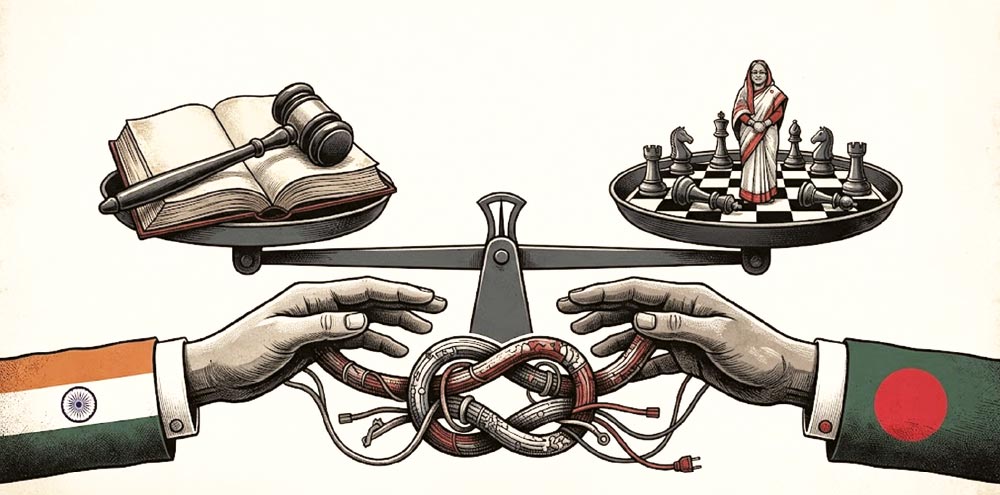
 India may have had “hardly any choice” when Sheikh Hasina arrived in August 2024. But the emergency has passed. The harder question now is what New Delhi and Dhaka should do with the legal and diplomatic consequences. There are moments in international politics when a government does not choose between good and bad options; it chooses between difficult ones.
India’s decision to receive Sheikh Hasina after the dramatic collapse of her government in August 2024 was one such moment. Indian High Commissioner to Bangladesh Dinesh Trivedi has offered one of the clearest explanations yet of New Delhi’s position. Speaking at the Bay of Bengal Conversation 2026 in Dhaka, he said: “At that point in time, Hasina was still the prime minister of Bangladesh. We had hardly any choice on that. It was our duty as a neighbour to accept the reality of life, because situations are such where at times you are not prepared for it.” The veteran diplomat and politician posed the question at the heart of India’s dilemma: “What was our choice? If you would have said that no, we are not going to accept, we don’t give landing permission, things would have been-I don’t know what.”
Trivedi also stressed that Hasina had not been brought to India by the Indian Air Force or Army and that India itself had not been prepared for her sudden arrival. His explanation deserves serious consideration. But it should not end the debate. It leads directly to the more important question confronting India and Bangladesh today: When does an extraordinary act of neighbourly crisis management cease to be an emergency decision and become a continuing question of law, sovereignty and accountability?
The two countries need to separate the Hasina question from the larger architecture of bilateral relations. Water sharing, trade, connectivity, energy, border management, migration, climate change and security cannot permanently remain hostage to one political dispute.
The circumstances of August 2024 were exceptional. Bangladesh was experiencing a dramatic political upheaval. The government had collapsed amid mass protests, violence and profound uncertainty. Hasina left the country and arrived in India at a moment when the consequences of refusing landing permission could not easily be calculated. For New Delhi, refusing entry to an aircraft carrying the still-serving prime minister of a neighbouring country could itself have produced an unpredictable regional crisis.
 Bangladesh and India share a long and strategically sensitive border. Political instability in Bangladesh can have direct consequences for India through border security, migration, communal tensions, trade and regional connectivity.
New Delhi could reasonably conclude that accepting Hasina was the safer immediate option. But there is a crucial distinction between receiving a political leader in an emergency and determining the consequences after the emergency has passed. Emergency protection is one question. Extradition is another.
The first concerns immediate safety and regional stability. The second concerns law, evidence, treaty obligations, judicial process and the sovereign rights of two states. Confusing the two helps neither country.
Trivedi’s phrase “hardly any choice” is persuasive when applied to the circumstances surrounding Hasina’s arrival. It becomes much less persuasive if extended indefinitely. A decision taken under extraordinary circumstances cannot automatically determine every decision that follows. Bangladesh has formally sought Hasina’s extradition. India says the matter is being handled through a structured legal process involving the courts. Trivedi has said: “The courts are involved. So nobody can give you a time frame.”
If India believes that extradition cannot proceed because of treaty provisions, judicial concerns, evidentiary questions, humanitarian considerations or other legal grounds, these issues should be examined according to law. If Bangladesh believes that its request is legally sustainable and that accountability could be pursued through credible judicial procedures, it should demonstrate that through evidence, institutional safeguards and due process.
Neither side benefits from reducing the issue to political slogans. Bangladesh has the sovereign right to seek accountability through its legal institutions. India has the sovereign right-and, where applicable, the treaty-based responsibility-to determine whether an extradition request meets the required legal conditions.
Bangladesh cannot expect India to surrender an individual automatically simply because Dhaka has requested it. Equally, India’s acceptance of Hasina in an extraordinary emergency cannot by itself become an unlimited political justification for keeping her indefinitely.
The answer must ultimately come from law. This is particularly important because India-Bangladesh relations have for too long been vulnerable to personality-driven diplomacy.
The two countries need to separate the Hasina question from the larger architecture of bilateral relations. Water sharing, trade, connectivity, energy, border management, migration, climate change and security cannot permanently remain hostage to one political dispute.
A prolonged confrontation would be a strategic loss for both countries. India does not owe Bangladesh an automatic extradition. But it does owe its neighbour a serious and legally grounded consideration of the request. Bangladesh does not have the right to dictate the outcome of India’s judicial process.
If India requires assurances concerning due process, human rights or judicial safeguards, Dhaka should be prepared to provide them. If Bangladesh provides such assurances, New Delhi should address them substantively. If legal obstacles remain, they should be identified clearly.
The issue also carries significance beyond Bangladesh and India. South Asia has a long history of political leaders crossing borders, seeking refuge and becoming subjects of extradition disputes. How India handles the Hasina case will be watched across the region. The better precedent would be that a politically sensitive extradition request could be handled through law without destroying the underlying relationship between two neighbouring states.
The ultimate test of India-Bangladesh relations should not be whether the two governments agree about Sheikh Hasina.
The test is whether they can disagree about her without allowing that disagreement to destroy the relationship between their peoples. A good neighbour may have to open the door in a crisis. A responsible neighbour must then help ensure that the next door opened is the door to law, accountability, mutual respect and a more stable regional order.
In the end, Sheikh Hasina will return. If she does, Dinesh Trivedi’s curious remark - “Hasina still then the prime minister” - could very well prove prophetic, potentially creating serious grounds for questioning the primary legitimacy of both the two-year interim regime and the 13th Jatiya Sangsad polls.
The writer is a journalist

Loading...
Loading...
Also read



Editor : Iqbal Sobhan Chowdhury
Published by the Editor on behalf of the Observer Ltd. from Globe Printers, 24/A, New Eskaton Road, Ramna, Dhaka.
Editorial, News and Commercial Offices : Aziz Bhaban (2nd floor), 93, Motijheel C/A, Dhaka-1000.
Phone: PABX- 41053001-06; Advertisement: 41053012; 01793317829, 01550707291, E-mail: [email protected], [email protected] Online: email: [email protected] 41053014; 01550707297 Advertisement: 01550707296
Published by the Editor on behalf of the Observer Ltd. from Globe Printers, 24/A, New Eskaton Road, Ramna, Dhaka.
Editorial, News and Commercial Offices : Aziz Bhaban (2nd floor), 93, Motijheel C/A, Dhaka-1000.
Phone: PABX- 41053001-06; Advertisement: 41053012; 01793317829, 01550707291, E-mail: [email protected], [email protected] Online: email: [email protected] 41053014; 01550707297 Advertisement: 01550707296


