



| HEADLINE |

|

Dignity, Sovereignty and National Interest: A New Doctrine of Bangladesh’s Foreign Policy?
Published : Sunday, 11 October, 2026 at 12:00 AM
Sultan Mahmud Sarker


 When a nation’s diplomatic voice learns to speak in its own language, the world pauses and listens. Bangladesh now stands at such a crossroads. After the end of a long chapter, as the nation seeks to rediscover its identity, a fundamental question arises: What path will our foreign policy take? Will it serve whose interests or follow whose instructions, or will it be guided by our own conscience and the principles of justice? In searching for answers, a new doctrine is emerging-dignity, sovereignty and national interest. Three words, yet within them lie the history of a nation’s self-respect, the realities of the present and its aspirations for the future.
Today’s Bangladesh is no longer a country whose foreign policy is shaped by bowing before a powerful neighbour or adjusting itself to the preferences of others. Through the blood-soaked path of the July-August mass uprising, the nation demonstrated that its dignity is not for sale. The determination of the younger generation must now be reflected in the country’s diplomatic posture. A nation that has reclaimed its voice on the streets cannot afford a timid or submissive foreign policy. Bangladesh now seeks a place on the global stage with a voice of confidence, informed by history and driven by courage.
The first condition of this transformation is to understand that diplomacy does not mean submission. Genuine diplomacy is the art of building relationships while maintaining a clear and principled position. For too long, Bangladesh struggled to maintain this balance-sometimes because of excessive dependence, sometimes out of fear, and at times by sacrificing its own interests to accommodate another country’s agenda. It is now time to break away from that cycle. Bangladesh must make it clear that it is a sovereign state with its own interests and sense of dignity. Such firmness does not mean confrontation; it means building relationships based on mutual respect rather than one-sided dependence.
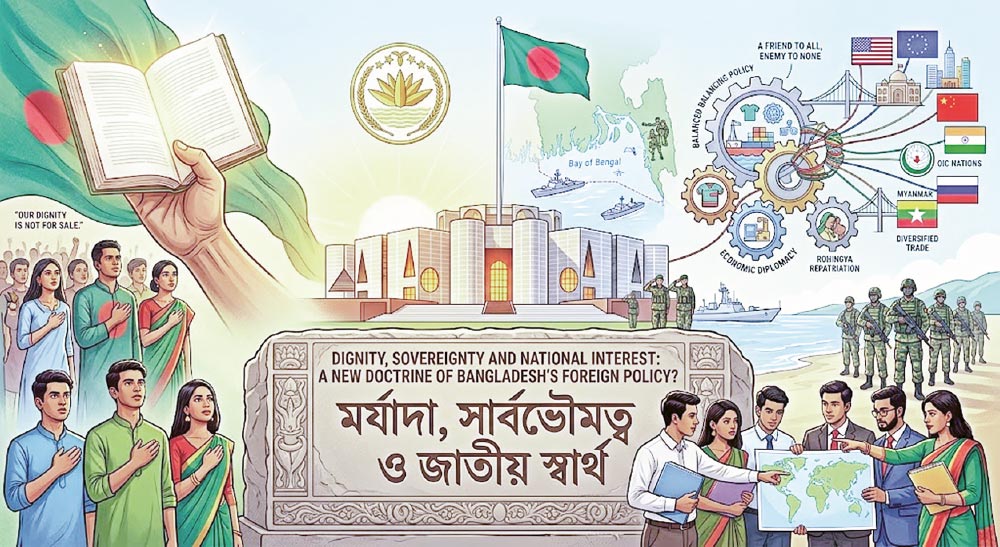 Yet national dignity must never turn into isolationism. Bangladesh’s geopolitical position leaves little room for a one-dimensional foreign policy. Located beside a major regional power and along the strategically important waters of the Bay of Bengal, Bangladesh must master the delicate art of strategic balancing. Blind allegiance to any single power should have no place in our foreign policy. Every relationship must be assessed based on mutual interests, goodwill and fairness. The essence should be simple: a friend to all, an enemy to none, but a servant to no one. Bangladesh must build a diplomatic framework in which economic needs, security concerns and regional stability are considered together.
The greatest test of this balancing policy will come in relations with neighbours. The most important change required is a change in mindset. Being a neighbour does not mean entitlement to unilateral concessions; it means mutual dependence and responsibility. On issues ranging from border killings and water sharing to trade imbalances and transit facilities, Bangladesh must articulate its position clearly and negotiate as an equal partner, not as a supplicant. In dealing with Myanmar, Bangladesh must maintain a firm position on humanitarian and security concerns, particularly the repatriation of the Rohingya, while working with the international community for a sustainable solution. Friendly relations with neighbours should remain a priority, but friendship must never come at the cost of national dignity.
The same balance is necessary when Bangladesh looks toward the broader Muslim world. As home to one of the world’s largest Muslim populations, Bangladesh still has considerable untapped potential in its relations with Muslim-majority countries. Engagement with the Middle East should move beyond labour-market dependence toward investment, technology transfer, defence cooperation and strategic partnership. Relations with OIC member states should also move beyond symbolic religious solidarity toward practical economic and strategic cooperation. Deeper engagement with Saudi Arabia, the United Arab Emirates, Qatar, Turkiye, Indonesia and Malaysia could enable Bangladesh to play a more meaningful role in the Muslim world. Such relationships require strategic patience and long-term planning, not merely short-term calculations.
At the heart of the global equation lies the hard reality of power. International relations often demonstrate that the balance of power determines whose voice carries greater weight at the diplomatic table. Bangladesh must therefore shape its foreign policy through a realistic assessment of its own capabilities. Economic productivity, military preparedness and political stability are essential pillars. The stronger these become, the stronger Bangladesh’s voice will be globally.
In dealing with major powers such as the United States, the European Union, China, Russia and Japan, Bangladesh should avoid complete dependence on any single bloc and instead evaluate each relationship according to its national interests. Diversifying sources of trade, investment, technology transfer and defence procurement can reduce dependence and strengthen Bangladesh’s bargaining power. The country must also become more active in multilateral institutions such as the United Nations, the World Trade Organization and international climate frameworks-not merely as a participant, but as a country capable of influencing agendas and negotiations.
The key instruments for achieving these objectives are Bangladesh’s diplomatic missions abroad. Yet many embassies remain largely focused on routine consular services. This must change. Embassies should become dynamic centres of economic diplomacy, attracting investment, expanding export markets, connecting Bangladesh with its diaspora talent and promoting the country through cultural diplomacy. Ambassadorial appointments should prioritize professionalism and competence over partisan considerations. An ineffective ambassador can undermine a nation’s diplomatic potential for years. Strengthening the institutional capacity of the Ministry of Foreign Affairs, promoting research-based policymaking and providing modern training for young diplomats are equally essential to building a professional and forward-looking diplomatic corps.
None of these ambitions can succeed unless Bangladesh strengthens its domestic foundations. Diplomacy never succeeds in a vacuum; its strength comes from within. A stronger economy, political stability and social cohesion increase a nation’s bargaining power. The success of foreign policy therefore depends on domestic reform, including controlling corruption, strengthening institutional accountability, increasing productivity and consolidating democratic practices. Export diversification, investment in technology and developing the skills of young people can build an economy strong enough for Bangladesh to be seen not as a dependent state, but as a capable and promising partner. Military modernization and stronger security capabilities are also important, because defence capacity contributes to diplomatic confidence.
Ultimately, Bangladesh has a historic opportunity to redefine its foreign policy. At its heart must be three inseparable values: dignity, which is never for sale; sovereignty, which is not a matter of compromise; and national interest, which must be determined by the long-term welfare of the nation rather than short-term political calculations.
Implementing this doctrine will not be easy. It will require visionary leadership, a skilled diplomatic corps and, above all, national consensus. Yet a nation that has regained its voice through blood and sacrifice can walk this path.
When Bangladesh stands tall in the councils of the world, it will mark the true emergence of a new Bangladesh, a country that is not afraid, does not bow its head, but extends the hand of friendship, sincerity and justice to all while preserving its own dignity.
The writer is a PhD Researcher at University of Rajshahi and teacher of Gazipur Cantonment Public School and College

Loading...
Loading...
Also read



Editor : Iqbal Sobhan Chowdhury
Published by the Editor on behalf of the Observer Ltd. from Globe Printers, 24/A, New Eskaton Road, Ramna, Dhaka.
Editorial, News and Commercial Offices : Aziz Bhaban (2nd floor), 93, Motijheel C/A, Dhaka-1000.
Phone: PABX- 41053001-06; Advertisement: 41053012; 01793317829, 01550707291, E-mail: [email protected], [email protected] Online: email: [email protected] 41053014; 01550707297 Advertisement: 01550707296
Published by the Editor on behalf of the Observer Ltd. from Globe Printers, 24/A, New Eskaton Road, Ramna, Dhaka.
Editorial, News and Commercial Offices : Aziz Bhaban (2nd floor), 93, Motijheel C/A, Dhaka-1000.
Phone: PABX- 41053001-06; Advertisement: 41053012; 01793317829, 01550707291, E-mail: [email protected], [email protected] Online: email: [email protected] 41053014; 01550707297 Advertisement: 01550707296


