



| HEADLINE |

|

Ice crisis threatens local fish trade during hilsa ban
Published : Wednesday, 14 October, 2026 at 11:05 AM
Observer Correspondent


Collected Photo
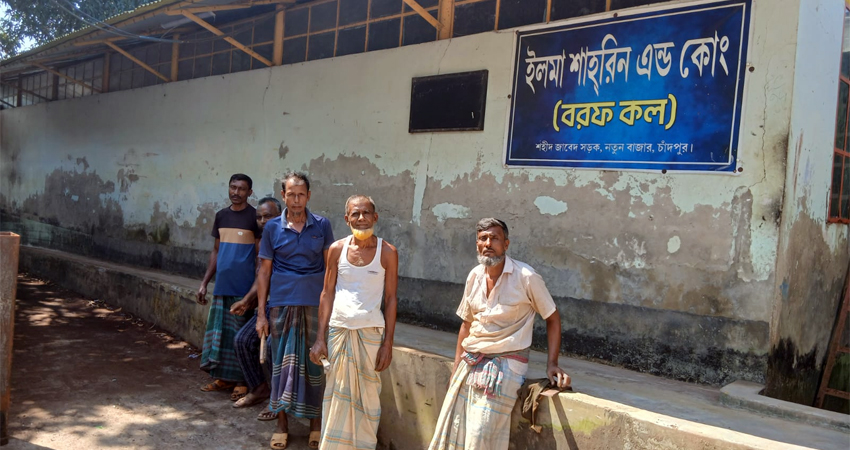
The closure of ice factories during the ongoing hilsa fishing ban has left around 500 workers at Chandpur's Baro Station fish market without work, while traders warn that the shortage of ice is threatening the local fish trade.
The district task force decided to keep all ice factories closed to prevent the storage, transportation, buying, and selling of hilsa during the ban on catching mother hilsa.
On Tuesday (October 13) afternoon, workers at the fish market and nearby ice factories were seen sitting idle due to a lack of work.
Workers said they supported the authorities' decision to close the ice factories to protect hilsa during its breeding season. However, they said the lack of ice was causing locally caught fish to spoil and discouraging wholesale buyers from coming to the market. More than 400 workers have reportedly become unemployed as a result.
Traders said local fish are sold at several markets, including Dherra, Wireless, Biponibagh, Bou Bazar, Chowrasta and Bhatialpur. Without ice, fish auctioned in the early hours are becoming soft and spoiling before reaching consumers' homes.
Veteran fish traders Abdul Malek Mia and Md Manik said ice was essential for preserving live and fresh fish, including hrimp, punti, rohu, catla, tilapia and other varieties.
Buyers also expressed concern over fish being kept alive artificially with oxygen and brought to wholesale markets for sale. They warned that such fish could pose health risks, although no specific evidence of harm was cited.
Malek Munshi, a worker at the fish landing station, said they were selling only live fish because wholesalers were reluctant to buy other varieties without ice.
He said rohu, catla, carp, and mrigal arriving from Shariatpur, along with shrimp from Khulna, were lying at the market without buyers. As a result, fish worth lakhs of taka were at risk of going to waste every day.
He added that around 50 wholesale traders at Baro Station were also facing the threat of substantial losses. He urged the authorities to allow at least one ice factory to operate to preserve local fish supplies.
Md Shabe Barat Sarkar, general secretary of the Chandpur Fish Traders Cooperative Association, said traders would jointly take action against anyone involved in selling or storing hilsa in violation of the ban.
However, he said keeping at least one ice factory open was essential to sustain the market for other fish. The shortage had discouraged wholesalers from purchasing live fish in Chandpur, leaving more than 500 workers struggling without work.
He urged the administration to permit one ice factory to operate under appropriate restrictions.
Chandpur District Fisheries Officer Fakhrul Islam said the decision to close the ice factories was not his alone but had been taken unanimously by the district task force after reviewing the situation.
The government has imposed a 22-day ban from October 8 to October 29 on catching, selling, buying, storing and transporting hilsa and other fish in a 70-kilometre stretch of the Padma-Meghna rivers, from Char Bhairabi in Haimchar to Shatnol in Matlab Uttar, to ensure the safe breeding of mother hilsa.
-EM

Loading...
Loading...
Also read









Editor : Iqbal Sobhan Chowdhury
Published by the Editor on behalf of the Observer Ltd. from Globe Printers, 24/A, New Eskaton Road, Ramna, Dhaka.
Editorial, News and Commercial Offices : Aziz Bhaban (2nd floor), 93, Motijheel C/A, Dhaka-1000.
Phone: PABX- 41053001-06; Advertisement: 41053012; 01793317829, 01550707291, E-mail: [email protected], [email protected] Online: email: [email protected] 41053014; 01550707297 Advertisement: 01550707296
Published by the Editor on behalf of the Observer Ltd. from Globe Printers, 24/A, New Eskaton Road, Ramna, Dhaka.
Editorial, News and Commercial Offices : Aziz Bhaban (2nd floor), 93, Motijheel C/A, Dhaka-1000.
Phone: PABX- 41053001-06; Advertisement: 41053012; 01793317829, 01550707291, E-mail: [email protected], [email protected] Online: email: [email protected] 41053014; 01550707297 Advertisement: 01550707296


