



| HEADLINE |

|

Bangladesh Eyes $10b UK Export Bonanza as Market Share Target Doubles
Published : Thursday, 15 October, 2026 at 12:00 AM
Business Correspondent


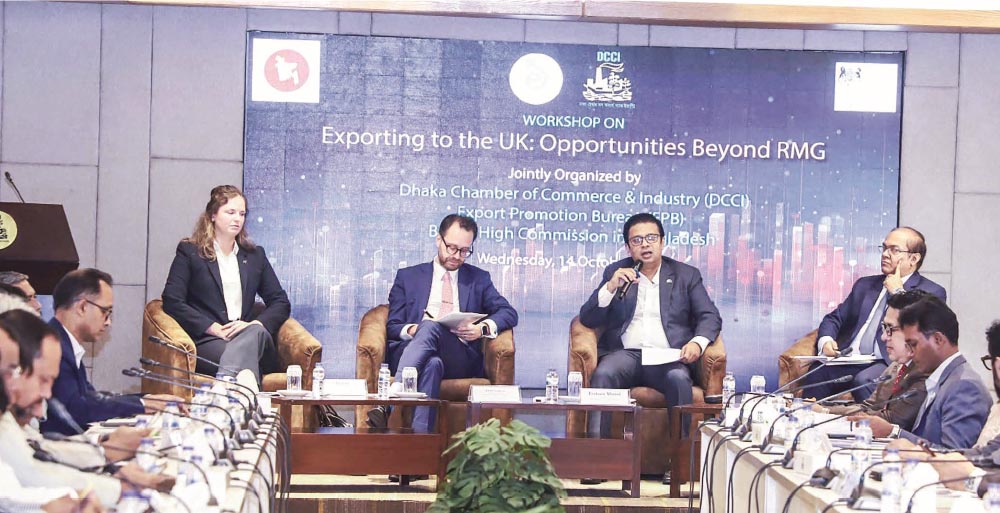 Bangladesh could more than double its exports to the United Kingdom to $10 billion by raising its share of the British import market from a meagre 0.49 per cent to just 1 per cent, but breaking into that market will require a decisive shift beyond readymade garments (RMG), stronger compliance and the dismantling of trade barriers, business leaders have said.
With Bangladesh's exports to the UK heavily concentrated in garments, the country is leaving vast opportunities untapped in one of the world's largest import markets. Export diversification, internationally recognised product standards, modern certification systems and better market intelligence are crucial to unlocking the next phase of trade growth, they said.
Leaders of the Dhaka Chamber of Commerce and Industry (DCCI) also urged exporters to prepare early to capitalise on preferential market-access opportunities under the British government's Developing Countries Trading Scheme (DCTS), particularly as Bangladesh approaches graduation from the least developed country (LDC) category.
The recommendations came at a workshop titled “Exports to the UK Market: Prospects for Sectors Beyond Readymade Garments”, jointly organised by the DCCI, Export Promotion Bureau (EPB) and British High Commission in Bangladesh at the DCCI Auditorium in Motijheel on Wednesday.
Presenting the keynote paper, EPB Vice-Chairman and Chief Executive Officer Mohammad Hasan Arif said Bangladesh exported goods worth $4.67 billion to the UK in fiscal year 2025-26, with RMG accounting for 94 per cent of the total.
The concentration exposes the limits of Bangladesh's export basket even as the British market offers enormous room for expansion. The UK's total imports stood at $948 billion, yet Bangladesh captured only 0.49 per cent of that market.
Arif said lifting the share to 1 per cent could propel Bangladesh's exports to the UK to $10 billion, making diversification and the removal of tariff and non-tariff barriers critical to achieving the target.
As the country prepares to graduate from the LDC category, he urged exporters to tap the potential of pharmaceuticals, food and frozen food, shrimp, agricultural products, bicycles, light engineering and plastics.
He stressed that Bangladesh must reduce its excessive dependence on a single product and pursue broader export growth through improved value-chain management, stronger compliance and enhanced production capabilities.
The EPB chief also called for internationally recognised standards and testing facilities, a better understanding of British market regulations, improved access to finance for small and medium-sized enterprises (SMEs), and stronger entrepreneurial skills to help local businesses compete.
In his welcome address, DCCI President Taskin Ahmed said Bangladesh's longstanding trade and investment relationship with the UK offered scope for a broader partnership, but the country's export performance remained overwhelmingly dependent on garments.
To break that dependence, he called on businesses to improve product quality, meet international standards, strengthen certification systems, ensure traceability across product origins and supply chains, and invest in packaging, branding and market intelligence.
Ahmed said exporters must also develop a clear understanding of British consumer demand and regulatory requirements to turn market-access opportunities into sustainable export earnings.
He described the DCTS as an important opportunity for Bangladeshi businesses, urging entrepreneurs to prepare to make the most of the scheme. He also called for removing existing tariff and non-tariff barriers to expand bilateral trade and investment.
Acting British High Commissioner to Bangladesh James Goldman said the two countries enjoyed a longstanding relationship underpinned by growing trade and investment ties.
He said continued access to the UK market after Bangladesh's graduation from the LDC category would provide businesses across sectors with greater certainty to plan ahead, expand operations and invest.
Goldman expressed hope that more Bangladeshi businesses would seize the opportunities available in the British market and strengthen the commercial relationship between the two countries.
During the workshop, Ellie Parker, Regional Adviser for Trade Development covering South Asia, Central Asia and the South Caucasus at the British High Commission, conducted a technical session on the UK's Developing Countries Trading Scheme.
The session examined market-access opportunities under the DCTS before and after Bangladesh's LDC graduation, offering practical guidance on preferential tariff benefits and highlighting key considerations for exporters seeking to enter or expand in the UK market.
Additional Commissioner Mohammad Shahidul Islam of the Customs Bond Commissionerate, Chattogram, under the National Board of Revenue; Amrita Makin Islam, director of the Footwear, Leather Goods and Accessories Exporters Association; Khurshid Ahmad Farhad, director of Hortex Foundation; Mohammad Mustaq Ahmed Tanvir, director of Meghna Group; Yasir Obayed, managing director of Cupcake Exports Limited; Shyamal Das, managing director of M.U.C. Foods Limited; and Safiuzz Sami Alamgir, president of the Bangladesh Flexible Packaging Industries Association were also present in the discussion.

Loading...
Loading...
Also read



Editor : Iqbal Sobhan Chowdhury
Published by the Editor on behalf of the Observer Ltd. from Globe Printers, 24/A, New Eskaton Road, Ramna, Dhaka.
Editorial, News and Commercial Offices : Aziz Bhaban (2nd floor), 93, Motijheel C/A, Dhaka-1000.
Phone: PABX- 41053001-06; Advertisement: 41053012; 01793317829, 01550707291, E-mail: [email protected], [email protected] Online: email: [email protected] 41053014; 01550707297 Advertisement: 01550707296
Published by the Editor on behalf of the Observer Ltd. from Globe Printers, 24/A, New Eskaton Road, Ramna, Dhaka.
Editorial, News and Commercial Offices : Aziz Bhaban (2nd floor), 93, Motijheel C/A, Dhaka-1000.
Phone: PABX- 41053001-06; Advertisement: 41053012; 01793317829, 01550707291, E-mail: [email protected], [email protected] Online: email: [email protected] 41053014; 01550707297 Advertisement: 01550707296


