



| HEADLINE |

|

Payra Port bridge deck casting completed, marks milestone in First Terminal Project
Published : Friday, 16 October, 2026 at 12:00 AM
Staff Correspondent


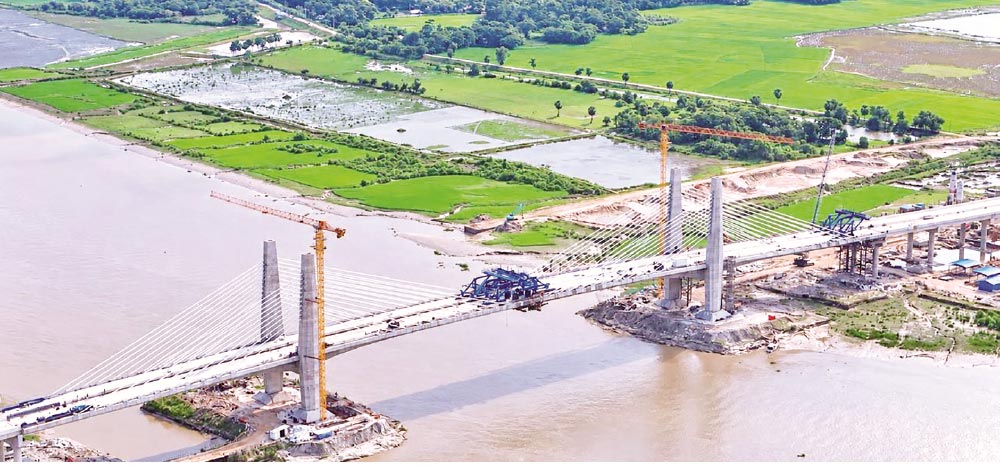 The final concrete casting of the deck of the bridge over the Andermanik River at Payra Port was completed on Thursday, marking a major milestone in the development of the port’s First Terminal Project.
The bridge, being constructed with associated works under the First Terminal Project, is expected to establish direct road connectivity between the terminal at Charipara on the Rabnabad River and Dhaka and other major commercial centres.
According to the project officials, once operational, the bridge is expected to reduce cargo transportation time and costs, facilitate the movement of goods and passengers, and strengthen Payra Port’s role in the country’s import-export trade.
Payra Port Authority officials said the improved connectivity could also encourage investment in industries and renewable energy projects in the port area. “Several investors have expressed interest in developing industries and solar power plants on land designated for these purposes in the Payra Port Master Plan,” officials said, adding that such investments could expand port-related economic activities and strengthen the regional economy.
The latest milestone follows another significant development at the First Terminal earlier this month. On October 7, the Chinese-flagged cargo vessel Fan Zhou-6 berthed directly at the terminal carrying five pieces of modern cargo-handling equipment.
The arrival marked the delivery of major operational machinery to the terminal for the first time in two years. Senior port officials were present to oversee the vessel’s berthing.
The bridge, which is being constructed at a cost of US$ 86.17 million (BDT 1,063 crore), is a 1,180-metre-long extradosed structure featuring a 58.5-metre tower. Its main deck is 23.2 metres wide, while the approach decks are 21.2 metres wide. The bridge will have four traffic lanes, with two lanes in each direction.
As the Andermanik River must remain navigable for vessels, the bridge has been designed with only two main piers to allow ships and launches to pass without obstruction.
Construction began with the installation of the first pile on February 1, 2024. China Civil Engineering Construction Corporation (CCECC) and China Railway Bridge Construction Group (CRBCG) are jointly implementing the project under the supervision of a South Korean consultancy firm.
The bridge has also become a local attraction, with residents and visitors gathering along the adjoining road to watch the structure take shape. According to the design, the bridge will be illuminated at night with lighting intended to evoke the shape of a water lily.

Loading...
Loading...
Also read



Editor : Iqbal Sobhan Chowdhury
Published by the Editor on behalf of the Observer Ltd. from Globe Printers, 24/A, New Eskaton Road, Ramna, Dhaka.
Editorial, News and Commercial Offices : Aziz Bhaban (2nd floor), 93, Motijheel C/A, Dhaka-1000.
Phone: PABX- 41053001-06; Advertisement: 41053012; 01793317829, 01550707291, E-mail: [email protected], [email protected] Online: email: [email protected] 41053014; 01550707297 Advertisement: 01550707296
Published by the Editor on behalf of the Observer Ltd. from Globe Printers, 24/A, New Eskaton Road, Ramna, Dhaka.
Editorial, News and Commercial Offices : Aziz Bhaban (2nd floor), 93, Motijheel C/A, Dhaka-1000.
Phone: PABX- 41053001-06; Advertisement: 41053012; 01793317829, 01550707291, E-mail: [email protected], [email protected] Online: email: [email protected] 41053014; 01550707297 Advertisement: 01550707296


