



| HEADLINE |

|

Severe wildfire smog
Indonesia drops dry ice from sky
Published : Friday, 16 October, 2026 at 8:22 AM
Observer Online Report


Collected Photo
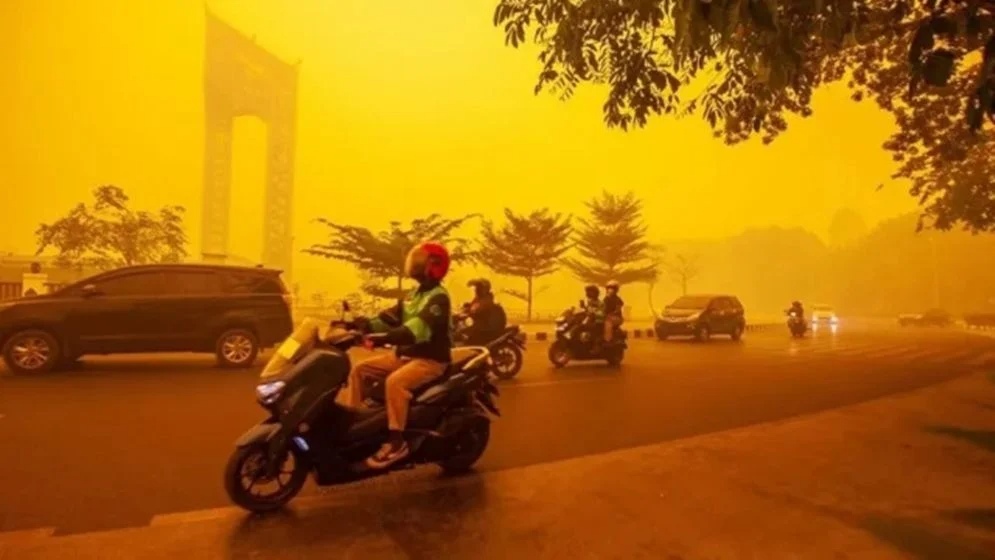
Indonesian authorities have begun test-spraying "dry ice" (solid carbon dioxide) from aircraft into the sky to clear toxic smog blanketing vast areas of the country due to severe forest and peatland wildfires.
Experiencing its worst wildfire season in a decade following severe droughts driven by a strong El Niño phenomenon this year, Indonesia deployed aircraft to scatter 1.5 tons of dry ice over the heavily affected South Sumatra province on Thursday.
While cloud-seeding chemicals have been used for weeks to induce rain, the application of dry ice represents a fundamentally different approach. Coordinating Minister for Political and Security Affairs Dudung Abdurrahman explained that instead of forming clouds to generate rain, the dry ice breaks up smog in the lower atmosphere, allowing it to disperse upward.
"If this experiment proves successful, we will expand operations to Central Kalimantan and other haze-affected regions nearby," he stated.
Indonesian President Prabowo Subanto has directed all agencies to intensify efforts to extinguish the wildfires and mitigate the effects of the toxic smog. According to independent forest monitoring platform Nusantara Atlas, more than one million fires have broken out across Indonesia this year, scorching nearly 900,000 hectares of land.
The haze has turned the skies over Kalimantan and South Sumatra copper-brown. The polluted air has also drifted into neighboring Singapore and Malaysia, creating severe public health risks. To manage the crisis, Malaysia has initiated cloud-seeding operations in Kuala Lumpur and Johor Bahru, with Indonesian authorities granting Malaysian aircraft permission to enter their airspace along the border.
Public anger has mounted over the fires, which are often sparked by land-clearing agricultural burning. Indonesian police have already filed cases against more than 200 individuals and nine corporate entities in connection with the blazes.
-SA

Loading...
Loading...
Also read






Editor : Iqbal Sobhan Chowdhury
Published by the Editor on behalf of the Observer Ltd. from Globe Printers, 24/A, New Eskaton Road, Ramna, Dhaka.
Editorial, News and Commercial Offices : Aziz Bhaban (2nd floor), 93, Motijheel C/A, Dhaka-1000.
Phone: PABX- 41053001-06; Advertisement: 41053012; 01793317829, 01550707291, E-mail: [email protected], [email protected] Online: email: [email protected] 41053014; 01550707297 Advertisement: 01550707296
Published by the Editor on behalf of the Observer Ltd. from Globe Printers, 24/A, New Eskaton Road, Ramna, Dhaka.
Editorial, News and Commercial Offices : Aziz Bhaban (2nd floor), 93, Motijheel C/A, Dhaka-1000.
Phone: PABX- 41053001-06; Advertisement: 41053012; 01793317829, 01550707291, E-mail: [email protected], [email protected] Online: email: [email protected] 41053014; 01550707297 Advertisement: 01550707296


