



| HEADLINE |

|

Merit In, Ageism Out
Justice Does Not Retire at 35



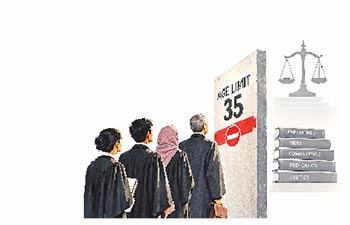 A right that expires with a birthday is no right at all. On 13 October 2026, Law Minister Md. Asaduzzaman proposed to make that courage a crime of the calendar, announcing plans to bar anyone over 35 from entering the legal profession. His target is the retired official seeking a second vocation in the twilight of his career. Yet this blunt instrument may prove fatal to talented individuals from diverse backgrounds, including Bangladeshis who, after years pursuing government jobs, exceed the prescribed age limit and turn to law to rebuild their careers.
The reaction on social media was swift. If advocacy is to be fenced by age, why not Parliament and the Cabinet? A ceiling of 35 for MPs and ministers, critics suggested, might bring fresher perspectives and bolder leadership. Others questioned why an age limit for the Bar Council examination should not be matched by a retirement age for practising lawyers, and why former judges, legislators and ministers may return to the Bar unchallenged! A profession that polices its threshold, they argued, should also police its exit. Supporters cite opportunities for young graduates, long-term professional development and the discipline, seniority and continuity underpinning the Bar’s apprenticeship tradition. These arguments have merit but cannot justify so restrictive a measure. The Bar Council already admits candidates through a rigorous, competitive examination. Why then should entry depend on the calendar rather than merit and competence?
The constitutional objections are formidable. An age ceiling may violate Article 40, which guarantees the right to pursue a lawful profession, and implicate Article 32’s protection of life and personal liberty, including livelihood. Unlike salaried employees, lawyers answer to no employer; their fitness to practise should depend on ability, not age. Litigants could lose seasoned counsel, young advocates their mentors, and senior practitioners without institutional pensions their only financial security. Such a rule would squander talent and constitute age discrimination, particularly when retired judges remain free to appear before courts they once served.
Comparative practice offers the government little support. The United Kingdom, the United States and Canada impose no general upper age limit. In 1995, India’s Supreme Court struck down a Bar Council rule barring enrolment after 45. Nor does the Bangladesh Legal Practitioners and Bar Council Order, 1972, prescribe such a limit.
Justice has never asked an advocate’s age; it asks only whether the advocate is ready to serve. Shutting the door on latecomers is to forget that conscience, like the law itself, does not diminish with the passing years.

Loading...
Loading...
Also read



Editor : Iqbal Sobhan Chowdhury
Published by the Editor on behalf of the Observer Ltd. from Globe Printers, 24/A, New Eskaton Road, Ramna, Dhaka.
Editorial, News and Commercial Offices : Aziz Bhaban (2nd floor), 93, Motijheel C/A, Dhaka-1000.
Phone: PABX- 41053001-06; Advertisement: 41053012; 01793317829, 01550707291, E-mail: [email protected], [email protected] Online: email: [email protected] 41053014; 01550707297 Advertisement: 01550707296


