



| HEADLINE |

|

Abul Khair Group brings safe drinking water to two villages
Published : Saturday, 17 October, 2026 at 6:00 PM
Press Release


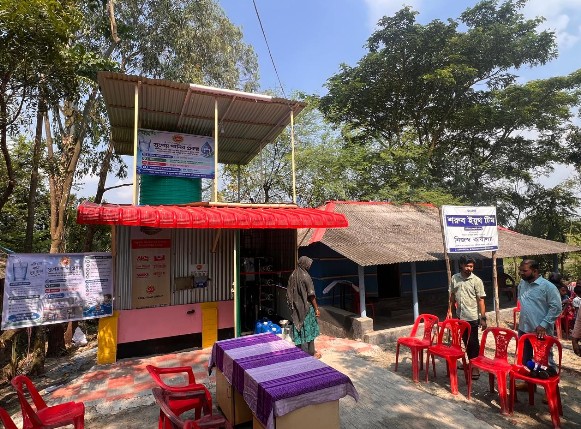
Abul Khair Group Launches Two Water Purification Plants in Coastal Bangladesh.
Shyamnagar, Satkhira, lies on the edge of the Sundarbans. Surrounded by water, its residents nevertheless struggle to access safe drinking water. The coastal water crisis is not merely a matter of thirst; it threatens people's health, dignity and future. Drinking saline water contributes to a range of health concerns, including gastrointestinal illnesses, high blood pressure, kidney complications and skin diseases. Women bear a disproportionate burden, often having to travel long distances every day to collect drinking water for their families.
For years, girls in the villages of Khagraghat and Kaikhali in Shyamnagar have missed school while fetching water. Collecting water from distant tube wells and ponds was part of their daily routine. Rainwater harvesting provided relief for only two to three months during the monsoon, while the remaining ten months brought hardship. Following Cyclone Sidr and Cyclone Aila, salinity levels in the soil and pond water in the area increased further.
Now, the situation is beginning to change. With financial support from private industrial conglomerate Abul Khair Group, two reverse osmosis (RO) water purification plants have been installed in the two villages. On 17 October, Sheikh Shabab Ahmed, Head of Corporate Affairs and Legal at Abul Khair Group, inaugurated the plants. One is located in front of Nur Uddin's house in Khagraghat, while the other is situated in front of Alauddin Mallick's house in Kaikhali.
One Tap, Transforming Many Lives
Rahima Begum, 45, a homemaker from Khagraghat, said, “Now, fresh-tasting water flows at the turn of a tap. This technology has given us a new lease on life.” She explained that while stored rainwater was sufficient during the monsoon, drinking saline water during the rest of the year had been a constant ordeal. Her children frequently suffered from stomach ailments throughout the year.
Amenа Khatun, a woman in her sixties from Kaikhali, recalled that she previously had to walk two to three miles to collect a single pitcher of fresh water. “Now that a tap has been installed near our homes, it feels like we have been given a new life,” she said.
Rahima Begum also noted that girls had previously missed school to fetch water. With safe drinking water now available nearby, they can attend school more regularly without the burden of daily water collection.
Sheikh Shabab Ahmed, Head of Corporate Affairs and Legal at Abul Khair Group, said the severity of the coastal water crisis had deeply affected the organisation. “We wanted to provide a sustainable solution that would directly help protect people's lives and support children's growth and development,” he said.
Dr. Amjad Hossain, a physician in Shyamnagar, explained that high iron content can make water reddish in colour and bitter in taste, potentially contributing to gastrointestinal problems and dental issues. He noted that the reddish colour and bitter taste were no longer evident in the treated water.
Laboratory tests conducted by the Department of Public Health Engineering's Khulna Regional Laboratory found that the treated water had significantly lower levels of total dissolved solids (TDS), which measure the concentration of dissolved salts and minerals in water.
In Kaikhali, TDS levels in water from a conventional tube well measured 8,217 mg/L, falling to 28 mg/L after treatment. In Khagraghat, the level dropped from 4,081 mg/L to 92 mg/L. Iron concentration in Kaikhali's water also decreased from 1 mg/L to 0.01 mg/L following treatment.
Minimising Water Waste Through Smart Technology
Each local user has been provided with a digital card. Water flows when the card is held against the tap and stops as soon as the card is removed, helping prevent unnecessary water wastage.
Each plant is equipped with ten solar panels that power the pumps. Solar energy reduces dependence on the rural electricity grid, helps ease electricity costs and makes the water supply less vulnerable to power outages. The initiative also demonstrates how renewable energy can support more reliable and environmentally sustainable water services in rural communities.
Creating Employment Opportunities for Local Youth
The project has also created opportunities for young people in the area to gain employment and develop entrepreneurial skills. Members of Shyamnagar-based youth organisation Shorub Youth Club are operating the plants. Local young people are involved in plant operations, maintenance and water distribution, creating opportunities to reduce unemployment and strengthen community participation.
In these villages of Shyamnagar, the taps are delivering more than just water. They are helping girls return to school, giving mothers more time for their families and improving the prospects for children's health and well-being.
Improved access to safe drinking water may also help reduce certain health risks associated with prolonged exposure to saline water, including some concerns relating to women's reproductive health. By making safe water more accessible, the initiative seeks to contribute to better health, greater dignity and an improved quality of life for women and the wider community.

Loading...
Loading...
Also read








Editor : Iqbal Sobhan Chowdhury
Published by the Editor on behalf of the Observer Ltd. from Globe Printers, 24/A, New Eskaton Road, Ramna, Dhaka.
Editorial, News and Commercial Offices : Aziz Bhaban (2nd floor), 93, Motijheel C/A, Dhaka-1000.
Phone: PABX- 41053001-06; Advertisement: 41053012; 01793317829, 01550707291, E-mail: [email protected], [email protected] Online: email: [email protected] 41053014; 01550707297 Advertisement: 01550707296


