



| HEADLINE |

|

Maha Saptami: The sacred nine plants of Durga Puja
Published : Saturday, 17 October, 2026 at 8:59 PM
Sakia Kawser Siddique



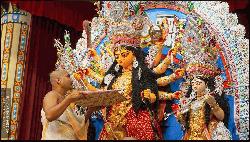
Maha Saptami marks a major stage of Sharadiya Durga Puja in Bangladesh on Saturday, October 17, with the ritual of Nabapatrika forming the centrepiece of the day’s observances. Nine plants are bound together, ceremonially bathed and worshipped as manifestations of the goddess, connecting Durga Puja with Bengal’s distinctive traditions of plant symbolism and religious worship.
What is Nabapatrika?
The word Nabapatrika combines the Sanskrit words nava, meaning nine, and patrika, referring to leaves or plants. In the ritual, nine plants are tied together, traditionally around a banana plant, and worshipped as representations of different forms or powers of the goddess.
The plants commonly include banana, colocasia, turmeric, jayanti, bel, pomegranate, ashoka, mankachu and paddy. Their identification and the divine forms associated with them can vary across ritual traditions.
The assembled plants are given a ceremonial bath, traditionally in a river or other water body, and are dressed in a sari before being installed at the place of worship. In Bengal, the arrangement is also popularly known as Kola Bou, or the banana bride, because of its appearance in a sari.
Although it is sometimes popularly described as Ganesha’s wife, the Kola Bou is worshipped in the Nabapatrika tradition as a manifestation of the goddess. Its placement beside Ganesha does not, by itself, establish that it represents his wife.
The religious meaning of the nine plants
Nabapatrika expresses the idea that divine power can be represented through different forms of nature. In the ritual tradition, the plants are associated with aspects of the goddess and are worshipped together as a sacred presence.
A study titled Durga Puja: Rituals and Ecology, available through Vidyasagar University’s institutional repository, describes the nine plants as representing different forms of the goddess. The list includes banana, turmeric, paddy, bel, pomegranate and several other plants associated with Bengali religious practice.
The associations are not identical in every account. For example, paddy is commonly linked with prosperity and Lakshmi, while banana is associated with Brahmani in one widely cited scheme. The ritual’s significance lies in the worship of the plants collectively as Nabapatrika, rather than in assuming that every community follows one universal list of symbolic associations.
What is the historical background?
The precise origins of Nabapatrika are difficult to establish. Its use of plants as sacred representations has prompted scholars to examine the relationship between Durga Puja, nature worship and older forms of goddess veneration. However, interpretations of its earliest origins should be distinguished from what historical sources can demonstrate.
In her peer-reviewed study, The Rite of Durgā in Medieval Bengal, published in the Journal of the Royal Asiatic Society in 2012, scholar Bihani Sarkar examined Raghunandana Bhattacharya’s Durgapuja-tattva, a medieval Bengali ritual manual, alongside related texts. The study reconstructs aspects of Durga Puja as it may have been performed in Bengal between the 14th and 16th centuries.
Medieval ritual manuals provide valuable evidence of how Durga Puja ceremonies were prescribed and understood. They do not, however, establish a definitive date for the emergence of Nabapatrika or prove a single origin for every element of the ritual. Its exact historical development therefore remains uncertain.

Nabapatrika in Bengal and Bangladesh
The ritual is observed in Bangladesh and West Bengal, particularly during the morning observances of Maha Saptami. In many Bengali pujas, the plants are taken to a river or pond for the ceremonial bath before being brought to the mandap and installed for worship. Where access to a natural water body is impractical, arrangements may differ.
In Bangladesh, the main Durga Puja rituals begin on Maha Saptami following the Bodhan ceremonies of Shashthi. This year, the Saptami tithi extends across October 17 and 18 on the civil calendar. The timing of the Nabapatrika ceremony can depend on the almanac followed by a temple or puja committee, so the two calendar dates should not be interpreted as two separate principal Saptami observances.
The ritual marks the transition from the invocation of the goddess on Shashthi to the main days of worship. As devotees gather at temples and community mandaps, Nabapatrika brings together religious devotion, plant symbolism and long-established Bengali ritual practice.
For worshippers, the nine plants are not merely decorations accompanying the idol. Their consecration and worship express the presence of the goddess through a group of living forms, making Nabapatrika one of the distinctive observances of Bengal’s autumnal Durga Puja.
Sources: Navapatrika, BSS
sks

Loading...
Loading...
Also read








Editor : Iqbal Sobhan Chowdhury
Published by the Editor on behalf of the Observer Ltd. from Globe Printers, 24/A, New Eskaton Road, Ramna, Dhaka.
Editorial, News and Commercial Offices : Aziz Bhaban (2nd floor), 93, Motijheel C/A, Dhaka-1000.
Phone: PABX- 41053001-06; Advertisement: 41053012; 01793317829, 01550707291, E-mail: [email protected], [email protected] Online: email: [email protected] 41053014; 01550707297 Advertisement: 01550707296
Published by the Editor on behalf of the Observer Ltd. from Globe Printers, 24/A, New Eskaton Road, Ramna, Dhaka.
Editorial, News and Commercial Offices : Aziz Bhaban (2nd floor), 93, Motijheel C/A, Dhaka-1000.
Phone: PABX- 41053001-06; Advertisement: 41053012; 01793317829, 01550707291, E-mail: [email protected], [email protected] Online: email: [email protected] 41053014; 01550707297 Advertisement: 01550707296


