



| HEADLINE |

|

Five priorities set for primary education reform: Bobby Hajjaj
Published : Monday, 19 October, 2026 at 6:47 PM
Observer Online Report


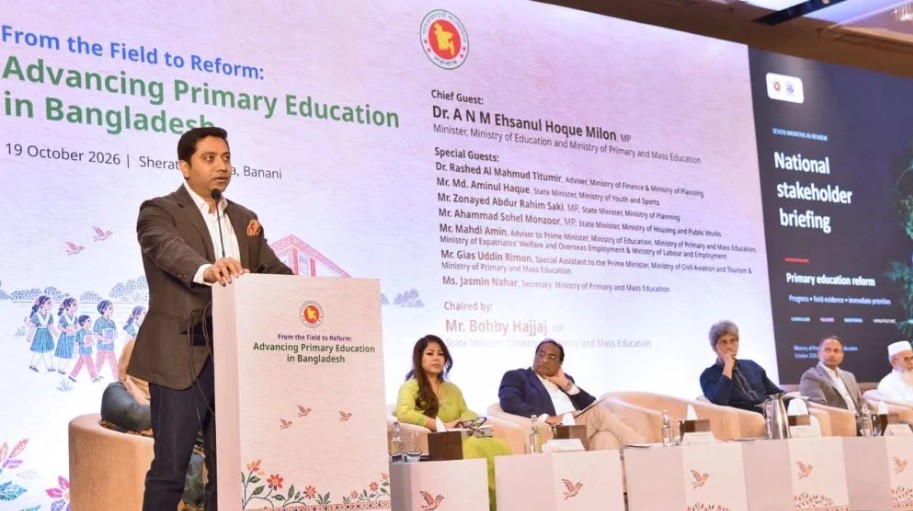
State Minister for Primary and Mass Education Bobby Hajjaj has identified curriculum, teachers, monitoring, infrastructure and technology as five priorities for improving the quality of primary education in Bangladesh.
He said the five areas were closely interconnected and that reform in one area without addressing the others would not deliver the desired results. He stressed the need for coordinated measures based on ground-level realities and feedback from stakeholders.
Hajjaj made the remarks while chairing a national dialogue and experience-sharing workshop titled ‘From the Field to Reform: Advancing Primary Education in Bangladesh’ at the Sheraton Hotel in Dhaka on Monday. The Ministry of Primary and Mass Education, the Directorate of Primary Education and UNICEF jointly organised the event.
He said Prime Minister Tarique Rahman had outlined the government’s vision for primary education. The government was working to ensure access to education for every child, improve learning quality, develop moral values and equip students with skills for their future careers, he added.
Hajjaj said he had held more than 60 hours of discussions over the past few months with officials, monitoring officers, headteachers and others directly involved in primary education. The government had reviewed the experiences and opinions of more than 3,000 stakeholders, including over 1,700 monitoring officers and more than 1,500 headteachers, he added.
The discussions had helped identify existing challenges, key priorities and possible solutions, he said.
The state minister said preparations were under way to introduce a new curriculum in 2028, focusing on learning outcomes and a child-friendly education system. Improving proficiency in Bangla, mathematics and English, play-based learning, digital content and practical learning activities would receive attention.
He also stressed the need to reduce disparities in learning time among schools and establish appropriate standards for both public and private primary education institutions.
On teacher development, Hajjaj said work was under way on a teacher policy integrating recruitment, pre-service training, placement, professional development and evaluation. He emphasised subject-specific skills, regular professional development and ensuring that teachers received proper training before taking classes.
He also called for separate evaluation systems for teachers and schools and more effective teacher training centres at the upazila level.
Regarding monitoring, he said staff shortages and excessive administrative workloads needed to be addressed to improve school supervision. Initiatives included an 11-step school inspection system and improvements to digital information management.
He said monitoring should focus not merely on preparing reports but also on teacher attendance, regular classroom instruction and students’ actual learning outcomes.
Hajjaj added that school infrastructure needed to extend beyond buildings to include child-friendly classrooms, furniture, toilets and safe drinking water. Construction should also take account of local geographical conditions, particularly in river erosion-prone and hilly areas.
He stressed that digital content, information management and technology-based monitoring should be integrated to ease teachers’ workloads and improve student learning.
The recommendations from the national dialogue will be presented to the relevant ministries, directorates and development partners, he said.
Planning State Minister Md Jonaed Abdur Rahim Saki, speaking as the chief guest, said improving school infrastructure alone would not be enough to raise education standards and prevent dropouts. He called for greater attention to teachers’ status, salaries, benefits and professional skills.
Saki said the government aimed to allocate 5 per cent of gross domestic product to education in phases, with 2 per cent allocated in the first fiscal year.
He also stressed teacher training, addressing shortages and ensuring a dignified working environment. He called for preparations to implement the new curriculum over the next two years and urged schools to focus on the depth and quality of learning rather than the breadth of subjects.
Director General of the Directorate of Primary Education Shahina Ferdousi delivered the welcome address.
Among those attending were State Minister for Cultural Affairs Ali Newaz Mahmud Khaiyam, members of parliamentary standing committees on primary and mass education and education, Prime Minister’s Special Assistant Gias Uddin, and Campaign for Popular Education executive director Rasheda K Choudhury. Government officials, development partners and civil society representatives also joined the dialogue.
sks

Loading...
Loading...
Also read



Editor : Iqbal Sobhan Chowdhury
Published by the Editor on behalf of the Observer Ltd. from Globe Printers, 24/A, New Eskaton Road, Ramna, Dhaka.
Editorial, News and Commercial Offices : Aziz Bhaban (2nd floor), 93, Motijheel C/A, Dhaka-1000.
Phone: PABX- 41053001-06; Advertisement: 41053012; 01793317829, 01550707291, E-mail: [email protected], [email protected] Online: email: [email protected] 41053014; 01550707297 Advertisement: 01550707296


