



| HEADLINE |

|

Nobel Prize in Economics 2026: What Relevance for Bangladesh Development Future?
Published : Friday, 23 October, 2026 at 12:00 AM
Masudul Alam Choudhury


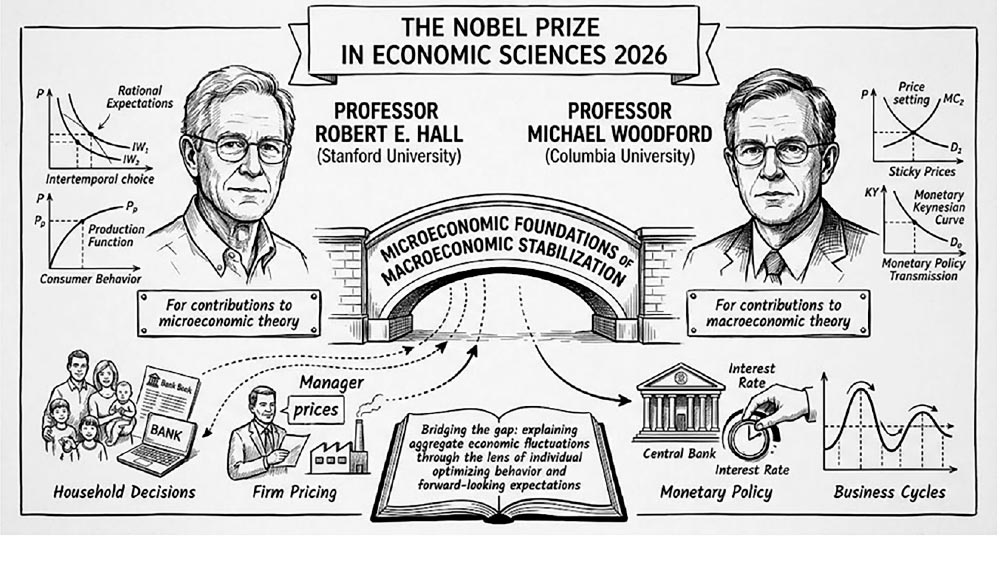
 The Nobel Prize for Economics 2026 awarded to Professor Robert E Hall of Stanford University and Professor Michael Woodford of Columbia University is in the area of microeconomic foundations of macroeconomic stabilisation. The focus here is on the contribution the laureates have made to the field of stabilisation as the well-known field of non-inflationary economic growth. The additional area of contribution in this early Keynesian paradigm, is the property of modelling stabilisation as a sustained attainment of non-inflationary economic growth. In order to build in the state of the economy with stabilization combined with sustainability as outstanding features, the much-needed socio-scientific causality of household consumption and savings decision-making and its aggregate effect in economy at large, became the subtle outlook for studying the social and market capitalist economy as an interactive social phenomenon beyond a sheer economic one. Thereby, it is examined by the laureate project the wide-spread effect that preferences at the microsocial level of households on consumption and savings have inter-causal relations on policy-making, institutions, and national economies, particularly of the Western capitalist genre.
A Brief Academic Reflection on the Socio-Economic Genre of the Laureate Paradigm
Such questions and their analytical studies were indeed, examined by Keynes in respect of his notion of the macroeconomic general equilibrium income multiplier by the impact of marginal propensity to consume. This indicator was a microeconomic element. Yet, this feature is not explained in macroeconomics. Consequently, macroeconomic monetary and fiscal policies remained aggregate conceptions. The result then was the unexplained query: weather complementarity or tradeoff should define such policies. Socio-economic institutions aspired by Keynesian school of macroeconomic reasoning; the neoclassical school of marginalism imported into macroeconomic theorising, as of Economics laureate Robert Lucas on importation of microeconomic preference aggregation into macroeconomics by his rational expectations theory, and the new classical economics that continued with Milton Friedman -- all of them, and many more prominent economists, contributed to the paradigm similar to that of the laureates 2026. The creative difference is this. The new paradigmatic explanation of economic phenomena was premised on a scientific principle of aggregating microeconomic level preferences in rational choices and decision-making embodied in what I now characterise as, ‘sustainable microeconomic foundation of macroeconomic stabilisation’.
The Missing Element of the Principle of Complementarity between Economic Policies
Yet, there is no conclusive inference in the new laureate paradigm on the choice between monetary and fiscal policies to maintain a sustainable socio-economic state of economic stabilisation. Like the great Schumpeterian Gap in economics, and the debate between mathematical philosophers, Alfred North Whitehead and Bertrand Russell, remains unresolved in the area of theorizing, popularizing, and applying a socio-scientific worldview premised on pervasive complementarity. Such a new paradigm would be a revolutionary feat of all of socio-scientific reasoning, formalism, and application.
Needed Complementarity between Monetary and Fiscal Policies: Laureate Academic Contribution
In the context of monetary and fiscal policies, the banking sector governance on money supply, principally by overall interest-rate fluctuation, remains in tradeoff with fiscal policy. Thereby, in terms of sectoral impact, the private sector and all that it embodies in productive activities, benefits from expansionary monetary policy (lowering interest rate). The fiscal policy of government spending, while it is thought of increasing employment and attaining full-employment real economic output, is found to be inflationary, and thereby harmful to the private sector activities.
Laureates 2026 have opposed the above-mentioned economic reasoning of tradeoff, by their policy-prescription on complementarity between monetary policy and fiscal policy. An example offered is of the impact of such complementary economic policies on the energy sector. If we account for the solely economic consequences of energy shortage on heightened inflation and deepening unemployment, economic recovery can be explained by the Krugman type self-governing preference-based microeconomic rational decision-making. However, the declining household and institutional spending results in lowering inflation. But unemployment rate is not mitigated. The old-adage of economic thought provided by Phillips Curve Hypothesis and price acceleration in economics that, inflation and unemployment remain in tradeoff, abides. Such a socio-economic consequence contradicts the principle of sustainability in the laureate formulation of economic relations, despite upholding the principle of complementarity (monetary policy, fiscal policy, microeconomic preferences).
Laureate Academic Contribution to Sectoral Complementarity for Socio-Economic Development
The way out of the marginalist/tradeoff socio-economic quagmire, is to use a fruitful knowledge-inducing mobilisation by the complementarities of the private sector (monetary policy) and government expenditure (fiscal policy). The result then would be a complementary interrelationship between productivity and diversification, Thereby, the knowledge-induced Paul Romer’s (economic laureate) prescription on knowledge-training induced endogenous socio-economic growth would actualise following a brief delay in training. Employment in a resulting diversified and productive and non-inflationary type socio-economic transformation will be sustained for economy-wide economic stabilisation. Stability is further enhanced by knowledge-acquisition by the resilient virility of creative expansion. The ideas propounded by the new economic laureates present the pathbreaking theory and application of the principle of inter-variate complementarity in a knowledge-induced endogenous social and economic order.
Despite the spark of formalism and application of the principle of pervasive complementarity in economic knowledge, the new laureate paradigm appertains to western capitalist economic future. The endogenous theme of knowledge-induction in socio-economic worldview with social, moral, ethical characterization of the future remains absent.
Nobel Prize Economics 2026 Relevance to Bangladesh Development
Any study on Bangladesh economy (unnayan) cannot be isolated (tradeoff) from its social and ethical component. As Joseph Schumpeter wrote in his epic book, Capitalism, Socialism, and Democracy, or as the ripe field of political economy, his theory of creative destruction, which I develop in many publications as a distinct socio-scientific theory of creative evolution, there is an overarching worldview to formalise and apply for Bangladesh. The new laureate paradigm applied to the formalism and policies of growth and wellbeing (unnayun and kallayan) must coexist as complementary goals in the midst of social and economic interrelations. This will involve the same form of creative dynamics between the private and public sectors, the rural and urban sectors, and all sectors driven by the common objective of interactive and integrative self-governance. Such kinds of unifying preferences will determine the microeconomic aggregation of the macroeconomic (economy-wide) outlook and policies. Bangladesh Bank monetary policy and government’s fiscal agenda will be used in coexisting directions to attain sustainable participatory democracy in and among all sectors and their agencies and agents. Microeconomic preferences of households, entrepreneurs, private sector and public sector, centred on productivity, diversification and knowledge-creating training, will sustain a monetary policy with microeconomic foundations. Bangladesh government ought to establish think tank to establish underlying socio-economic reforms. These are the lessons to be derived from the economic laureate 2026 paradigm.
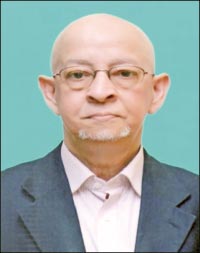
The writer is a retired Professor of Economics at Cape Breton University in Sydney, Nova Scotia, Canada

Loading...
Loading...
Also read



Editor : Iqbal Sobhan Chowdhury
Published by the Editor on behalf of the Observer Ltd. from Globe Printers, 24/A, New Eskaton Road, Ramna, Dhaka.
Editorial, News and Commercial Offices : Aziz Bhaban (2nd floor), 93, Motijheel C/A, Dhaka-1000.
Phone: PABX- 41053001-06; Advertisement: 41053012; 01793317829, 01550707291, E-mail: [email protected], [email protected] Online: email: [email protected] 41053014; 01550707297 Advertisement: 01550707296


