



| HEADLINE |

|

Hidden Costs of Building Materials
Published : Friday, 23 October, 2026 at 12:00 AM
Walid Khan


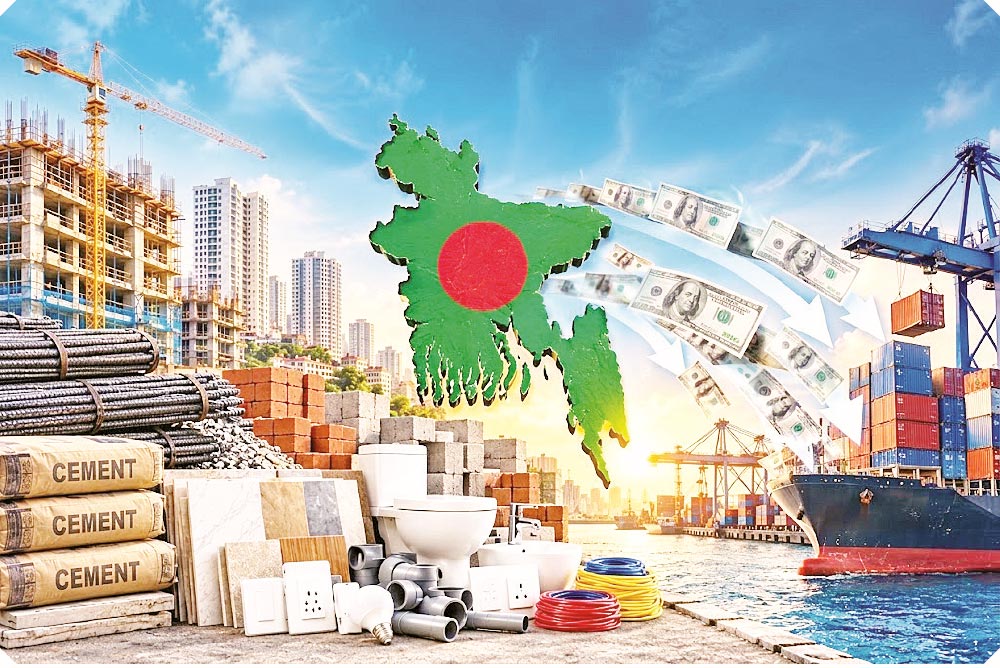 Bangladesh’s housing sector attracts around Tk 150,000 crore in investment every year, and the figure could exceed Tk 200,000 crore in the future. Yet the sector remains heavily dependent on foreign supplies for many construction materials and raw materials.
Although products such as steel rods, cement, tiles, glass and plastic fittings are manufactured locally, a significant share of the raw materials used to make them must be imported. As a result, rising global prices, higher transportation costs and changes in the US dollar exchange rate can directly affect construction costs.
A 2020 study by researchers at Khulna University of Engineering and Technology (KUET) estimated that around 75 to 85 per cent of construction materials and related products were produced locally. However, the study noted limitations in reliable annual production data. The estimate should not be treated as a verified figure for the current market.
Steel rods are among the most important materials used in building construction. Although Bangladesh has a large steel industry, manufacturers depend heavily on imported scrap metal to produce new steel.
According to a 2025 report by S&P Global Energy, Bangladesh imported 5.19 million tonnes of ferrous scrap in 2024, up from 4.68 million tonnes in 2023. As scrap is a major raw material for steel production, changes in its international price can affect the cost of producing rods used in buildings.
The cement industry also depends on imported raw materials. Although cement is manufactured locally, much of the clinker used in production comes from abroad. Other imported materials include gypsum, slag, limestone and fly ash.
An analysis by the Foreign Investors' Chamber of Commerce and Industry (FICCI) said more than 85 per cent of the raw materials used by Bangladesh's cement industry were imported. A report by *Prothom Alo* also said Bangladesh imported around 19.2 million tonnes of clinker in the last fiscal year covered by the report.
This dependence means that local cement production does not fully protect the housing sector from international price changes. Higher import and shipping costs can put pressure on manufacturers and may eventually affect construction expenses.
Bangladesh has also developed a strong domestic industry for tiles and sanitary ware. According to the Bangladesh Investment Development Authority (BIDA), local manufacturers met around 77 per cent of domestic tile demand and 89 per cent of sanitary ware demand in the 2017-18 fiscal year. These figures are historical and do not represent the current market share.
Glass production has also expanded. Local factories supply much of the glass used in buildings, helping reduce dependence on imported finished products. However, the available figures do not establish the current share of imported raw materials used by the glass industry.
The same issue applies to plastic fittings, electrical switches and sockets, and other household components. Many are manufactured in Bangladesh, but their production may depend on imported polypropylene (PP), polyethylene (PE) and polyvinyl chloride (PVC) resins.
BIDA data indicate that local production met around 48 to 50 per cent of domestic demand for electrical equipment such as switches, sockets and fans. This figure refers to finished products, not the raw materials used to manufacture them.
For sanitary ware, BIDA's 2017-18 figures showed an 89 per cent domestic production share. Yet local manufacturing does not necessarily mean that all the materials used in production are sourced within the country.
There is no comprehensive, up-to-date figure showing what percentage of the raw materials used for all these construction products comes from domestic sources and what percentage is imported. The share also varies by product and manufacturer.
For homebuyers and developers, the distinction is important. Even when a product is made locally, its production cost may rise if imported raw materials become more expensive. Changes in the exchange rate and transport costs can also affect the prices of construction materials.
Reducing housing costs therefore requires more than expanding local factories. Bangladesh also needs to strengthen domestic sources of raw materials, explore suitable alternatives and improve supply-chain efficiency.
Reliable, updated data on local production and raw-material imports would help policymakers and industry leaders identify where import dependence is greatest. Such information is essential for planning a more resilient construction sector and making housing costs easier to manage.

Loading...
Loading...
Also read



Editor : Iqbal Sobhan Chowdhury
Published by the Editor on behalf of the Observer Ltd. from Globe Printers, 24/A, New Eskaton Road, Ramna, Dhaka.
Editorial, News and Commercial Offices : Aziz Bhaban (2nd floor), 93, Motijheel C/A, Dhaka-1000.
Phone: PABX- 41053001-06; Advertisement: 41053012; 01793317829, 01550707291, E-mail: [email protected], [email protected] Online: email: [email protected] 41053014; 01550707297 Advertisement: 01550707296


