



| HEADLINE |

|

Hilsa output, size decline despite sanctuaries in place
Published : Sunday, 25 October, 2026 at 12:00 AM
Our Correspondent


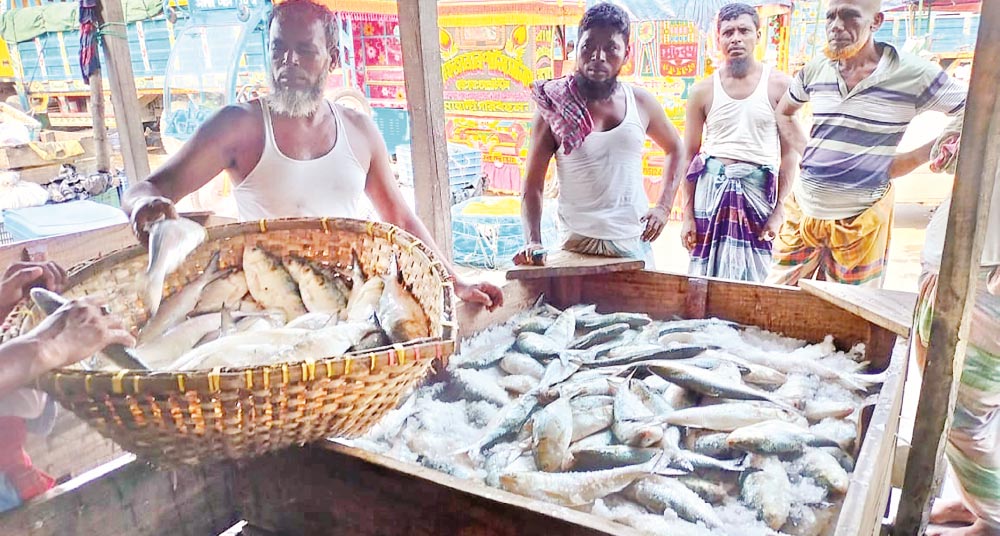 BARISHAL, Oct 24: ‘There is no hilsa in the river’ or ‘the fish are not growing to the expected size’ are common complaints among fishers.
The continued decline in hilsa production has raised questions about the effectiveness of sanctuaries and the role of environmental changes in the river ecosystem.
A 22-day ban on fishing to protect mother hilsa remains in force until October 29, but experts say fishing restrictions, raids and seized nets alone cannot measure the success of conservation efforts. Researchers must also examine water quality, food availability, jatka hilsa survival and the role of predatory fish.
Barishal Division has four designated hilsa sanctuaries in Barishal, Bhola and Patuakhali districts, covering about 312 kilometres of river stretches, according to the Department of Fisheries. Barguna, Pirojpur and Jhalakathi have no separate hilsa sanctuaries, although fishing restrictions and enforcement measures apply there.
Mir Mohammad Ali, an assistant professor in the Department of Aquaculture at Sher-e-Bangla Agricultural University, said sanctuary management must consider the entire river ecosystem. A former WorldFish researcher, he stressed the need to monitor plankton, water quality, jatka hilsa diets and predatory fish.
Mir Mohammad Ali further said, hilsa migrate between rivers, estuaries and the sea. Their breeding and growth depend on suitable water temperature, dissolved oxygen, salinity, currents and food availability. Plankton forms the base of the aquatic food chain, while larger fish may prey on jatka hilsa, he added.
Researchers at the Bangladesh Fisheries Research Institute studied water quality, plankton, hilsa and jatka hilsa abundance in the Shahbazpur Channel sanctuary in Bhola from July 2022 to June 2023. A review of the study by AFM Nazmus Saleheen, a fisheries researcher with field experience in Bhola, found that some water properties varied across locations. The researchers called for improved water quality and regular monitoring, noting a lack of in-depth biological and physical studies since the sanctuary was established.
A separate study published in the Bangladesh Journal of Fisheries Research in June 2026 examined the Tetulia River from July 2023 to June 2024, and identified 24 genera of phytoplankton belonging to seven groups. Phytoplankton abundance was higher downstream than upstream, said marine biologist Dr Kamrul Islam, who reviewed the paper. However, the lack of follow-up studies makes it difficult to determine long-term changes.
Research is also needed to establish how predatory fish affect jatka hilsa. A study published in Science Asia identified boal, pangas, air and other catfish, chital, shol and gojar as potential predators in the Padma-Meghna river system. But its findings were based on the experiences of 324 fishers, traders, processors and researchers, rather than examinations of fish stomach contents.
Experts say the role of other species, including poa and lalchewa, also needs scientific verification. Reducing predator numbers without understanding their ecological roles could disrupt the food chain.
Meanwhile, hilsa production in Barishal Division has fallen sharply. Department of Fisheries data show production declined from 372,343 tonnes in fiscal year 2022-23 to 348,834 tonnes in 2023-24 and 334,783 tonnes in 2024-25. In 2025-26, it dropped to 266,597 tonnes. The decline of 105,746 tonnes over three years represents about 28%. Production also fell by 68,186 tonnes in the latest fiscal year.
Dr Rajib Sarker, a professor at Patuakhali Science and Technology University’s Department of Fisheries Biology and Genetics, said researchers must assess juvenile hilsa density, breeding success, plankton diversity and water quality. Data should be collected consistently over several years, comparing sanctuaries with nearby areas where fishing is allowed. Pollution, currents, salinity and changes in river depth must also be considered, he said.

Loading...
Loading...
Also read



Editor : Iqbal Sobhan Chowdhury
Published by the Editor on behalf of the Observer Ltd. from Globe Printers, 24/A, New Eskaton Road, Ramna, Dhaka.
Editorial, News and Commercial Offices : Aziz Bhaban (2nd floor), 93, Motijheel C/A, Dhaka-1000.
Phone: PABX- 41053001-06; Advertisement: 41053012; 01793317829, 01550707291, 01550707296
E-mail: [email protected], [email protected]. [email protected], [email protected], [email protected], [email protected], Online-email: [email protected]


