



| HEADLINE |

|

Chief Whip stresses youth mental health for nation-building
Published : Sunday, 25 October, 2026 at 5:54 PM
Observer Online Report


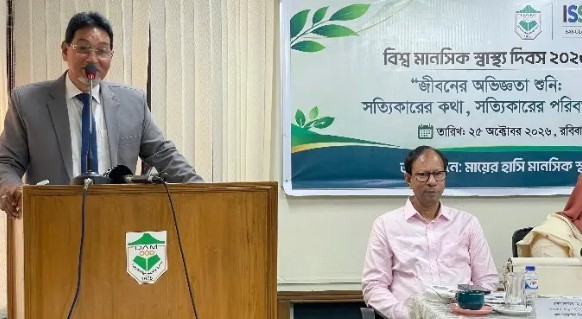
Chief Whip Nurul Islam Moni has stressed the need to ensure young people's mental well-being alongside their physical health to build a prosperous, developed and humane Bangladesh.
He said families, educational institutions and the state must work together to protect young people's mental health, raise awareness and help them cope with stress.
Ensuring their mental well-being would help harness their talent, creativity and energy to accelerate national development, he added.
He made the remarks as the chief guest at a seminar marking World Mental Health Day at the Dhaka Ahsania Mission auditorium in Dhanmondi, Dhaka, on Sunday.
The seminar was organised by the Mayer Hashi Mental Health Service Centre to raise awareness of mental health and draw policymakers' attention to the issue. This year's theme was ‘Mental health: Listen to lived experience, real stories, real change’.
Dr SM Ziauddin Haider, special assistant to the Prime Minister on health affairs with the rank of state minister, attended the event as a special guest.
He stressed the importance of mental well-being for everyone, noting that maternal anxiety and stress during pregnancy could affect the unborn child. He said greater attention to maternal mental health from pregnancy was essential to raising a healthy generation.
The seminar was chaired by Dhaka Ahsania Mission President Professor Golam Rahman and moderated by the organisation's senior psychologist, Rakhi Ganguly.
Among others, Professor Dr Saifun Nahar Sumi, head and director of the National Institute of Mental Health, and Professor Dr Abu Tayeb Abu Ahmed, vice-president of Dhaka Ahsania Mission, attended the event.
Speakers said every mental health statistic represented a person and a family often struggling silently and in isolation.
They noted that many people still view mental illness as a sign of weakness, personal failure or sin, or attribute it to supernatural causes such as spirits and witchcraft. Fear of social stigma often discourages people from seeking treatment, while some families conceal mental health problems, leaving affected individuals without proper care and support.
They also stressed the need to give people with lived experience of mental health conditions a meaningful role in healthcare services and policymaking. Maternal mental health issues, particularly antenatal and postnatal depression, often receive insufficient attention despite their significant impact on child development and family well-being.
Presenting the keynote paper, Iqbal Masud, director of the Health and Nutrition Sector at Dhaka Ahsania Mission, said nearly one in six adults in Bangladesh experienced some form of mental health condition, while around 92 per cent received no treatment.
He said mental healthcare in Bangladesh had traditionally centred on urban hospitals, with institutions such as the National Institute of Mental Health and Hospital in Dhaka and Pabna Mental Hospital playing major roles. However, community-based follow-up and day-care services remained inadequate.
Depression, anxiety and substance addiction, alongside suicide, further complicated the situation, he said.
Citing World Health Organization data, Masud said 4,714 people died by suicide in Bangladesh in 2021, an average of nearly 13 deaths a day. Young people and women were particularly affected, he added.
Suicide is preventable, he said, stressing the need to raise mental health awareness, ensure accessible and quality treatment, and build a supportive social environment.
sks

Loading...
Loading...
Also read








Editor : Iqbal Sobhan Chowdhury
Published by the Editor on behalf of the Observer Ltd. from Globe Printers, 24/A, New Eskaton Road, Ramna, Dhaka.
Editorial, News and Commercial Offices : Aziz Bhaban (2nd floor), 93, Motijheel C/A, Dhaka-1000.
Phone: PABX- 41053001-06; Advertisement: 41053012; 01793317829, 01550707291, E-mail: [email protected], [email protected] Online: email: [email protected] 41053014; 01550707297 Advertisement: 01550707296


