



| HEADLINE |

|

Sajek tourism under threat as blockade, unrest spark security concerns
Published : Tuesday, 27 October, 2026 at 12:00 AM
Mohosinul Karim


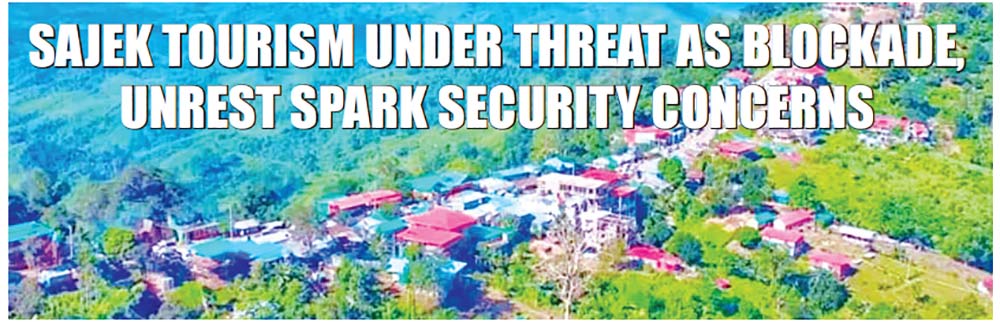 The unrest, fuelled by recurring blockades and escalating tensions between rival political organisations in the Chittagong Hill Tracts, has brought this tourism paradise to its knees. Transport is disrupted. Visitors are terrified. And the fear that grips this region is palpable.
Unless political disputes, territorial rivalries and the spectre of illegal firearms are confronted head-on, stakeholders warn, the situation could plunge deeper into chaos - taking with it the last remnants of a once-thriving industry.
On Sunday, the Sajek Gonoodhikar Rokkha Committee and Sajek Karbari Association continued their indefinite blockade of the Sajek tourist route in Baghaichhari upazila, their three-point demands still unmet, their resolve unshaken.
"We Are Bleeding"
For Mohammad Ibrahim, joint general secretary of the Sajek Hotel and Resort Owners Association, the pain is personal and profound. Around 110 hotels and resorts in Sajek once generated approximately Tk 1 crore in daily transactions during normal periods. Today, those numbers exist only in memory.
"Repeated unrest is causing us serious losses. Thousands of families could lose their livelihoods if the situation continues."
His voice trembles with the weight of responsibility - for his employees, for their children, for a community that built its life around welcoming strangers who now dare not come.

Swapan Chandra Debnath, former vice-president of the Khagrachhari Hotel Owners Association, speaks of more than 30 hotels supporting thousands of families in his district. His warning is chilling in its simplicity:
"If the situation does not improve, the tourism industry will be destroyed."
Three Thousand Stranded, Gunfire Erupts
The horror reached its peak when around 3,000 tourists found themselves trapped in Sajek during a blockade. What followed was the stuff of nightmares - protesters attacking security personnel, gunfire shattering the mountain air, security forces returning fire before escorting terrified visitors to safety in Khagrachhari.
For those who witnessed it, the memory is seared into their minds. For those who hear about it, the message is clear: Sajek is no longer safe.
The incident exposed the terrifying reality of armed confrontations in a major tourist destination - a place where visitors have limited options when roads are blocked and violence erupts.
A Battle for Territory, A Toll on Innocents
The crisis has intensified over the past month amid allegations of a struggle for territorial influence between the United People's Democratic Front (UPDF) and the Parbatya Chattagram Jana Samhati Samiti (JSS), led by Santu Larma.
Three rounds of blockades in two weeks. Vehicle movement suspended. Half-day blockades of roads and waterways. Clashes and exchanges of gunfire. An ultimatum demanding rivals leave Sajek. The hill region, once celebrated for its tranquillity, has become a battleground.
Police allege that UPDF leaders planned to hold tourists and local residents hostage - allegations that could not be independently verified, but which have deepened the climate of fear.
Khagrachhari Hill District Council Chairman Mracha Thowai Marma minced no words:
"A group is determined to create instability in the hill region. The government must remain vigilant."
Voices Crying for Peace
Amid the darkness, there are flickers of hope.
Abdul Wadud Bhuiyan, chairman of the Parliamentary Standing Committee on Chittagong Hill Tracts Affairs, stood before the local administration and leaders of the two organisations on Sunday. His message was one of unity:
"Peace, communal harmony and development require collective efforts beyond political affiliations."
A three-member team led by Baghaichhari UNO Amena Marjan met protesters on Monday to hear their demands, identify grievances and explore a solution. The government has formed three national committees to address illegal firearms recovery, prevent extortion and resolve fundamental problems.
But for tourism operators, dialogue alone is not enough. Restoring transport is not enough. Unless visitors feel safe throughout their journeys - unless every winding road is secure, every trail protected - confidence will not return.
Livelihoods on the Line
Behind the statistics lie human stories. The hotel cook who has fed thousands of guests now wonders how to feed his own children. The tour guide who once earned enough to send his daughter to school now watches her future slip away. The transport worker who knew every shortcut now sits idle, his engine cold, his savings dwindling.
Tourism supports hotel and resort employees, restaurant operators, transport workers, guides, traders and local suppliers. Prolonged disruption could affect the entire economy of Sajek and Khagrachhari.
Stakeholders have called for sustained dialogue, effective law enforcement, prevention of armed violence and action against illegal firearms - measures that would ensure political disputes do not repeatedly disrupt civilian life.
The Road Ahead
The immediate challenge for the authorities is stark: restore safe access to Sajek while preventing further escalation. Tourism operators say a lasting political settlement and reliable security arrangements are essential to rebuild visitor confidence, protect jobs and restore economic activity across the hill districts.
Until then, Sajek waits. Its beauty remains untouched - the clouds, the valleys, the mist that wraps the mountains in mystery. But its soul is wounded. Its people are hurting. And a paradise that once welcomed the world now wonders if the world will ever return.

Loading...
Loading...
Also read



Editor : Iqbal Sobhan Chowdhury
Published by the Editor on behalf of the Observer Ltd. from Globe Printers, 24/A, New Eskaton Road, Ramna, Dhaka.
Editorial, News and Commercial Offices : Aziz Bhaban (2nd floor), 93, Motijheel C/A, Dhaka-1000.
Phone: PABX- 41053001-06; Advertisement: 41053012; 01793317829, 01550707291, 01550707296
E-mail: [email protected], [email protected]. [email protected], [email protected], [email protected], [email protected], Online-email: [email protected]


