



| HEADLINE |

|

Historical Baldha Garden: A serene place in old Dhaka
Baldha Garden covers about 3.38 acres of land and is divided into two sections—Syki and Sibily. Government information lists around 672 species and approximately 18,000 plants. Mused by its camellia flowers, Rabindranath Tagore wrote a poem titled Camellia.
Published : Tuesday, 17 November, 2026 at 12:00 AM
Tanvir Raihan


 The streets of Wari are busy as ever. Cars move through traffic, horns echo between buildings, and the Mayor Hanif Flyover carries a steady stream of vehicles overhead. High-rises and concrete structures dominate the landscape. Then comes a gate.
A few steps inside, the noise begins to fade. Trees form a green canopy overhead, sunlight filters through the leaves, birds call from hidden branches and a quiet pond appears ahead.
For a moment, the city seems to disappear.
This is Baldha Garden, one of Old Dhaka’s historic green spaces, and a place long associated with a flower made famous by Rabindranath Tagore: the camellia.
The closing scene of Tagore’s celebrated poem Camellia remains familiar to Bengali readers. The flower intended for Komola ultimately finds its place behind the ear of a Santal girl. Against her dark cheek, the white flower becomes an image of natural beauty, quietly contrasting with social vanity and artificial sophistication.
Tagore visited Dhaka in 1926. According to information from the National Botanical Garden, the poet was drawn to the camellia at Baldha Garden while staying at Joy House. The poem Camellia was later published in his 1932 collection Punashcha. As 2026 marks a century since that visit, the question naturally returns: what happened to that camellia?
The original plant may no longer exist. A descendant may survive. Whatever its botanical fate, the memory of the flower remains part of Baldha Garden’s cultural identity.
Yet the garden’s history began long before Tagore arrived. In 1909, Narendra Narayan Roy Chowdhury, landlord of the Baldha Estate, established the garden in Wari. His ambition extended beyond creating a private ornamental garden. He sought to build a living collection of plants from different parts of the world.
According to the National Botanical Garden, he collected rare plants from nearly 50 countries.
Today, Baldha Garden covers about 3.38 acres and is divided into two sections-Syki and Sibily. Government information lists around 672 species and approximately 18,000 plants.
But its significance cannot be measured by numbers alone. The garden has remained largely unchanged in size while Dhaka has expanded around it. Buildings have risen, traffic has increased and some parts of the garden now face waterlogging during heavy rain. Noise from the surrounding city also reaches deeper into the grounds.
Still, the old trees remain.
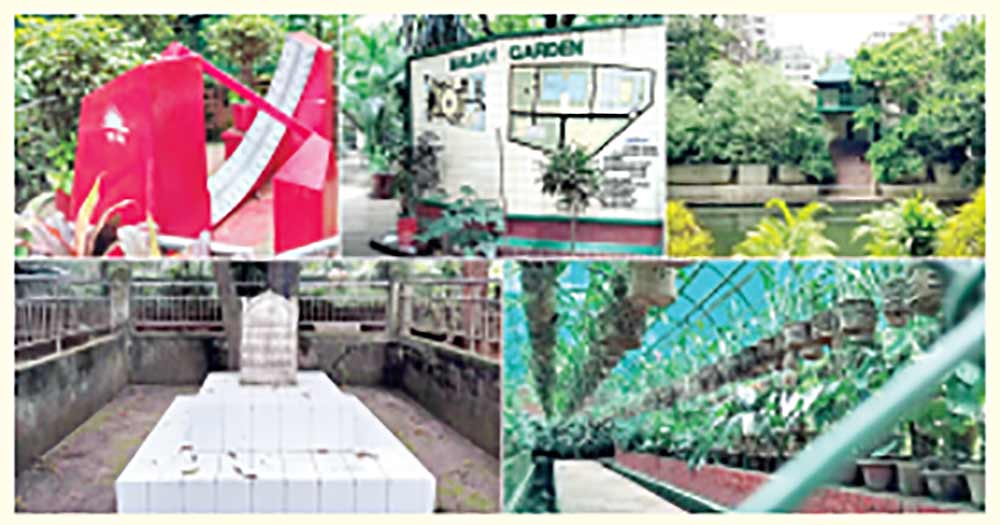
The Sibily section includes Shankhanad Pond, Joy House, the Fern House and an old sundial. Beside the pond, dense foliage can temporarily hide the surrounding buildings, creating the feeling of a quieter Dhaka within the modern city.
Gardener Hafizul Islam knows the plants almost as characters in an old story. He points out the pale trunk and layered bark of the cajuput tree and the deep yellow flowers of Konokshudha. For him, tending the garden also means preserving its stories.
Researcher Dr Mohammad Ali Khan has spent years studying Narendra Narayan Roy Chowdhury and his legacy. His research suggests that around 138 books written by Roy Chowdhury have been traced. He primarily wrote plays and also authored a novel titled Silopetra.
The founder’s grave and those of family members are located within the garden, near the historic sundial. Once used to indicate local time through the shadow of its iron gnomon, the sundial now stands as a reminder of another era.
Management of Baldha Garden was transferred to the Forest Department in 1962. It is currently operated as a satellite unit of the National Botanical Garden.
In 2025, the garden was declared a Kunjaban, recognising its importance for biodiversity conservation, cultural heritage, education and research. But recognition alone cannot ensure its survival.
Dr Mohammad Ali Khan has called for greater attention to waterlogging, water supply and the preservation of old trees. He has also suggested collecting seeds from existing plants and establishing another conservation garden elsewhere. As afternoon falls, sunlight settles softly on the leaves and the pond grows darker. Gradually, the sounds of Dhaka return.
Outside the gate, the city moves at its usual pace. Inside, a few acres of green continue to hold another time.
A century ago, Tagore came here and encountered a flower that later became part of Bengali literature. Long before him, Narendra Narayan Roy Chowdhury brought plants from distant lands and planted them in the heart of Old Dhaka.
Today, Baldha Garden stands between memory and modernity.
Its old trees, rare plants, pond and historic structures are more than elements of a garden. They are fragments of Dhaka’s living memory.
A century later, the original camellia may be impossible to find.
But as long as Baldha Garden survives, the story of that flower, and the world that once surrounded it, may survive too.

Loading...
Loading...
Also read



Editor : Iqbal Sobhan Chowdhury
Published by the Editor on behalf of the Observer Ltd. from Globe Printers, 24/A, New Eskaton Road, Ramna, Dhaka.
Editorial, News and Commercial Offices : Aziz Bhaban (2nd floor), 93, Motijheel C/A, Dhaka-1000.
Phone: PABX- 41053001-06; Advertisement: 41053012; 01793317829, 01550707291, 01550707296
E-mail: [email protected], [email protected]. [email protected], [email protected], [email protected], [email protected], Online-email: [email protected]


