



| HEADLINE |

|

What Bangladesh Can Learn from Green Housing Abroad
Published : Friday, 30 October, 2026 at 12:00 AM
Walid Khan


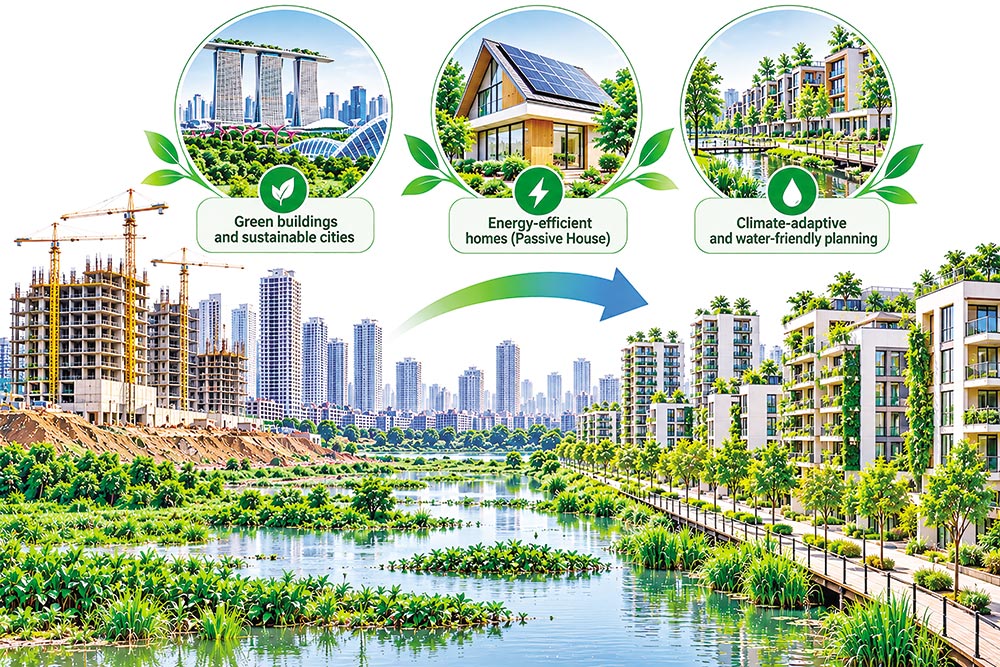
From Singapore's green building initiatives to Germany's energy-efficient homes and the Netherlands' climate-adaptive planning, international experience offers valuable lessons for Bangladesh as it seeks to balance housing demand with environmental protection.
The challenge is not to stop housing development, but to make it environmentally responsible, climate-resilient and affordable.
International experience offers useful lessons. Singapore has introduced its Green Mark certification scheme to assess the environmental performance of new and existing buildings. Its Green Building Masterplan aims to make 80 per cent of buildings, measured by gross floor area, green by 2030. The approach promotes energy efficiency, sustainable design and healthier indoor environments.
Germany provides another example through the Passive House standard, which originated there. It promotes strong insulation, airtight construction and efficient ventilation to reduce energy use while maintaining comfortable indoor conditions. These principles can be adapted to local climates, although Bangladesh would need designs suited to its heat, humidity and heavy rainfall.
The Netherlands offers lessons in climate-adaptive construction. Its planning guidance encourages governments, housing organisations and developers to consider waterlogging, extreme heat, drought, biodiversity and flood risks when designing buildings and neighbourhoods.
Bangladesh already has laws to regulate development and protect the environment. The Bangladesh Environment Conservation Act, 1995, the Environment Conservation Rules, 2023, the Bangladesh National Building Code, 2020, and the Real Estate Development and Management Act, 2010 provide important safeguards. The Natural Water Bodies, Open Space, Parks and Playgrounds (Preservation) Act, 2000 also protects designated water bodies and public spaces.
However, laws can achieve little without effective enforcement. The government and planning authorities, including RAJUK, must prevent unauthorised filling of wetlands, ensure compliance with approved land-use plans and monitor construction. Environmental assessments should properly examine effects on drainage, water resources and nearby communities. Violations must face lawful consequences, and approval information should be accessible to the public.
Housing companies also have a major responsibility. Developers should avoid ecologically sensitive land, preserve trees, provide adequate drainage and open spaces, reduce construction waste and adopt energy-efficient designs. They should also consider affordable housing rather than focusing exclusively on high-income buyers.
Buyers can influence the market through their choices. Before purchasing a flat, they should check planning approval, environmental compliance, building safety and the developer’s record. They can also consider natural ventilation, energy efficiency, water management and access to open spaces instead of judging a property only by its price, location or appearance.
Affordable housing is equally important. Urban development should not displace low-income residents without lawful procedures, fair compensation and appropriate resettlement. Improving services in underserved neighbourhoods can help make cities safer and more inclusive.
Bangladesh needs investment and new homes, but progress should not come at the cost of nature or public safety. By learning from international practices and strengthening the roles of government, developers and buyers, the country can build housing that protects the environment while meeting people’s needs. A successful housing project should create not only a building, but also a healthier and more sustainable place to live.

Loading...
Loading...
Also read



Editor : Iqbal Sobhan Chowdhury
Published by the Editor on behalf of the Observer Ltd. from Globe Printers, 24/A, New Eskaton Road, Ramna, Dhaka.
Editorial, News and Commercial Offices : Aziz Bhaban (2nd floor), 93, Motijheel C/A, Dhaka-1000.
Phone: PABX- 41053001-06; Advertisement: 41053012; 01793317829, 01550707291, 01550707296
E-mail: [email protected], [email protected]. [email protected], [email protected], [email protected], [email protected], Online-email: [email protected]


