



| HEADLINE |

|

Rising Steel Prices and Their Impact on Apartment Costs
Published : Friday, 27 November, 2026 at 12:00 AM
Staff Correspondent


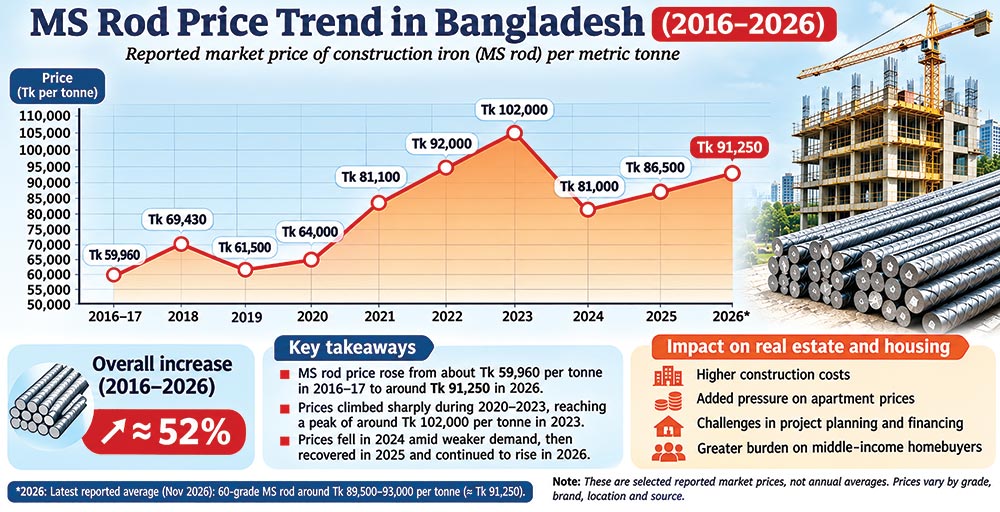 Rising steel prices are adding fresh pressure to Bangladesh's construction industry, increasing project costs and raising concerns about apartment affordability. As steel is a major material in residential construction, continued price increases could force developers to revise budgets and, in some cases, apartment prices.
Steel is widely used in building foundations, reinforced concrete columns, beams and slabs. The quantity required depends on a building's height, design, soil conditions and engineering specifications. Any significant increase in its price can therefore affect the overall construction budget.
For developers, the impact goes beyond higher material expenses. Rising steel costs can affect project planning, cash flow and completion schedules, particularly when prices increase after construction has started.
The impact varies from project to project. High-rise buildings may require different quantities and specifications of steel compared with smaller residential buildings. Construction methods, design and quality standards also influence material requirements.
Developers may respond to higher costs by revising apartment prices, reducing profit margins, renegotiating supply contracts or adjusting construction schedules. Projects already sold at fixed prices may face additional financial pressure because developers cannot always transfer the entire cost increase to existing buyers.
For prospective buyers, higher construction expenses could mean increased prices for newly launched apartments. However, steel is only one component of the total cost. Land prices, cement, labour, transportation, financing, utility connections and approval fees also influence apartment prices.
Several factors determine steel prices, including international prices of scrap metal, iron ore and other raw materials. Bangladesh's dependence on imported steelmaking inputs makes the domestic market vulnerable to global price fluctuations.
 The exchange rate is another important factor. A weaker taka can increase the cost of imported scrap and other raw materials. Energy, transportation and production expenses also influence the final price of steel products.
The rising cost of construction presents another challenge for middle-income families already struggling to afford apartments in major cities. Higher development expenses may make new housing projects more expensive and discourage some developers from launching projects when market conditions remain uncertain.
However, apartment prices do not necessarily rise immediately or by the same proportion as steel prices. Developers may absorb some additional costs, depending on market demand, profit margins and their financial position.
Better cost management, efficient material use, reduced construction waste and reliable supply chains can help developers control expenses without compromising building safety. Bulk purchasing and accurate structural design may also reduce unnecessary costs. For buyers, checking construction specifications, payment schedules and sale agreement terms is equally important.
Ultimately, keeping apartments affordable will require more than controlling steel prices. Stable raw material supplies, predictable market conditions and efficient construction practices will be essential for Bangladesh's real estate sector.
As of November 2026, the retail price of 60-grade MS rod in Dhaka was reported at around Tk 89,500-93,000 per tonne, with an average of approximately Tk 91,250. Prices vary by manufacturer, brand and dealer. Leading brands, including BSRM, AKS, GPH Ispat and KSRM, were selling their products at different rates within this range.

Loading...
Loading...
Also read






Editor : Iqbal Sobhan Chowdhury
Published by the Editor on behalf of the Observer Ltd. from Globe Printers, 24/A, New Eskaton Road, Ramna, Dhaka.
Editorial, News and Commercial Offices : Aziz Bhaban (2nd floor), 93, Motijheel C/A, Dhaka-1000.
Phone: PABX- 41053001-06; Advertisement: 41053012; 01793317829, 01550707291, 01550707296
E-mail: [email protected], [email protected]. [email protected], [email protected], [email protected], [email protected], Online-email: [email protected]


