



| HEADLINE |

|

Unsold Flats Put Dhaka Developers Under Financial Pressure
Published : Friday, 6 November, 2026 at 12:00 AM
Staff Correspondent


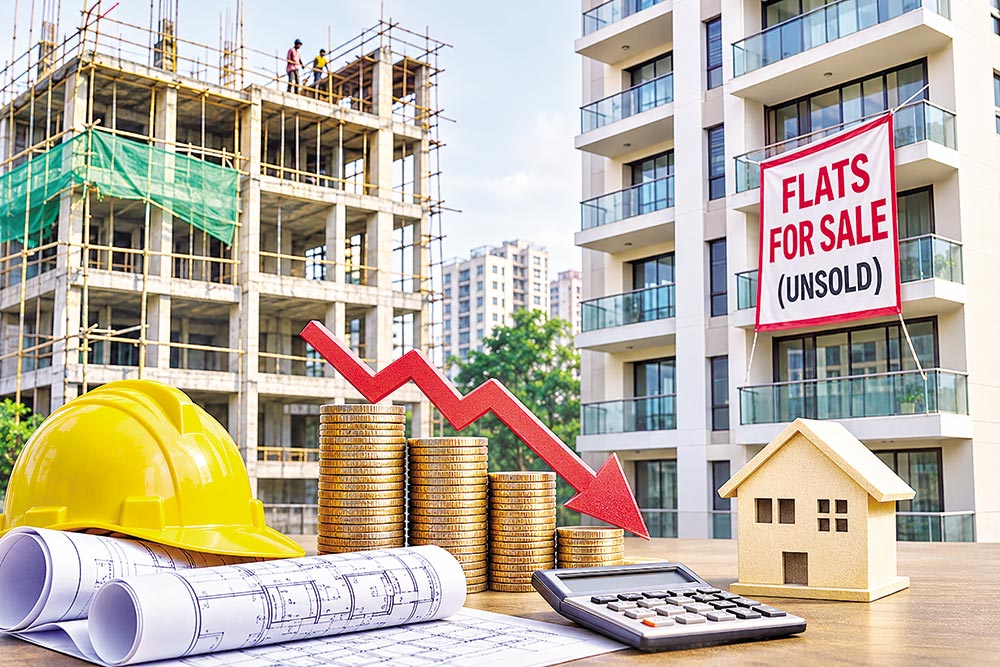 Falling registrations, rising construction costs and cancelled joint-venture deals are slowing new projects and putting pressure on the housing market.
The slowdown in Dhaka’s real estate market is creating financial pressure on developers, with unsold flats tying up investment and making it difficult to complete ongoing projects.
Many buyers are delaying purchases because of economic uncertainty. Even some customers who have already booked flats are struggling to pay their instalments. As a result, developers are finding it difficult to maintain construction work and invest in new projects.
Data from the Directorate of Registration show that 41,804 flat transfer deeds were registered across the country between January and June 2026. Of these, 29,913 were registered in Dhaka.
The number of registrations in the first half of 2026 was 19.61 percent lower than the average for the same period in 2025. It was also 42.73 percent lower than the figure for the corresponding period in 2023.
The fall in registrations has added to developers’ cash-flow problems. Money that would normally come from new sales is no longer entering their businesses at the expected rate.
Mezba Uddin Maruf, director of Green Hat Real Estate, said his company had around 200 unsold flats across more than 30 ongoing projects in Dhaka.
He said economic and political uncertainty had made people reluctant to buy flats unless they had an urgent need.
Developers are also facing higher construction costs.
Rising prices of steel rods, cement and other materials have increased project expenses, while weak sales have reduced their ability to absorb the additional costs.
According to a report by The Business Standard, cement prices ranged from Tk 540 to Tk 580 per bag in July 2026. Steel rods were selling at Tk 85,000 to Tk 100,000 per tonne.
High bank interest rates are adding to the pressure on both developers and buyers.
Anup Kumar Sarkar, senior executive director of Concord Group, said high interest rates had made it difficult for middle-income people to buy flats.
He said buyers usually financed around 70 percent of a flat's price through bank loans. With interest rates rising to 14 - 16 percent, monthly instalments had increased significantly, reducing buyers' purchasing capacity.
The slowdown has also affected the launch of new projects. According to a REHAB official, around 450 joint-venture agreements between landowners and developers in Dhaka were cancelled in the first six months of 2026. About 1,000 such agreements had been cancelled in 2025.
The cancellations indicate that many landowners and developers are becoming cautious about starting new projects amid uncertainty over sales and construction costs.
A prolonged slowdown could affect businesses beyond the real estate sector. Steel, cement, tiles, bricks and sand suppliers, as well as transport workers and construction labourers, depend on regular building activities.
For developers, an unsold flat means more than a unit waiting for a buyer. It represents money locked in property, continuing maintenance and financing costs, and reduced capacity to repay loans or start new projects.

Loading...
Loading...
Also read



Editor : Iqbal Sobhan Chowdhury
Published by the Editor on behalf of the Observer Ltd. from Globe Printers, 24/A, New Eskaton Road, Ramna, Dhaka.
Editorial, News and Commercial Offices : Aziz Bhaban (2nd floor), 93, Motijheel C/A, Dhaka-1000.
Phone: PABX- 41053001-06; Advertisement: 41053012; 01793317829, 01550707291, 01550707296
E-mail: [email protected], [email protected]. [email protected], [email protected], [email protected], [email protected], Online-email: [email protected]


