



| HEADLINE |

|

Gen Z’s War Against Gangster Capitalism
Is the concentration of corporate wealth destroying the economic future of a generation?
Published : Saturday, 7 November, 2026 at 12:00 AM
FARUK AHMED


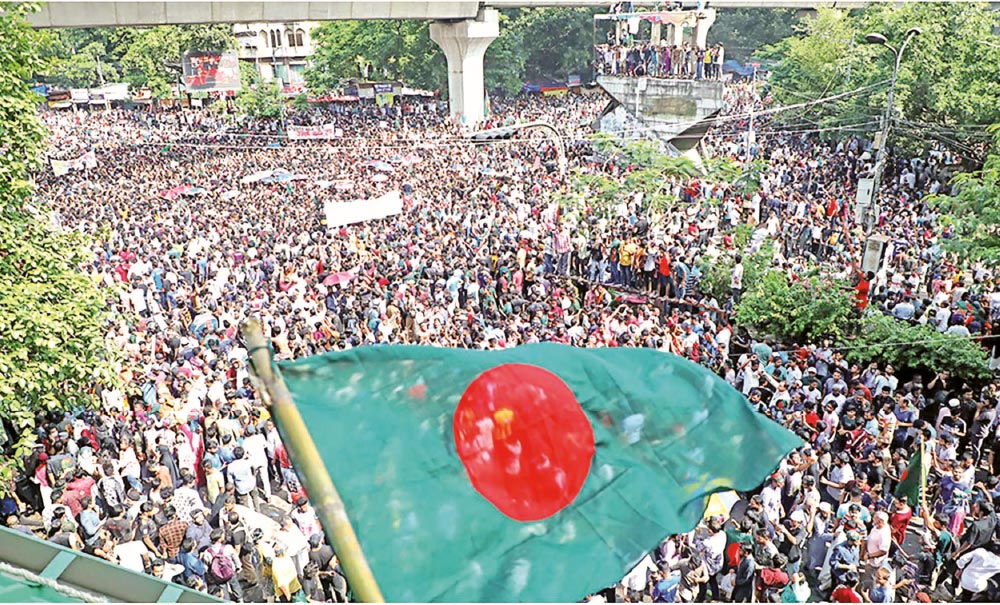
From Dhaka to Delhi and across Europe, Gen Z is demanding more than political change. It wants a fair chance to work, earn, own a home and build a future. Governments and businesses that dismiss this demand as youthful anger risk misunderstanding the scale of the economic crisis beneath it.For Bangladesh, the stakes are particularly high.
A generation is fighting for its future-and putting the economic system on trial.
The streets are sending a warning that governments and corporate boardrooms can no longer afford to ignore. From Dhaka to Delhi, Paris to Berlin, Gen Z is challenging a system in which wealth is multiplying at the top while economic security is slipping beyond the reach of millions.
Jobs are uncertain, housing is unaffordable, education offers no guarantee of employment, and the promise of a better life is losing credibility. This is no longer simply a revolt against political leaders. It is a rebellion against an economic order that many young people believe has rigged the future against them.
The July 2024 uprising in Bangladesh, India’s Cockroach Janta Party campaign and recent youth demonstrations across Europe are not evidence of one centrally organised international movement. Their immediate triggers and political contexts differ.
At the centre of this discontent is a disturbing question: has the growing power of corporate and financial interests weakened the promise that hard work, education and enterprise can deliver a better life?
Scholar Henry A. Giroux uses the term “Gangster Capitalism” to describe a form of economic and political power in which concentrated wealth, corporate influence and institutional corruption undermine democratic accountability and social responsibility.
 The concept is a critical framework, not a claim that all private businesses operate this way. Its relevance lies in the growing concern that when economic power becomes excessively concentrated and politically influential, the costs are transferred to workers, consumers and younger generations.
This is where the generational revolt acquires its economic significance. Young people are not simply protesting against governments. They are questioning an economic structure in which corporate profits and asset values can rise while wages, job security and access to housing fail to keep pace.
Across Europe, the pressure is visible in the cost of living. Eurostat figures cited in the source material show that 24.2 per cent of people aged 15-29 in the European Union were at risk of poverty or social exclusion in 2025.
Eurofound data show that house prices rose by 55.4 per cent between 2010 and 2025, while rents increased by 26.7 per cent. Food and non-alcoholic beverage prices also climbed sharply during the period covered by the source material.
For many young Europeans, education no longer guarantees economic independence. Secure employment is harder to obtain, housing is increasingly beyond reach, and the prospect of building a stable life is receding. The anger is therefore not merely about inflation or unemployment in isolation. It is about the widening gap between economic growth and the ability of ordinary people to benefit from it.
 The mobilisation of Germany’s Gen Z Regelt campaign on October 31, 2026, illustrated the scale of this frustration, with organisers estimating participation at around 120,000. In France, demonstrations initially linked to school conditions and teacher shortages broadened into wider expressions of discontent. The immediate demands differ, but the deeper anxiety concerns a future in which young people feel economically marginalised.
India presents another dimension of the same crisis. The Cockroach Janta Party campaign, associated with Abhijeet Dipke, has drawn attention to examination irregularities, alleged paper leaks, recruitment transparency and the scarcity of jobs. These grievances expose a serious weakness in the education-to-employment pipeline: millions invest years in education, yet cannot be confident that qualifications will lead to fair recruitment or decent work.
The problem is not confined to the failure of individual governments. It also reflects an economic model in which access to opportunity can be shaped by privilege, connections and institutional weaknesses. When recruitment becomes opaque and competition unfair, public confidence erodes. When young people see wealth accumulating at the top while their own prospects stagnate, frustration becomes political.
Bangladesh faces an especially consequential version of this challenge. The July 2024 uprising carried demands for dignity, justice, accountability and opportunity. But political change alone cannot deliver the economic transformation that a young population expects. The test for the government led by Prime Minister Tarique Rahman is whether it can translate those expectations into productive employment, fair competition, quality education and a credible investment environment.
The warning is stark. Source material citing a United Nations human rights investigation reports that nearly 40 per cent of Bangladeshi young people aged 15-24 were not in education, employment or training, with the proportion around 60 per cent among young women and girls.
Such exclusion represents a vast loss of productive potential. A country cannot secure a demographic dividend when a substantial share of its young population remains outside education and the labour market.
Bangladesh needs investment, industrial expansion and private-sector job creation. But investment cannot flourish sustainably where market concentration, political patronage, weak governance and unfair competition undermine confidence. Nor can the country build a competitive economy if entrepreneurs without political connections struggle to access finance, public contracts or market opportunities.
This is where the danger of gangster capitalism becomes particularly relevant. If corporate influence and political connections determine who gets access to economic opportunity, markets cease to function as engines of innovation and productivity. They become instruments of privilege. Smaller businesses are crowded out, new entrepreneurs lose incentives, and productive investment gives way to rent-seeking.
The consequences extend far beyond inequality. Weak competition can discourage innovation and raise costs for consumers. Poor corporate governance can undermine confidence among investors and lenders. An economy that fails to create enough decent jobs risks losing skilled young people to migration, weakening its future tax base and domestic consumption. Persistent exclusion can also deepen political instability, making long-term investment decisions more uncertain.
Bangladesh must therefore avoid confusing the interests of powerful businesses with the interests of the private sector as a whole. Competitive businesses, responsible investors and entrepreneurs are indispensable to economic growth. The problem is not private enterprise; it is unaccountable economic power that captures institutions, distorts competition and shifts the burden of failure onto society.
The remedy requires more than promises of growth. It demands transparent public recruitment, effective competition policy, stronger corporate governance, accountable financial institutions, fair access to credit and investment in skills that match the needs of industry. Young people must have a genuine route from education to employment, while women must be able to participate fully in the economy. Public policy must reward productivity and innovation rather than political proximity.
The global protests also carry a warning for corporations. Profitability cannot be separated indefinitely from social legitimacy. Businesses depend on consumers with purchasing power, skilled workers, stable institutions and predictable markets. An economic system that weakens these foundations may deliver short-term gains but risks undermining the conditions for long-term growth.
The central challenge is not to dismantle capitalism or discourage investment. It is to ensure that markets remain competitive, wealth creation is accompanied by wider opportunity, and economic power is subject to public accountability. Without that balance, the promise of growth will increasingly sound hollow to those excluded from its benefits.
From Dhaka to Delhi and across Europe, Gen Z is demanding more than political change. It wants a fair chance to work, earn, own a home and build a future. Governments and businesses that dismiss this demand as youthful anger risk misunderstanding the scale of the economic crisis beneath it.
For Bangladesh, the stakes are particularly high. Its young population can become the driving force of industrial transformation-or a generation trapped between limited jobs, unequal opportunity and broken expectations.
If economic power remains concentrated while opportunity remains scarce, the country may squander its demographic dividend and turn its greatest potential asset into its most serious economic liability.

Loading...
Loading...
Also read








Editor : Iqbal Sobhan Chowdhury
Published by the Editor on behalf of the Observer Ltd. from Globe Printers, 24/A, New Eskaton Road, Ramna, Dhaka.
Editorial, News and Commercial Offices : Aziz Bhaban (2nd floor), 93, Motijheel C/A, Dhaka-1000.
Phone: PABX- 41053001-06; Advertisement: 41053012; 01793317829, 01550707291, 01550707296
E-mail: [email protected], [email protected]. [email protected], [email protected], [email protected], [email protected], Online-email: [email protected]


