



| HEADLINE |

|

$646 Foreign Debt on Every Bangladeshi as External Borrowings Hit $113b
Published : Monday, 9 November, 2026 at 12:00 AM
Business Correspondent


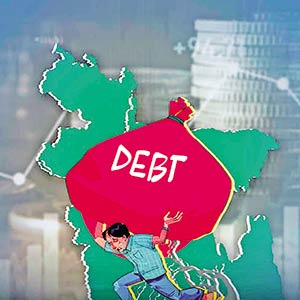 Every Bangladeshi citizen is now carrying an average external debt burden of around $646, as the country's foreign borrowings have nearly tripled to $113 billion in a decade, exposing the economy to mounting repayment risks.
With debt servicing accelerating, export earnings overwhelmingly dependent on garments and new loans carrying increasingly costly terms, Bangladesh faces the danger of a deepening foreign debt trap unless it urgently strengthens its repayment capacity.**
The country's outstanding external debt comprises $89.51 billion in public and publicly guaranteed debt, $9.87 billion in private non-guaranteed debt and $14.06 billion in short-term debt, according to the World Bank's International Debt Report 2026.
Bangladesh now ranks third among South Asian countries in external debt, behind India and Pakistan. Although some debt indicators remain more favourable than those of several regional economies, economists warn that continued borrowing, less favourable loan terms and a lack of export diversification could place the country under severe pressure to meet its external obligations in the coming years.
Only the Maldives recorded faster external debt growth than Bangladesh in South Asia over the past decade.
India's external debt reached $764 billion, up 59 per cent over the decade, while Pakistan's nearly doubled to $135 billion. Sri Lanka's debt rose 31 per cent to $57 billion, Nepal's surged 186.5 per cent to $11 billion, Bhutan's increased 57 per cent to $3.3 billion and the Maldives' more than quadrupled to $4.7 billion.
The growing debt stock is becoming increasingly significant when measured against the country's capacity to earn foreign currency.
The World Bank data show that Bangladesh spent 16 per cent of its export earnings on external debt principal and interest payments in 2025, down 3.1 percentage points from the previous year.
Despite the improvement, the ratio remains above India's level and the South Asian average of 10 per cent. Sri Lanka and Bhutan spent 26 per cent and 19 per cent of their export earnings, respectively, on debt servicing.
External debt servicing costs account for 2 per cent of Bangladesh's gross national income (GNI), while its debt stock stands at 24 per cent of GNI, slightly above the regional average of 21 per cent.
More alarming is the debt-to-export ratio, which has reached 210 per cent. This means Bangladesh's outstanding external debt is equivalent to more than twice its annual export earnings.
The corresponding ratios are 83 per cent in India, 324 per cent in Pakistan, 301 per cent in Bhutan and 272 per cent in Sri Lanka, against a South Asian average of 95 per cent.
He said export earnings were a crucial measure of repayment capacity, arguing that the debt-to-GDP ratio alone could not adequately capture a country's ability to meet its external obligations.
Bangladesh's heavy dependence on a single export category makes the situation more vulnerable, he added.
Mustafizur Rahman, distinguished fellow at the Centre for Policy Dialogue (CPD), said debt servicing costs relative to net export earnings were among the most important indicators of a country's repayment capacity.

Loading...
Loading...
Also read



Editor : Iqbal Sobhan Chowdhury
Published by the Editor on behalf of the Observer Ltd. from Globe Printers, 24/A, New Eskaton Road, Ramna, Dhaka.
Editorial, News and Commercial Offices : Aziz Bhaban (2nd floor), 93, Motijheel C/A, Dhaka-1000.
Phone: PABX- 41053001-06; Advertisement: 41053012; 01793317829, 01550707291, 01550707296
E-mail: [email protected], [email protected]. [email protected], [email protected], [email protected], [email protected], Online-email: [email protected]


