



| HEADLINE |

|

Eisenkot signals willingness to include Netanyahu in coalition talks
Published : Monday, 9 November, 2026 at 8:28 AM
Observer Online Report


Collected Photo
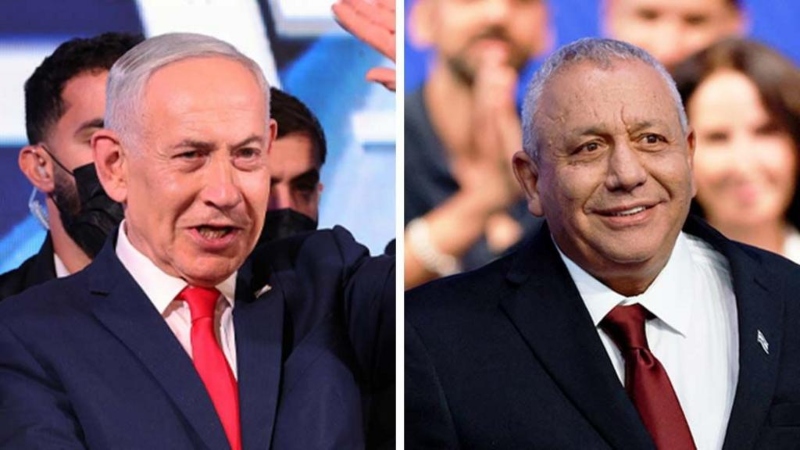
Opposition leader Gadi Eisenkot, who was tasked with forming Israel's next government, indicated he has no objection to including controversial Prime Minister Benjamin Netanyahu in a potential coalition administration.
Speaking at a ceremony at the President's Office in Jerusalem on Sunday (November 8) after receiving the mandate from President Isaac Herzog, Eisenkot suggested that members of Netanyahu's Likud party as well as far-right Finance Minister Bezalel Smotrich could be invited to join the government.
Eisenkot stated, "If members of Likud and the Religious Zionist Party truly believe that this is a time for unity, I see no logical reason why they would not support a government under my leadership."
Eisenkot, who ran as Netanyahu's chief opponent, now has six weeks to assemble a coalition. During his address, he pledged to act in the public interest and represent all segments of Israeli society.
Meanwhile, President Isaac Herzog warned of heightened political uncertainty following the 3 November US mid-term elections, which saw victories for several political figures critical of Israel and US military assistance. Highlighting a "new political reality" in the United States, Herzog emphasized that Israel urgently requires a stable government.
Eisenkot served as Chief of General Staff of the Israel Defense Forces from 2015 to 2019 and held an observer role in Netanyahu's war cabinet during the first eight months of the Gaza military campaign.
Despite his past role, Arab-led political parties representing Palestinian citizens of Israel supported Eisenkot's bid in an effort to oust Netanyahu.
In the 27 October elections, Eisenkot's four-party alliance secured 48 seats, while Netanyahu's right-wing bloc won 53 seats, leaving both sides short of the 61-seat majority required in the Knesset. Arab-led parties secured a record 19 seats.
While Eisenkot has ruled out forming a direct coalition with the Arab-led parties—which could have reached a 67-seat block—he could potentially reach the 61-seat threshold by securing the support of ultra-Orthodox religious parties, United Torah Judaism and Shas.
Alternatively, he could seek to pass a confidence vote with a minority of fewer than 61 seats.
-SA

Loading...
Loading...
Also read







Editor : Iqbal Sobhan Chowdhury
Published by the Editor on behalf of the Observer Ltd. from Globe Printers, 24/A, New Eskaton Road, Ramna, Dhaka.
Editorial, News and Commercial Offices : Aziz Bhaban (2nd floor), 93, Motijheel C/A, Dhaka-1000.
Phone: PABX- 41053001-06; Advertisement: 41053012; 01793317829, 01550707291, 01550707296
E-mail: [email protected], [email protected]. [email protected], [email protected], [email protected], [email protected], Online-email: [email protected]


