



| HEADLINE |

|

Capitalism: Selling dreams, buying human lives
Published : Tuesday, 24 November, 2026 at 4:21 PM
Aamir Al Hamza


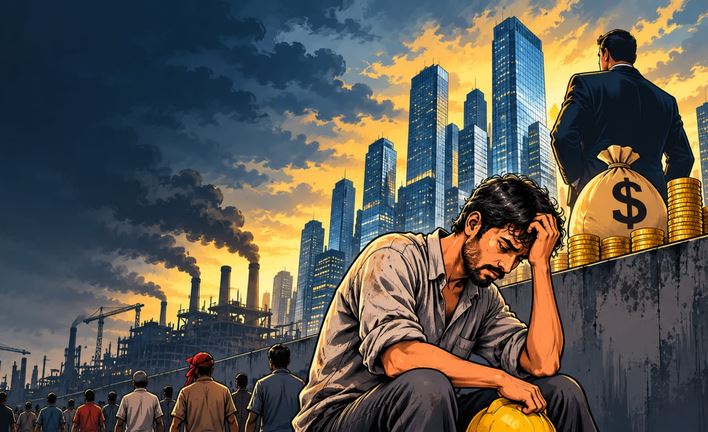
If capitalism creates prosperity, why are millions of people working harder than ever but struggling to afford a decent life? If workers produce the wealth, why do so few own so much of it? And if economic freedom is the promise of capitalism, why are ordinary people increasingly trapped by debt, rising living costs and insecure employment?
These questions expose one of the greatest contradictions of the modern economic system. Capitalism has transformed the world, driven technological innovation, expanded international trade and created enormous wealth. Yet, behind its success lies another reality: workers who struggle to survive on their wages, families forced to borrow for basic necessities and a growing concentration of wealth among those who already possess economic power. Has capitalism become a system in which human beings exist primarily to generate profit, rather than profit existing to improve human lives?
The rise of capitalism: How did it become the world's dominant system?
Capitalism is an economic system built around private ownership, investment, market competition, wage labour and profit. Under this system, individuals and businesses own productive resources, decide what to produce and compete to sell goods and services. Prices are largely influenced by supply and demand.
Although its roots can be traced to European commercial expansion and the growth of trade during the 16th and 17th centuries, modern industrial capitalism emerged during the Industrial Revolution in the late 18th century. Factories, machinery and mass production gradually transformed traditional economies into industrial societies.
Scottish economist Adam Smith laid important intellectual foundations for modern market economics in his 1776 book The Wealth of Nations. He argued that competition and individuals pursuing their economic interests could contribute to wider prosperity. His ideas helped establish the case for markets and economic freedom.
Capitalism subsequently expanded through industrialisation, colonial trade, international investment and technological development. After the Second World War, market economies became increasingly influential, while the collapse of the Soviet Union in 1991 further strengthened the global dominance of market-oriented economic systems.
But does the success of an economic system automatically prove that it is fair? And should an economic model be judged only by how much wealth it produces, or also by how that wealth is distributed?
Capitalism versus Socialism: Who should own the wealth?
The fundamental difference between capitalism and socialism concerns ownership, control and the distribution of economic resources.
Capitalism gives priority to private ownership and market competition. Socialism, in its broad theoretical sense, emphasises social or collective ownership of important productive resources, democratic economic participation and a fairer distribution of wealth.
Karl Marx and Friedrich Engels argued that private ownership of the means of production allows a capitalist class to accumulate wealth through the labour of others. Their criticism was not simply that some people become rich, but that the economic relationship between owners and workers creates structural inequality.
However, socialism is not a single economic model. Democratic socialism, social democracy and state-directed economic planning differ considerably. Nordic countries such as Sweden, Denmark and Norway demonstrate how competitive markets can coexist with strong welfare systems, collective bargaining, public healthcare and accessible education. These countries are not fully socialist economies, but their social policies reflect several principles associated with social democracy.
Economist Amartya Sen, in Development as Freedom, argued that development should be understood through people's actual freedoms and capabilities, not merely through income or economic growth.
Is an economy truly successful if a child cannot access quality education because of family income? What does economic freedom mean to someone who cannot afford medical treatment? Should healthcare and education depend entirely on purchasing power?
Socialism's emphasis on human welfare and social responsibility offers an important challenge to these questions, although historical experiences also demonstrate that excessive centralisation, weak accountability and restrictions on individual freedom can undermine economic performance. The real issue is how to combine economic efficiency with social justice.
The exploitation of labour: Who actually creates the wealth?
If a factory stops operating, production stops. If workers stop working, the economy cannot function. Yet why does ownership of productive assets often determine who receives the largest share of economic rewards?
Marx's theory of surplus value raises precisely this question. A worker sells labour in exchange for wages, but the value generated through production can exceed the compensation received. Business owners retain the remaining surplus after costs. Profit is not automatically evidence of exploitation, but the unequal bargaining power between workers and employers can allow the gains of production to flow disproportionately towards capital owners.
The problem takes several forms. Workers may face wages that fail to keep pace with inflation, excessive working hours, unpaid overtime, unsafe workplaces and insecure employment. Employers can also transfer business risks to workers through temporary contracts, outsourcing and the use of subcontractors.
The situation is changing, but not necessarily improving. Digital platforms have created new employment opportunities, yet many delivery riders and gig workers face unpredictable earnings, algorithmic supervision and limited access to insurance, paid leave and pensions.
Women face additional disadvantages through wage discrimination, occupational segregation and unpaid domestic and care work. Their contribution to society often remains economically undervalued.
The International Labour Organization (ILO) and OECD reported in April 2025 that the global labour income share declined by 1.6 percentage points between 2004 and 2024. The report estimated that workers would have received an additional US$2.4 trillion in purchasing-power-adjusted income in 2024 if their share had remained at its 2004 level. Automation, globalisation and weakening collective bargaining power were among the factors identified.
If productivity increases but workers do not receive a fair share of the gains, who is really benefiting from technological and economic progress?
A world of extraordinary wealth and persistent inequality
The concentration of wealth makes the contradiction even more visible.
According to the World Inequality Report 2026, the richest 10 per cent of the global population own 75 per cent of global wealth, while the poorest 50 per cent own just 2 per cent. The richest 10 per cent also receive 53 per cent of global income, compared with only 8 per cent for the bottom half.
Oxfam's January 2026 report, Resisting the Rule of the Rich, found that global billionaire wealth reached a record US$18.3 trillion in 2025. The organisation also reported that one in four people worldwide faced hunger.
These figures raise questions beyond the simple difference between rich and poor. How much economic influence should extreme wealth provide? Can markets remain genuinely competitive when a handful of powerful corporations dominate industries? Can political equality survive when financial power becomes sufficiently concentrated to influence public policy?
Nobel laureate Joseph Stiglitz, in his 2025 book The Origins of Inequality, argues that inequality is shaped by policy decisions, corporate rules, market power, financialisation and globalisation. He particularly examines how monopoly power allows businesses to extract economic rents at the expense of wider society.
Thomas Piketty similarly warns that the accumulation of capital can reinforce inequality across generations. If wealth grows faster than the wider economy, why should people who depend entirely on wages have an equal opportunity to build financial security?
Is capitalism losing its appeal?
Capitalism is not necessarily approaching its end, but its legitimacy faces serious questions. The cost of housing, healthcare and education, insecure employment, growing inequality and the disruptive effects of artificial intelligence are challenging the promise that economic growth will automatically improve everyone's lives.
The ILO has warned that technological progress can increase productivity without ensuring that workers share equally in its benefits. It has also highlighted the potential for AI to deepen existing labour-market inequalities without appropriate policies.
Stiglitz's argument is particularly relevant here: inequality is not an unavoidable outcome of every market economy. Different policies and institutional arrangements can produce different results.
Therefore, the question is not simply whether capitalism will disappear. Could it lose public confidence if it continues to reward ownership more generously than labour? Could future generations demand stronger public services, greater worker participation and more democratic control over economic decisions?
A system does not need to collapse to lose public support. Sometimes, the more important warning is that people gradually stop believing in the promises it makes.
Bangladesh: The people behind the profits
Bangladesh illustrates why this debate matters beyond economic theory.
The garment industry has helped transform the country's export economy and created employment for millions of people, particularly women. But should the success of the industry be measured only by export earnings and business growth?
On November 19, 2026, the ILO addressed the minimum wage review and labour unrest in Bangladesh's ready-made garment sector. It stressed that wage decisions should consider workers' and their families' needs, living costs, inflation, productivity and the sustainability of businesses. It also emphasised freedom of association and collective bargaining. International Labour Organization
When workers who contribute to international supply chains struggle to afford food, housing, healthcare and education, does the economic success of those supply chains tell the complete story?
The same questions apply to other sectors. Can a country achieve inclusive development when informal workers lack social protection, young people struggle to find secure employment and middle-income families face increasing pressure from essential expenses?
Bangladesh needs investment, private enterprise and economic growth. But it also needs stronger labour protections, fair wages, accessible public services and institutions that ensure workers have a meaningful voice in decisions affecting their lives.
The economy must serve humanity
The future of economic systems should not be determined by the interests of capital owners alone. Adam Smith's market philosophy, Marx's criticism of exploitation, Keynes's argument for public intervention, Piketty's analysis of wealth concentration and Amartya Sen's emphasis on human capabilities all offer different ways to examine the relationship between markets and society.
Their disagreements are important, but one question remains common to the debate: what should economic progress ultimately achieve?
Socialism's emphasis on collective welfare, social protection and the fair distribution of economic opportunities deserves serious consideration. Likewise, capitalism must demonstrate that private enterprise and market competition can coexist with human dignity and economic justice.
Ultimately, workers are not machines, consumers are not merely sources of revenue, and human lives are not financial assets. The person working in a factory, the farmer cultivating food, the rider delivering orders and the employee spending long hours in an office are not secondary participants in the economy. They are the people who make the economy possible.
If an economic system can create billionaires but cannot guarantee workers a dignified life, should we call it progress? If people spend their best years producing wealth but remain unable to secure their own future, who is the economy really working for?
Perhaps the greatest failure of modern capitalism is not that it creates wealth, but that it allows society to forget who creates it. An economy should not measure the value of human beings by how much profit they generate. It should be measured by whether they can live with dignity, security, freedom and hope.
After all, capital can generate profit, but it is human labour that builds the world.

Loading...
Loading...
Also read








Editor : Iqbal Sobhan Chowdhury
Published by the Editor on behalf of the Observer Ltd. from Globe Printers, 24/A, New Eskaton Road, Ramna, Dhaka.
Editorial, News and Commercial Offices : Aziz Bhaban (2nd floor), 93, Motijheel C/A, Dhaka-1000.
Phone: PABX- 41053001-06; Advertisement: 41053012; 01793317829, 01550707291, 01550707296
E-mail: [email protected], [email protected]. [email protected], [email protected], [email protected], [email protected], Online-email: [email protected]


