



| HEADLINE |

|
History remembers: Justice Syed Mahbub Murshed


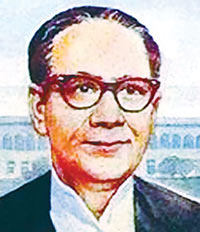 Presently, there is no mention of Justice Syed Mahbub Murshed in school or college textbooks-not in Bangladesh, nor elsewhere. His life and work remain largely absent from formal academic discourse. And yet, was he not one of the most significant figures in the political, legal, and cultural history of twentieth-century Bengal? History may have sidelined him in curricula, but his contributions continue to resonate through the foundations of our democracy, judiciary, and national conscience.
Justice Murshed stood beside famine-stricken people during the devastating Bengal famine of 1943. During the communal riots of 1946, he actively participated in humanitarian and social welfare initiatives with Anjuman Mufidul Islam. At a time of fear and hatred, he visited Hindu temples to reassure minority communities and worked relentlessly to protect communal harmony. He was deeply involved in the anti-colonial struggle against British rule and later played a vital role in shaping political safeguards for minorities in the subcontinent.
In 1949, he played a crucial role in the historic Nehru-Liaquat Pact, which sought to ensure the safety and rights of minorities and refugees in East Pakistan and West Bengal. During the 1960s, while serving briefly as an ad hoc judge of the Supreme Court, he simultaneously chaired the Red Cross, leading relief operations for victims of floods and cyclones-demonstrating a rare blend of judicial authority and humanitarian leadership.
Justice Murshed was also an active participant in the 1952 Language Movement. On February 21, defying Section 144, he joined his uncle, the undisputed leader of undivided Bengal, Sher-e-Bangla A.K. Fazlul Huq, in leading processions demanding linguistic rights. Both were briefly detained after attending the janaza of the Language Movement martyrs. In the 1954 elections, he played a leading role in drafting the historic 21-point programme of the United Front alongside Abul Mansur Ahmed.
In 1956, Justice Murshed assisted Huseyn Shaheed Suhrawardy in drafting Pakistan's first democratic constitution, which introduced parliamentary democracy. In 1961, he boldly opposed the Pakistani military regime by chairing the centennial celebrations of Rabindranath Tagore in East Pakistan-an act that symbolized resistance against cultural repression and affirmed Bengali cultural freedom.
Appointed Chief Justice of the East Pakistan High Court in early 1964, Justice Murshed upheld judicial independence with uncompromising integrity. In 1966, he contributed to the final draft of Sheikh Mujibur Rahman's historic Six-Point Movement. At the height of Ayub Khan's authoritarian rule in late 1967, he resigned from the post of Chief Justice to join the democratic movement-an extraordinary act of moral courage rarely witnessed in judicial history.
During the mass uprising of 1968-69, he actively supported the people's movement and organized legal defense for those accused in the Agartala Conspiracy Case. It was largely due to his relentless legal and moral pressure that all accused were unconditionally released. At the 1969 Round Table Conference, representing the dignity of the Bengali nation, he forcefully demanded the principle of "one person, one vote." This demand secured 169 out of 300 seats in the Pakistan National Assembly for East Pakistan, paving the way for majority rule and ultimately the Liberation War.
In the 1970 elections, Justice Murshed's moral authority and influence significantly contributed to the defeat of the Pakistani Punjabi ruling elite. During the 1971 Liberation War, he openly refused to cooperate with the illegitimate military regime. His solidarity lay firmly with the freedom struggle. In March 1971, his mobilization of the High Court Bar Association reached such intensity that no judge was willing-out of conviction and fear-to administer the oath of office to General Tikka Khan as Governor of East Pakistan.
Even after independence, Justice Murshed remained steadfast in his commitment to democracy, human rights, and the rule of law. Both before and after the Liberation War, he consistently advocated for the separation of the judiciary from the executive. He criticized state actions that harmed public interest while openly praising constructive initiatives. Notably, it was he who advised President Ziaur Rahman to pursue regional cooperation, an idea that later materialized as SAARC.
Justice Syed Mahbub Murshed was born on January 11, 1911, in Murshidabad-once the seat of Bengal's last independent Nawab, Siraj-ud-Daulah-into a distinguished family. A brilliant student, he secured first position in every academic stage. He topped the matriculation examination from Bogra Zilla School in 1926 and excelled at Presidency College, Calcutta, earning a BA (Honours) in Economics in 1930, an MA in 1932, and an LLB in 1933. In 1939, he completed his Bar-at-Law from Lincoln's Inn, ranking first with distinction among candidates from British India.
A true polymath, Justice Murshed possessed deep knowledge of history, philosophy, economics, law, theology, and literature. Fluent in Bengali, English, Arabic, Persian, Hindi, and Urdu, he was widely read in global literary traditions. He edited the Presidency College Magazine, led the Calcutta University debating team, and played an active role in sports, helping organize the Mohammedan Sporting Club in the 1930s.
As a writer, he gained international recognition for his essays on law, politics, and culture. His writings in The Guardian on Palestine and Middle Eastern affairs earned widespread acclaim, while his critical essays on Muhammad Ali Jinnah in The Statesman brought him early prominence. His speeches and writings were marked by intellectual depth, refined humor, moral clarity, and unwavering humanism.
Joining the High Court in 1955, Justice Murshed revolutionized judicial practice by introducing writ petitions to curb executive overreach and protect fundamental rights. He issued suo motu orders to protect minority communities and uphold justice during communal unrest. His judgments reflected empathy for the marginalized, clarity of thought, and fearless integrity. Former UN Secretary-General Kurt Waldheim once described him as one of the finest judges in the world.
A lifelong democrat, Justice Murshed believed deeply in freedom of thought, speech, and the press. Distressed by the post-independence decline in educational standards, he urged students and academics to lead reform. Ill health overtook him in the late 1970s, and he passed away on April 3, 1979-living and dying as the worthy heir of Sher-e-Bangla A.K. Fazlul Huq.
As a patriotic Bengali, he opposed the partition of Bengal, believing that despite political divisions, Bengalis remained united by language, culture, and shared dreams. In his final words, he said, "Even after my death, my spirit will linger around the precincts of the bar." Today, as we struggle for justice, democracy, freedom of the press, and the values of the Liberation War, we continue to search for him-in courtrooms, on the streets, and within our collective conscience.
Where can we find him now? And will Bengal ever witness another Justice Syed Mahbub Murshed?
The writer is a contributor
Loading...
Loading...
Also read



Editor : Iqbal Sobhan Chowdhury
Published by the Editor on behalf of the Observer Ltd. from Globe Printers, 24/A, New Eskaton Road, Ramna, Dhaka.
Editorial, News and Commercial Offices : Aziz Bhaban (2nd floor), 93, Motijheel C/A, Dhaka-1000.
Phone: PABX- 41053001-06; Advertisement: 41053012; 01793317829, 01550707291, E-mail: [email protected], [email protected] Online: email: [email protected] 41053014; 01550707297 Advertisement: 01550707296
Published by the Editor on behalf of the Observer Ltd. from Globe Printers, 24/A, New Eskaton Road, Ramna, Dhaka.
Editorial, News and Commercial Offices : Aziz Bhaban (2nd floor), 93, Motijheel C/A, Dhaka-1000.
Phone: PABX- 41053001-06; Advertisement: 41053012; 01793317829, 01550707291, E-mail: [email protected], [email protected] Online: email: [email protected] 41053014; 01550707297 Advertisement: 01550707296


