



| HEADLINE |

|
Floods taking heavy toll on our economy
Published : Monday, 13 July, 2026 at 12:00 AM
Dr Matiur Rahman


 The images have become painfully familiar: families stranded on rooftops, villages submerged, roads washed away, rescue boats navigating flooded streets, and shelters filling with the displaced. The floods of July 2026 have once again torn through Sylhet, Sunamganj, Habiganj and Moulvibazar in the northeast, while heavy rain and landslides have battered Chattogram, Bandarban and Cox's Bazar. Beyond the humanitarian emergency, however, lies a quieter and more lasting crisis, one that rarely makes it into official damage tallies but shapes the country's development path for years afterwards.
This year's flooding shows how much more complicated these disasters have become. Bangladesh is no longer contending only with seasonal river flooding. Flash floods driven by upstream water, intense local downpours, urban waterlogging and landslides are now arriving together, often in the same week, reflecting a climate in which extreme weather is growing more frequent and severe. Nature alone is not responsible for this. Decades of unplanned urban growth, encroachment on rivers and canals, destruction of wetlands, indiscriminate hill-cutting and poor drainage have all deepened the country's exposure, often because infrastructure has been built without regard for how water naturally moves across the land.
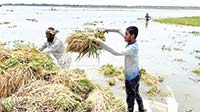
The economic damage begins with agriculture but does not end there. Crop losses are usually measured only by the market value of the harvest destroyed, a framing that overlooks everything a farmer spends before that harvest ever arrives: seed, fertiliser, irrigation, pesticide, labour and machinery, all of it sunk into the soil before the water ever rises. Much of that spending is financed through loans from banks, microfinance institutions or local lenders, and when the crop is lost, repayment becomes impossible. A natural disaster becomes a financial one almost overnight, trapping rural households in debt and narrowing their ability to invest in the next season. Fisheries suffer a parallel fate, as floodwaters wash fish from ponds and commercial farms and disrupt hatchery cycles that take months to rebuild, squeezing both farming incomes and food supply nationwide.
What makes the damage spread so widely is how tightly Bangladesh's economy has become woven together. Agriculture in the haor basins, tourism in Cox's Bazar, commerce in Chattogram, and manufacturing in the urban centres are all connected through the same national supply chains, so a disruption in one place quickly travels to the rest. Transport is the clearest illustration of this. Bangladesh depends overwhelmingly on roads to move goods domestically, and when highways flood, or bridges become impassable, produce fails to reach wholesale markets, industrial inputs are delayed, and transport costs climb. The resulting shortages feed food inflation in cities that may be nowhere near the flooding itself.
The shock has been especially severe in the southeast, where landslides and damaged roads have cut off hill districts from agriculture and trade, while weeks of heavy rain have hit tourism in Cox's Bazar, one of the country's most important service industries. Cancelled bookings and disrupted transport have left hotels, restaurants and thousands of informal workers struggling to earn a living. Around the Rohingya camps, the same rainfall raises the risk of landslides, disease and sanitation failures, adding further financial strain on the government and its development partners.
These recurring disasters point to a structural weakness in Bangladesh's growth story. The country has made genuine economic progress over recent decades, but its resilience has not kept pace with that growth, and each flood forces farmers, small business owners and low-income families to rebuild almost from nothing. One of the clearest gaps is the near-total absence of disaster insurance. In many countries, agricultural and business insurance spreads such losses across financial institutions and insurance markets; in Bangladesh, the loss falls almost entirely on the individual, and a single flood can erase years of savings and push a family into lasting poverty. Bangladesh deserves credit for reducing flood-related deaths through early warning systems and community preparedness, but its economic response remains reactive, treating floods mainly as humanitarian emergencies rather than as recurring economic risks demanding long-term reform.
That mindset needs to change, and prevention deserves the same priority currently given to recovery. Since most of Bangladesh's major rivers originate beyond its borders, meaningful flood mitigation depends on stronger regional cooperation and the timely sharing of hydrological data, making transboundary water management a matter of economic security rather than diplomacy alone. Infrastructure planning must also become climate-sensitive, designed to work with natural drainage rather than block it, since filled canals, encroached wetlands and undersized culverts have too often turned development projects into the very obstructions that worsen flooding.
Agriculture needs stronger financial protection too, through state-supported crop insurance and weather-indexed schemes of the kind already used in India, Kenya and the Philippines, adapted to Bangladesh's own conditions. A dedicated recovery fund for small and medium enterprises, offering concessional loans and temporary tax relief after a flood, would let local businesses resume operations quickly and protect the jobs depending on them. Climate adaptation should be understood as productive investment rather than a burden, since money spent on resilient infrastructure, drainage and wetland restoration consistently prevents far larger losses down the line. Future infrastructure and urban development should also face mandatory climate-risk assessment before approval, so today's projects do not become tomorrow's disaster.
Bangladesh's rivers and floods are not a temporary problem to be engineered away; they are part of its geography and history. Countries such as the Netherlands have shown that giving rivers room, restoring wetlands and respecting floodplains often protects better than embankments alone, and Bangladesh would do well to treat its own rivers, haors and wetlands as valuable infrastructure rather than obstacles.
The July floods will eventually recede, the roads will reopen, and public attention will move on, as it always does. But without real reform, the same cycle will repeat next year and the year after. The task ahead is not simply responding to floods once they strike, but building an economy resilient enough to withstand them, one whose future will depend far less on how much relief it distributes after disaster than on how wisely it invests before the next flood arrives.
The writer is a researcher and development professional
Loading...
Loading...
Also read



Editor : Iqbal Sobhan Chowdhury
Published by the Editor on behalf of the Observer Ltd. from Globe Printers, 24/A, New Eskaton Road, Ramna, Dhaka.
Editorial, News and Commercial Offices : Aziz Bhaban (2nd floor), 93, Motijheel C/A, Dhaka-1000.
Phone: PABX- 41053001-06; Advertisement: 41053012; 01793317829, 01550707291, E-mail: [email protected], [email protected] Online: email: [email protected] 41053014; 01550707297 Advertisement: 01550707296
Published by the Editor on behalf of the Observer Ltd. from Globe Printers, 24/A, New Eskaton Road, Ramna, Dhaka.
Editorial, News and Commercial Offices : Aziz Bhaban (2nd floor), 93, Motijheel C/A, Dhaka-1000.
Phone: PABX- 41053001-06; Advertisement: 41053012; 01793317829, 01550707291, E-mail: [email protected], [email protected] Online: email: [email protected] 41053014; 01550707297 Advertisement: 01550707296


