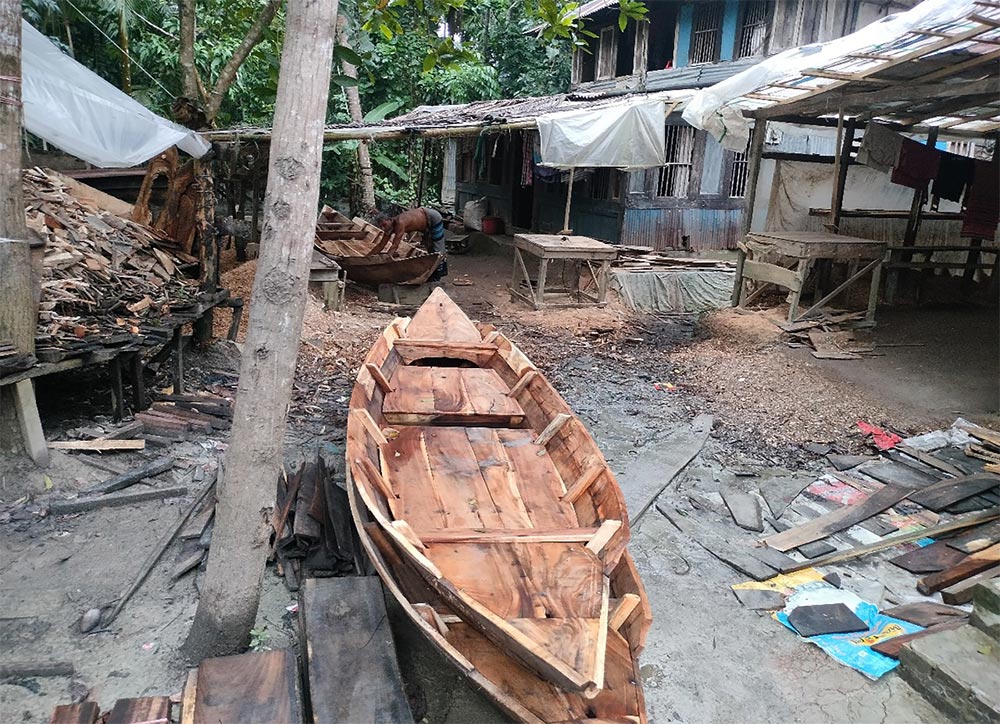
NESARABAD, PIROJPUR, Jan 11: In Dubi Village of Baldia Union Parishad in Nesarabad Upazila, every house resembles a boat factory.
The village contains about 500 houses, with only 10 per cent of households involved in other work. Boat building continues day and night in front of each home, and even inside.
School and college students work shoulder to shoulder with their parents here. More than 500 boats are made in this village alone every day. There is huge demand for these domestically crafted wooden boats across the southern region.
Boat builder Md. Masum, 43, said people from Nesarabad, Nazirpur, and Kaukhali upazilas of Pirojpur District; Banaripara and Ujirpur upazilas of Barisal District; and Jhalokati District's Sadar and Nalchiti upazilas, plus various upazilas in Gopalganj, all use boats made here.
Masum has been involved in boat building for 30 years. Just as he built boats with his father's help when young, his son, now in Class II, also assists him.
Abdul Barek of Dubi Village's Chowkidar Bari said, his family works with four men. While waterways have always been the key transport route, boat building in home courtyards here began with his grandfather's help.
The 65-year-old Barek added that due to limited space, they build boats on verandas or in house gardens. His son, daughter-in-law, and wife all help daily. He said this village's boat building started with his grandfather, Arshad Ali.
Back then, building a boat with Sundarban's shala, shegun, and sundari wood took two weeks. The whole family worked together. His father, Atahar Ali, was a boat craftsman. Five brothers have been involved since their father's time, and four brothers' families remain in the profession.
Now the tools and wood have changed, but the manual labour remains. Two people can build a boat in a day.
Artisan Kabir Hossain from Dubi Village said, these boats are used in floating vegetable seedling production. Moreover, during the rainy season, movement is nearly impossible without a boat in the vast wetlands of Barisal, Ujirpur, Banaripara, Nesarabad, Nazirpur, Kaukhali, and surrounding areas.
Therefore, when the season arrives, demand increases so much that order lists grow long. He mentioned the 31st floating market in Nesarabad Upazila, noting all floating markets depend on boats.
Guava farmers in Nesarabad, Banaripara, and Jhalokati particularly use these boats to collect guava from orchards. They also use them to market other agricultural produce. Consequently, boat demand is now at its peak. Traders come to Dubi Village to collect boats for market.
Several masons from the village said, three to five workers operate regularly in each yard. Boat bodies are made from raintree, chambal, and karai wood. Two people need a day to build an 18-foot small boat. A medium-sized boat takes two days.
Some build boats from designs, but craftsmen typically work on contract. A boat can take about a week to complete. Craftsmen handle collecting wood pellets from the market, cutting them at their sawmills, and transporting them to the yard.
Prices vary by wood. A small boat sells for Tk 2,800. A medium boat sells for Tk 3,500 to Tk 4,000. Boats are bought at this price and taken to boat markets at Atghar-Kuriana Miarhat in Nesarabad and Baithaghata in Nazirpur.
There, small boats sell for Tk 3,500 and medium boats for Tk 4,500. During the rainy season, prices sometimes rise with demand. However, working indoors in the rain means boat building takes slightly longer.
Each boat yields an average profit of Tk 500 after expenses.
Hundreds of Dubi Village families have been involved in boat building for generations. Some supply wood, some make equipment, and some manage transport. During the rainy season, this small village's economy sees transactions worth several crore taka.
Yet, this small industry faces problems. Without government registration, the yards miss out on facilities. These craftsmen are also deprived of government financial assistance.
Mason Masum said he earns an average of Tk 20,000 monthly from Boishakh to Kartik. He took a loan of Tk 40,000 from a private development organisation. Repaying it in 46 instalments of Tk 1,100 each with interest has caused a financial crisis.
He hears of government easy-term loans, but his visit to the Bangladesh Small and Cottage Industries Corporation (BSCIC) revealed the opposite. A government official's recommendation as guarantor is required, which he could not obtain, so he did not get the loan.
HM Faizur Rahman, Acting Deputy Manager of the Pirojpur BSCIC office, said a microfinance project operates, but boat builders have not come to avail this assistance. He stated a government employee must be a guarantor for the loan, which most craftsmen cannot provide.
Consequently, they are deprived of loans from Tk 1 lakh to Tk 5 lakh at 6 per cent interest. The BSCIC official noted it is impossible to state exactly how many Dubi village families are directly involved, but various sources suggest over 2,000 people from at least 500 families are engaged.
UNO Amit Datta said Dubi Village's traditional boat-building is an important local cottage industry. The government is committed to preserving such heritage-based livelihoods through SME Foundation support, skill development programmes, and inclusion under rural employment and cottage industry policies.





