



| HEADLINE |

|

Digital campaigns, theme songs take centre stage



 Bangladesh is preparing for its 13th National Parliament election and national referendum on February 12, entering one of the most tightly regulated and digitally driven electoral cycles in its history. With posters banned, motorcades restricted, and social media campaigns dominating, political parties are relying on rhythm, symbolism, and technology to reach voters.
Campaigning officially began on January 22 and will conclude on February 10, with 127.6 million registered voters. Political parties have fielded candidates at an unprecedented scale, including BNP 288, Jamaat-e-Islami 224, Islami Andolan Bangladesh 253, GM Quader-led Jatiya Party 192, NCP 32, CPB 65, Bangladesh Khelafat Majlish 34, Nagorik Oikya 12, LDP 7, AB Party 3, and JSD RAB 1. Across constituencies, candidates are holding yard meetings, symbolic processions, and public interactions-all conducted without posters, banners, or large motorcades.
The government, citing environmental protection and electoral code compliance, banned all posters, drones, lighting displays, motorcades, and helicopters except for party presidents and general secretaries. Loudspeakers and microphones cannot operate after 8 pm, and processions using buses, trucks, or motorcycles are prohibited. Candidates are now relying on door-to-door canvassing, small processions, slogan chanting, and party songs to maintain visibility.
With traditional visual campaigning curtailed, parties are focusing on theme songs and symbolic representation. BNP's campaign centers on Dhaner Shish (paddy sheaves), with the anthem "Amar age amra, amader age desh, khomotar age jonota, sobar age Bangladesh" emphasizing people over power. Jamaat foregrounds Daripalla (scales) with "Nouka, Dhaner Shish, Langol dekha shesh, Daripalla ebar gorbe Bangladesh." NCP promotes Shapla Kali (water lily bud) with "Voter michhile amar protik Shapla Kali." Islami Andolan's theme, "Ebar jekhane-sekhane vote debo na bhai," and BSAD's "Coolir, Mazurer, Chashir, Gariber-Insafer Fakirer, Sab Manushurer" are also gaining traction online. Even the Election Commission has introduced a civic awareness theme song explaining how to vote "Yes" or "No" in the referendum.
Social media has become the primary battlefield. Candidates compete through reels, memes, live interviews, policy explainers, satire, and short videos targeting Gen-Z voters. Many candidates are crowdfunding on Facebook, and BNP has appointed constituency-based social media managers to coordinate messaging while highlighting local issues. Meta Ad Library data shows candidates and supporters spent over $52,000 (approximately Tk 6.4 million) on Facebook ads between December 25 and January 23.
BNP has introduced interactive tools such as the "Match My Policy" app, with over three lakh users sharing policy preferences, as well as "Letter to Tarique Rahman" and QR-based feedback systems. The party promises include a "Family Card" for monthly Tk 2,000-2,500 or essential goods for five million families, and a "Farmer Card" for fair fertilizer prices, incentives, insurance, and easy credit. The BNP-led alliance positions itself as an alternative to Awami League rule, alleging genocide, enforced disappearances, and systemic corruption, while highlighting its governance record from 1991-96 and 2001-06.
Jamaat's campaign, titled "Janataar Ishtehar," increasingly promotes anti-India narratives, amplifying discussions around Sheikh Hasina's post-August 2024 stay in India. Analysts note that pro-Jamaat content focuses less on policy and more on portraying BNP as "no different" from Awami League.
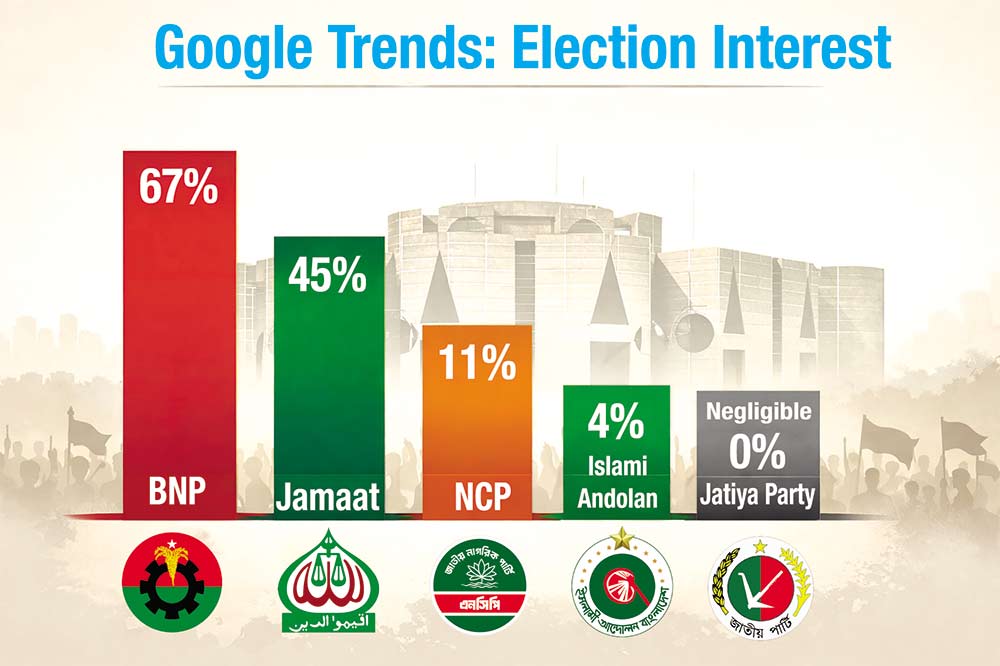
Google Trends shows BNP leads with 67 per cent average interest, followed by Jamaat-e-Islami at 45 per cent, NCP at 11 per cent, and Islami Andolan Bangladesh at 4 per cent, with Jatiya Party barely registering. Ground campaigns are dominated by BNP and Jamaat, with leaders Tarique Rahman and Dr Shafiqur Rahman touring multiple districts, while GM Quader's Jatiya Party struggles with organizational constraints, security concerns, and largely digital campaigns.
With posters gone and traditional motorcades restricted, Bangladesh's election has entered a new era where music, symbolism, policy apps, and social media define voter engagement. February 12 will test whether these digital-first strategies can match the reach and influence of traditional street politics.

Loading...
Loading...
Also read



Editor : Iqbal Sobhan Chowdhury
Published by the Editor on behalf of the Observer Ltd. from Globe Printers, 24/A, New Eskaton Road, Ramna, Dhaka.
Editorial, News and Commercial Offices : Aziz Bhaban (2nd floor), 93, Motijheel C/A, Dhaka-1000.
Phone: PABX- 41053001-06; Advertisement: 41053012; 01793317829, 01550707291, E-mail: [email protected], [email protected] Online: email: [email protected] 41053014; 01550707297 Advertisement: 01550707296
Published by the Editor on behalf of the Observer Ltd. from Globe Printers, 24/A, New Eskaton Road, Ramna, Dhaka.
Editorial, News and Commercial Offices : Aziz Bhaban (2nd floor), 93, Motijheel C/A, Dhaka-1000.
Phone: PABX- 41053001-06; Advertisement: 41053012; 01793317829, 01550707291, E-mail: [email protected], [email protected] Online: email: [email protected] 41053014; 01550707297 Advertisement: 01550707296


