



| HEADLINE |

|

Severe Gas Crisis Paralyzes Ctg: Stoves go off, industrial output declines
Published : Monday, 3 August, 2026 at 9:47 AM
Tanjeem


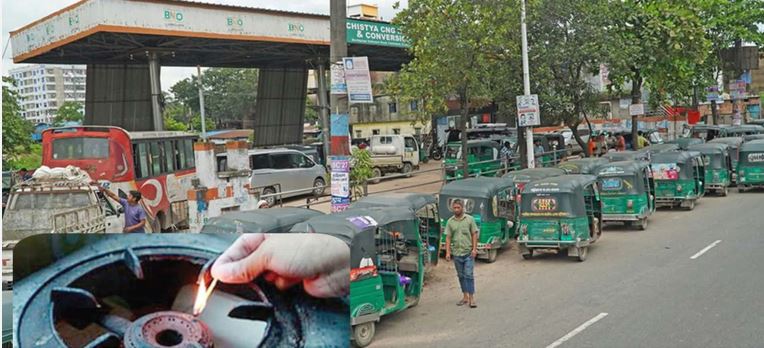
A severe gas crisis has gripped Chattogram, bringing daily life, transportation, industries and commercial activities to a near standstill.
Residential consumers are experiencing prolonged gas outages, factories have been forced to scale back production, CNG filling stations are struggling to meet demand, and reduced fuel supply to power plants has led to increased load shedding.
According to officials at Karnaphuli Gas Distribution Company Limited (KGDCL), Chattogram's normal daily gas demand stands at approximately 350 million cubic feet (MMCF). At the onset of the crisis, the city was receiving around 200 MMCF per day, but gas supply has declined even further since the beginning of August, intensifying shortages across both residential and industrial sectors.
Residential Areas Left Without Gas
Residents in most parts of the city-including Halishahar, Agrabad, Chandgaon, Chawkbazar, Bakalia, and Patenga-have been facing little to no gas pressure from early morning onwards. Many households are unable to cook lunch until late afternoon or even midnight, forcing families to rely on restaurant meals.
Ishrat Jahan, a resident of Askar Dighir Par area, said her family's meal schedule has been completely disrupted over the past week.
"The gas supply disappears in the morning, making it impossible to cook lunch on time. We have no choice but to buy food from restaurants. While adults can manage, I worry about having to feed my young children restaurant food every day."
CNG Stations Witness Long Queues
The crisis has also severely affected CNG refuelling stations, where low gas pressure has resulted in long queues of auto-rickshaws, microbuses, and other gas-powered vehicles. Many drivers wait for several hours but return empty-handed.
Mohammad Farhad Alam, an auto-rickshaw driver from Moijjar Tek, said the situation has become increasingly difficult.
"Previously, refuelling took 10 to 20 minutes. Now I spend up to four hours in line and often still don't get any gas. Most of my working day is wasted, making it difficult to earn enough to cover the vehicle owner's daily deposit and support my family."
Industrial Production Suffers
The shortage has dealt a major blow to Chattogram's industrial sector. According to KGDCL, several major industries-including Chittagong Urea Fertilizer Limited (CUFL)-have reduced production by 35 to 50 percent due to inadequate gas supply. Some factories are operating at less than half of their installed capacity.
Export-oriented industries, steel manufacturers, textile mills, and food processing companies have all reported significant operational disruptions and financial losses.
Power Generation Falls, Load Shedding Increases
Gas shortages have also reduced fuel supply to gas-fired power plants, lowering electricity generation capacity. As a result, Chattogram and surrounding areas have experienced increased load shedding in recent days, with both industrial zones and residential neighbourhoods reporting frequent power outages.
Industry stakeholders warn that electricity generation is unlikely to return to normal until gas supplies are restored. They say manufacturers are facing a dual challenge: reduced gas availability is forcing production cuts, while power shortages are causing further disruptions.
Business Leaders Warn of Economic Impact
Amirul Haque, President of the Chittagong Chamber of Commerce and Industry (CCCI), said the industrial sector has been among the worst affected by the crisis.
"Many factories have been forced to reduce production, while some are considering temporary shutdowns. This is affecting export order fulfilment, timely delivery of products, and overall production costs," he said.
He added that as Bangladesh's principal industrial and port city, disruptions in Chattogram would inevitably have broader implications for the national economy.
"The government must take immediate and effective measures to restore gas supply in order to keep industries operational," he said.
LNG Terminal Disruption Behind the Crisis
The crisis began after a fire and technical malfunction occurred on 21 July at the Floating Storage and Regasification Unit (FSRU) located in Moheshkhali, Cox's Bazar.
The incident significantly reduced LNG regasification and supply to the national gas grid. Daily gas supply, previously around 1 billion cubic feet, reportedly fell by nearly half.
Officials also said that due to the nationwide gas shortfall, a significant portion of the gas originally allocated for Chattogram has been diverted to meet demand in the capital, Dhaka, further worsening the shortage in the port city.
Authorities Hope for Improvement
Md. Tajuddin Dhali, General Manager (Engineering Services Division) at KGDCL, said the company has not been receiving gas according to demand from the national grid.
"We are distributing the limited supply through rationing. The situation was expected to improve after the afternoon of August 1, but instead it deteriorated further due to very low gas pressure and flow. We are maintaining constant communication with the higher authorities to resolve the crisis," he said.
According to the Energy and Mineral Resources Division, the operator of the damaged floating LNG terminal has requested until 10 August to complete repairs and resume operations.
Officials believe that until the terminal becomes fully operational and gas supply through the national grid returns to normal, Chattogram's gas crisis is unlikely to ease in the immediate future.
Residents in most parts of the city-including Halishahar, Agrabad, Chandgaon, Chawkbazar, Bakalia, and Patenga-have been facing little to no gas pressure from early morning onwards. Many households are unable to cook lunch until late afternoon or even midnight, forcing families to rely on restaurant meals.
Ishrat Jahan, a resident of Askar Dighir Par area, said her family's meal schedule has been completely disrupted over the past week.
"The gas supply disappears in the morning, making it impossible to cook lunch on time. We have no choice but to buy food from restaurants. While adults can manage, I worry about having to feed my young children restaurant food every day."
CNG Stations Witness Long Queues
The crisis has also severely affected CNG refuelling stations, where low gas pressure has resulted in long queues of auto-rickshaws, microbuses, and other gas-powered vehicles. Many drivers wait for several hours but return empty-handed.
Mohammad Farhad Alam, an auto-rickshaw driver from Moijjar Tek, said the situation has become increasingly difficult.
"Previously, refuelling took 10 to 20 minutes. Now I spend up to four hours in line and often still don't get any gas. Most of my working day is wasted, making it difficult to earn enough to cover the vehicle owner's daily deposit and support my family."
Industrial Production Suffers
The shortage has dealt a major blow to Chattogram's industrial sector. According to KGDCL, several major industries-including Chittagong Urea Fertilizer Limited (CUFL)-have reduced production by 35 to 50 percent due to inadequate gas supply. Some factories are operating at less than half of their installed capacity.
Export-oriented industries, steel manufacturers, textile mills, and food processing companies have all reported significant operational disruptions and financial losses.
Power Generation Falls, Load Shedding Increases
Gas shortages have also reduced fuel supply to gas-fired power plants, lowering electricity generation capacity. As a result, Chattogram and surrounding areas have experienced increased load shedding in recent days, with both industrial zones and residential neighbourhoods reporting frequent power outages.
Industry stakeholders warn that electricity generation is unlikely to return to normal until gas supplies are restored. They say manufacturers are facing a dual challenge: reduced gas availability is forcing production cuts, while power shortages are causing further disruptions.
Business Leaders Warn of Economic Impact
Amirul Haque, President of the Chittagong Chamber of Commerce and Industry (CCCI), said the industrial sector has been among the worst affected by the crisis.
"Many factories have been forced to reduce production, while some are considering temporary shutdowns. This is affecting export order fulfilment, timely delivery of products, and overall production costs," he said.
He added that as Bangladesh's principal industrial and port city, disruptions in Chattogram would inevitably have broader implications for the national economy.
"The government must take immediate and effective measures to restore gas supply in order to keep industries operational," he said.
LNG Terminal Disruption Behind the Crisis
The crisis began after a fire and technical malfunction occurred on 21 July at the Floating Storage and Regasification Unit (FSRU) located in Moheshkhali, Cox's Bazar.
The incident significantly reduced LNG regasification and supply to the national gas grid. Daily gas supply, previously around 1 billion cubic feet, reportedly fell by nearly half.
Officials also said that due to the nationwide gas shortfall, a significant portion of the gas originally allocated for Chattogram has been diverted to meet demand in the capital, Dhaka, further worsening the shortage in the port city.
Authorities Hope for Improvement
Md. Tajuddin Dhali, General Manager (Engineering Services Division) at KGDCL, said the company has not been receiving gas according to demand from the national grid.
"We are distributing the limited supply through rationing. The situation was expected to improve after the afternoon of August 1, but instead it deteriorated further due to very low gas pressure and flow. We are maintaining constant communication with the higher authorities to resolve the crisis," he said.
According to the Energy and Mineral Resources Division, the operator of the damaged floating LNG terminal has requested until 10 August to complete repairs and resume operations.
Officials believe that until the terminal becomes fully operational and gas supply through the national grid returns to normal, Chattogram's gas crisis is unlikely to ease in the immediate future.

Loading...
Loading...
Also read






Editor : Iqbal Sobhan Chowdhury
Published by the Editor on behalf of the Observer Ltd. from Globe Printers, 24/A, New Eskaton Road, Ramna, Dhaka.
Editorial, News and Commercial Offices : Aziz Bhaban (2nd floor), 93, Motijheel C/A, Dhaka-1000.
Phone: PABX- 41053001-06; Advertisement: 41053012; 01793317829, 01550707291, E-mail: [email protected], [email protected] Online: email: [email protected] 41053014; 01550707297 Advertisement: 01550707296
Published by the Editor on behalf of the Observer Ltd. from Globe Printers, 24/A, New Eskaton Road, Ramna, Dhaka.
Editorial, News and Commercial Offices : Aziz Bhaban (2nd floor), 93, Motijheel C/A, Dhaka-1000.
Phone: PABX- 41053001-06; Advertisement: 41053012; 01793317829, 01550707291, E-mail: [email protected], [email protected] Online: email: [email protected] 41053014; 01550707297 Advertisement: 01550707296


