



| HEADLINE |

|

Prices of iftar items rise by 10-20pc
Published : Friday, 20 February, 2026 at 12:00 AM
Mizanur Rahman


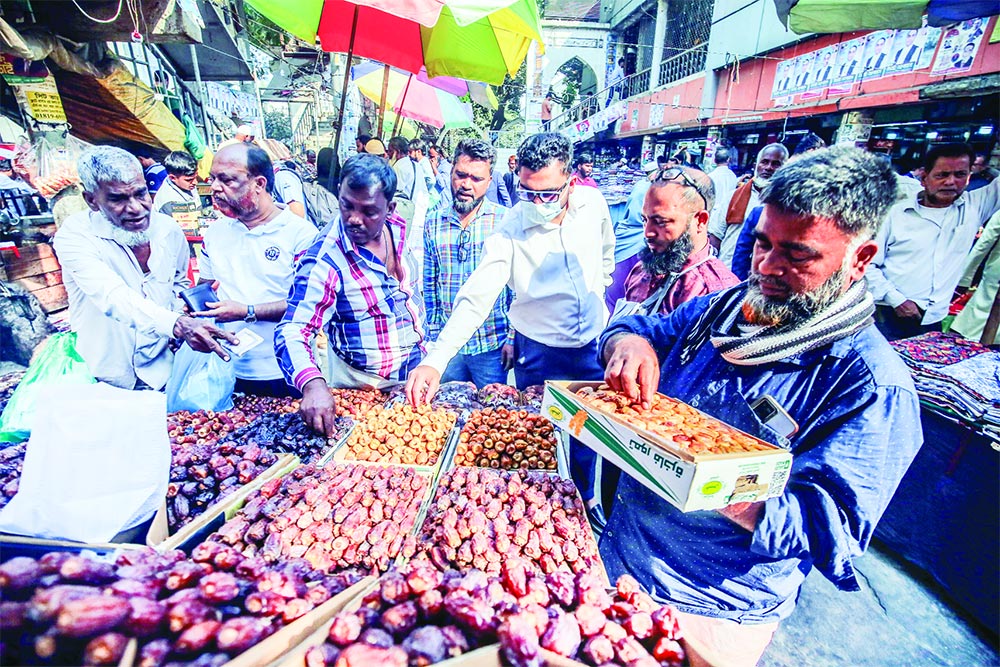 Prices of popular iftar items-including jilapi, beguni (a brinjal fritter), aloor chop (mashed potato fritter), puffed rice (muri), dates, and sarbat (a sweet drink made with fruit, sugar, or molasses and water)-have increased by 10 to 20 per cent this year due to rising commodity costs.
Consumers have expressed concern over the higher prices compared to last year and have also questioned the quality of food sold at roadside stalls.
Abul Kalam, a customer, said, "The price of jilapi is significantly higher this year than last year. I am not sure why vendors are charging more. However, we have not seen any reports of a sugar shortage in the country that would justify such an increase."
He added, "There are also concerns about the quality of foods prepared on the sidewalk. But these are essential iftar items, and iftar feels incomplete without them."
A visit to several markets in the city on Saturday found that, in addition to daily essentials, iftar items have seen a sharp price hike. Common items at most stalls include muri, piyaju, chhola bhaji (spiced fried chickpeas), chop, beguni, jilapi and burinda. Depending on the area, some shops offer additional delicacies. Despite the high prices, city dwellers continued to buy items to prepare their iftar on the second day of Ramadan. Most shops became crowded as the afternoon progressed, and fruit shops also saw a rush of buyers.
Shahnewaz, a sales representative of Mughal Restaurant, said beguni, piyaju and potato chop are selling at Tk 10 each. Saslik is priced between Tk 110 and Tk 120, while egg chop, rolls and small kebabs cost Tk 40 each. Halim is being sold at Tk 150 to Tk 650 per bowl, and chicken kebab at Tk 130 to Tk 160.
Compared to last year, the price of each item has increased by Tk 25 to Tk 30, mainly due to higher prices of sugar, pulses, spices and other ingredients.
Seasonal iftar vendors said jilapi, an integral part of iftar, is being sold at Tk 280 to Tk 370 per kg, anthor at Tk 30 per piece, piyaju at Tk 15 per piece, and fried chicken at Tk 120 per piece.
They claimed that iftar item prices have increased by 30 to 35 per cent this year. Traditional iftar packages are being sold at prices ranging from Tk 250 to Tk 549, higher than last year.
Shafiq Alauddin, a restaurant owner on Nazimuddin Road in Old Dhaka, said he will sell halim this year as usual. However, instead of increasing the price from last year's Tk 200, he has decided to reduce the portion size.
"The prices of various ingredients used to make halim have increased," he said. "As a result, we have to adjust either the price or the quantity. Otherwise, many customers will not be able to afford it."
At Star Kebab, samucha is selling at Tk 25, keema samucha at Tk 20, chicken saslik at Tk 60, chicken cutlet at Tk 60, chicken nuggets at Tk 100, chicken karahi at Tk 100, chicken wings at Tk 30, chicken lollipop at Tk 60, chicken anthor at Tk 25, chicken cheese balls at Tk 30, chicken tawa fry at Tk 80, jali kebab at Tk 25, chicken spring roll at Tk 35, chicken fry at Tk 80, chicken crumb fry at Tk 150 and vegetable roll at Tk 25. Butter paratha is selling at Tk 65, plain paratha at Tk 35 and keema paratha at Tk 65.
Chicken tikka is priced at Tk 120 per piece, beef seekh kebab at Tk 130, chicken boti kebab at Tk 125, beef adana kebab at Tk 140, beef boti kebab at Tk 160, chicken Kashmiri kebab at Tk 120 and mutton boti kebab at Tk 155.
A visit to major markets in the capital also showed a wide range of sherbet-making ingredients available, though prices have increased. Popular brands include Tang, Rooh Afza, glucose, fruit saline, isabgul and various local and imported fruit juices.
Sharbat powders in different flavours are being sold in 1-2 kg, 840g, 500g, 480g and 270g containers. Imported brands such as Nutri-C and Tang are priced between Tk 300 and Tk 1,600 depending on weight. Rooh Afza, produced by Hamdard Laboratories, is being sold at Tk 300 for a 300ml bottle and Tk 550 for a 750ml bottle.
Loading...
Loading...
Also read



Editor : Iqbal Sobhan Chowdhury
Published by the Editor on behalf of the Observer Ltd. from Globe Printers, 24/A, New Eskaton Road, Ramna, Dhaka.
Editorial, News and Commercial Offices : Aziz Bhaban (2nd floor), 93, Motijheel C/A, Dhaka-1000.
Phone: PABX- 41053001-06; Advertisement: 41053012; 01793317829, 01550707291, E-mail: [email protected], [email protected] Online: email: [email protected] 41053014; 01550707297 Advertisement: 01550707296
Published by the Editor on behalf of the Observer Ltd. from Globe Printers, 24/A, New Eskaton Road, Ramna, Dhaka.
Editorial, News and Commercial Offices : Aziz Bhaban (2nd floor), 93, Motijheel C/A, Dhaka-1000.
Phone: PABX- 41053001-06; Advertisement: 41053012; 01793317829, 01550707291, E-mail: [email protected], [email protected] Online: email: [email protected] 41053014; 01550707297 Advertisement: 01550707296


