



| HEADLINE |

|

Plastic burning main culprit behind Dhaka's toxic air, study finds


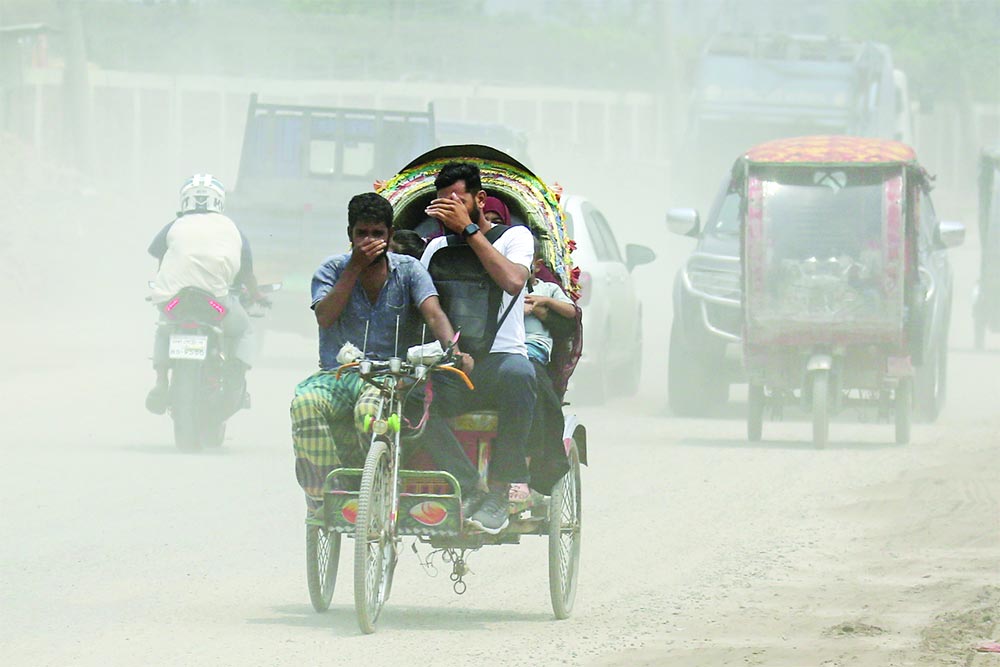 Burning plastic, polythene and paper for warmth in winter spreads micro plastic, makes Dhaka's air toxic, causes various lungs-related diseases, blood pressure and other ailments where medicine does not work, study said.
"A total of 2.40 billion tonnes of household waste are created in the world every year. 26 per cent of it is burnt near houses and 15 per cent are burnt in the designated places. Of this, 226.9 million tonnes of waste is created in the US and 26.7 million tonnes of waste is created in Bangladesh," Dhaka University Chemistry Department's Professor Abdus Salam told the Daily Observer on Wednesday.
The Ohio State University in the USA and the Dhaka University chemistry department jointly carried out the study over the impact of burning plastic in the air of US and Bangladesh. Prof Abdus Salam led the study from Bangladesh side. The joint study collected samples of air from 13 areas in Dhaka.
"Matuail and Aminbazar are the main dumping areas of waste and burnt in these areas, presently it is the main cause of Dhaka's worsening air quality situation," Md Ziaul Haque, director of Air Quality Management at DoE said.
He said the Dhaka North and South City Corporation have been asked to stop burning the waste immediately.
"We are set to discuss the issue with the new Minister today (Wednesday). We need to take action from higher ups to stop such programme as the weather is extremely dry…the smoke and particles are spreading from here and covered the sky of Dhaka.
Of the waste created in Bangladesh, 60 per cent is burnt near houses, creating smoke, carbon monoxide, mercury, hydrochloric acid and polycyclic aromatic hydrocarbons.
"We have identified the sources of air pollution, construction, brick and regular industries, use of non standard fuel in vehicle, power plants are the main cause of air pollution right at the moment," Prof Salam said adding that the newly elected government should come forward to take immediate action in this regard.
Studies estimate that air pollution contributes to over 200,000 deaths annually in Bangladesh (World Bank). PM2.5 is a known trigger for respiratory and cardiovascular diseases, strokes, and lung cancer. Among children, it exacerbates asthma, stunting, and cognitive impairment, while in newborns, it is linked to low birth weight and premature birth.
These health burdens also come with economic costs, including higher healthcare expenses and reduced productivity, which in 2019 amounted to 11 billion USD or 4.4-4.8 per cent of the country's GDP (World Bank).
In the study, it is said that micro plastic spreads in the air of these countries.
According to the study, 25 per cent of total plastic waste is spreading in South Asian countries. 91 per cent of it spreads in India, Bangladesh and Pakistan. The total waste created in this region is 32.2 million tonnes and 12 per cent of it is plastic.
Of the total plastic, 75 per cent is thrown in the soil and water. If things go in this way, the amount of plastic will stand at 60 million tonnes annually. If the use of plastic is stopped now, even 5 billion tonnes of plastic will remain in the environment. A plastic particle lasts at least 400 years.
In the research it is said 47 per cent of deaths due to air pollution take place in Bangladesh, India and Pakistan.
Respiratory medicine department professor Md Atiqur Rahman said if a plastic particle enters the body through breath, it first spreads in lungs and later in the blood.
It causes various lungs-related diseases, blood pressure and other ailments where medicine does not work. As a result, steps have to be taken so that plastic waste does not spread in nature, he added.
In 2023, it was ranked the most polluted country globally, with an annual average fine particulate matter (PM2.5) concentration of 79.9 µg/m³-more than double the national standard of 35 µg/m³ and 15 times the World Health Organization's (WHO) guideline of 5 µg/m³ (IQ Air, 2023).
These health burdens also come with economic costs, including higher healthcare expenses and reduced productivity, which in 2019 amounted to 11 billion USD or 4.4-4.8 per cent of the country's GDP (World Bank).
This health impact assessment (HIA) further assesses the consequences of such extreme pollution.
The study findings were published in the international science magazine SIS Environmental in September last year. In the study, it is feared micro plastic spreads in the air of Dhaka. In the study, samples of air from five areas in the US and six areas of Bangladesh were collected
Reducing exposure to PM2.5 pollution in Bangladesh could prevent approximately 102,456 deaths annually. This includes deaths due to ischemic heart disease (29,920), stroke (23,075), chronic obstructive pulmonary disease (20,976), lower respiratory infections (9,720), and lung cancer (3,063).
Meeting Bangladesh's national air quality standard could reduce deaths by 19 per cent, while meeting the WHO 2021 guideline would reduce deaths by 79 per cent, that is, 81,282 lives each year, and eliminate almost all asthma-related emergency visits and preterm births, as well as avoid 262 million annual sick leave days. Adherence to this standard would also reduce Years of Life Lost (YLL) by 21per cent and Years Lived with Disability (YLD) by 12 per cent.
"I am working in this field for last 20 years, attended several meetings in local abroad, enacted huge policies…but did not see the implementation of those," Professor Salam said adding that everyone is ready to join hand under several development partner's supporting fund but the situation is declining…now we are crossing the Delhi's pollution level, obtaining first as air pollution is concerned," Professor Salam said.

Loading...
Loading...
Also read



Editor : Iqbal Sobhan Chowdhury
Published by the Editor on behalf of the Observer Ltd. from Globe Printers, 24/A, New Eskaton Road, Ramna, Dhaka.
Editorial, News and Commercial Offices : Aziz Bhaban (2nd floor), 93, Motijheel C/A, Dhaka-1000.
Phone: PABX- 41053001-06; Advertisement: 41053012; 01793317829, 01550707291, E-mail: [email protected], [email protected] Online: email: [email protected] 41053014; 01550707297 Advertisement: 01550707296
Published by the Editor on behalf of the Observer Ltd. from Globe Printers, 24/A, New Eskaton Road, Ramna, Dhaka.
Editorial, News and Commercial Offices : Aziz Bhaban (2nd floor), 93, Motijheel C/A, Dhaka-1000.
Phone: PABX- 41053001-06; Advertisement: 41053012; 01793317829, 01550707291, E-mail: [email protected], [email protected] Online: email: [email protected] 41053014; 01550707297 Advertisement: 01550707296


