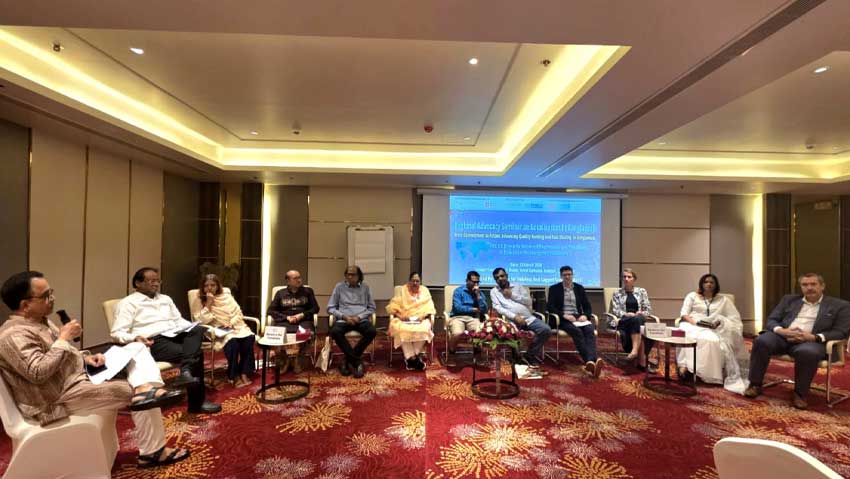
A seminar focusing on quality funding and equitable risk sharing in humanitarian response was held in Cox's Bazar, bringing together representatives from government agencies, NGOs and international organisations to discuss strengthening localisation in humanitarian efforts.
The seminar, titled “From Commitment to Action: Advancing Quality Funding and Risk Sharing,” was organised on Thursday by local voluntary organisation PULSE Bangladesh at a hotel conference hall in the coastal city.
The event was arranged under the “Together Project” with overall support from Malteser International. The programme began with a welcome speech by PULSE’s honorary executive director Abu Morshed Chowdhury.
During the seminar, Malteser International Bangladesh coordinator Mohammad Arif Dewan presented an overview of the activities being implemented under the Together Project in eight countries, including Bangladesh.
The keynote paper was delivered by PULSE project coordinator Rashedul Hasan.
Later, a plenary session on quality funding, risk sharing, and localisation in humanitarian response was held, moderated by Abu Morshed Chowdhury.
The panel discussion featured several prominent participants, including representative of the Refugee Relief and Repatriation Commissioner and Camp-in-Charge (Deputy Secretary) Md Shariful Islam; senior director of BRAC AKM Morshed; executive director of BETA Bangladesh Shishir Dutta; country director of Malteser International Keerti; principal coordinator of Inter Sector Coordination Group David Bagdan; chief executive of Muktee Cox's Bazar Bimal Chandra De Sarkar; representatives from UNHCR and Oxfam, along with several leaders from local and international organisations.
Representatives from Cox's Bazar Press Club, civil society members, journalists and officials from national and international organisations, including UN agencies, also attended the event.
Speakers at the seminar said that during crises or humanitarian disasters, local organisations, communities, and elected representatives are usually the first to respond and often remain active long after international organisations leave. Their close ties with local communities enable them to provide faster and more practical assistance.
However, they noted that despite global commitments to localisation, direct funding opportunities for local organisations remain limited. Much of the funding flows through international agencies or multiple intermediary layers, which delays the delivery of resources at the local level and increases administrative costs.
To make humanitarian assistance more effective, participants proposed several key recommendations. These include increasing direct and flexible funding for local organisations, introducing multi-year funding mechanisms, ensuring adequate administrative costs, establishing dedicated funds to strengthen local initiatives and developing policies for equitable risk sharing among governments, donors and international organisations.
In his opening remarks, Abu Morshed Chowdhury said the humanitarian system has historically followed a “risk transfer” model in which financial, legal, compliance and security risks are often shifted from international agencies to local and national NGOs.
He emphasised that future localisation efforts should be based on a balanced and collaborative approach built on trust, mutual accountability, and shared responsibility.
The seminar concluded with a vote of thanks delivered by Shishir Dutta, executive director of BETA.
SU/SH