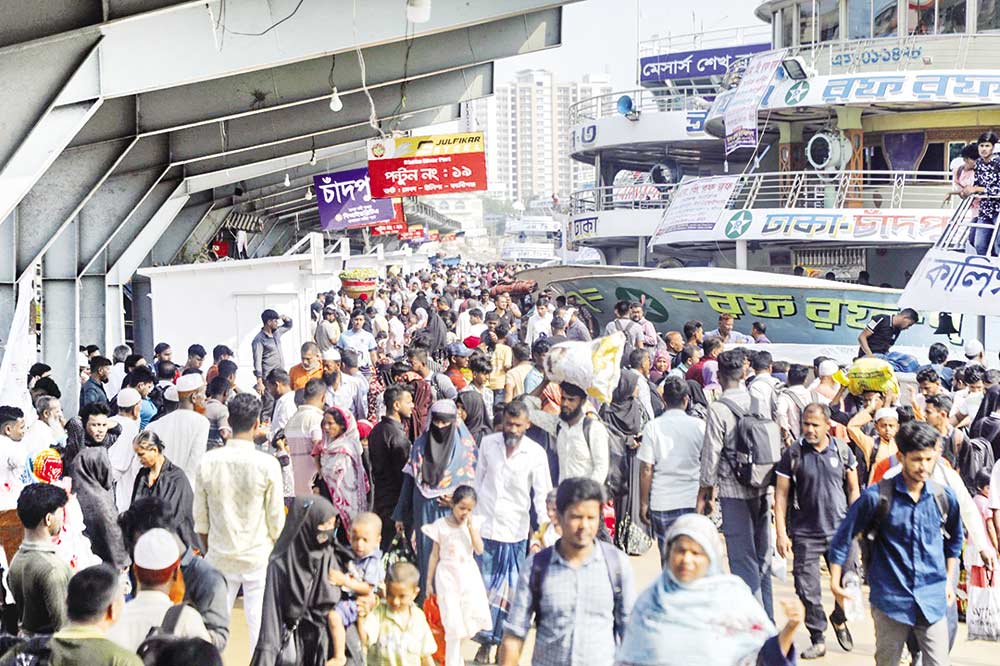
In the aftermath of the extended Eid-ul-Fitr holidays, the capital has begun returning to its usual bustling routine. Working professionals, students, and families from across the country are making their way back, creating a noticeable surge in passengers at major transit points. On Saturday morning, Kamalapur Railway Station witnessed massive crowds of Dhaka-bound passengers, reflecting the post-holiday rush.
The government's Eid holiday schedule, spanning March 17-23, followed by working days on March 24 and 25, and coupled with the Independence Day holiday on March 26 and the weekend, allowed many employees to extend their leave. Consequently, most workers are expected to resume duties from Sunday, making the return to Dhaka particularly crowded.
At Kamalapur, trains arriving from across the country were packed to capacity. Compartment after compartment was filled, with many passengers standing in aisles, hanging from doors, or even sitting in corridors. In some instances, passengers travelled on train roofs, highlighting both the high demand and safety risks.
Sahabul Islam, a passenger on the Sundarbans Express from Darshana in Chuadanga, said,
"I am a bank employee and had gone to my village during the extra leave. Since my office resumes tomorrow, I decided to return to Dhaka a day early. Many like me are travelling today. The journey by train is safe, but the crowd was overwhelming."
Similarly, Asma Akhtar raised concerns over overcrowding in the AC compartment:
"I booked an AC ticket expecting a comfortable journey, but standing passengers entered, making the compartment cramped. It was uncomfortable and posed a safety risk. Authorities should monitor AC compartments more strictly."
Passengers on other trains reported similar difficulties. Saimum, travelling on the Chilahati Express from Naogaon, said,
"I struggled to get a seat. Even after sitting, the compartment remained tightly packed until we reached Kamalapur."
Not all passengers had tickets. University student Sumon Ahmed admitted,
"I couldn't get a ticket, so I travelled on the roof. I will buy the ticket after leaving the station. The railway is a state asset, and rules should be followed, but sometimes there is no other option."
The pressure on roads mirrored that of the railways. Passengers arriving at Gabtoli, Sayedabad, and Jatrabari bus terminals faced congestion and chaos. Long-distance buses continuously offloaded passengers, creating bottlenecks. Many had to bargain for CNG auto-rickshaws, rickshaws, or motorbikes to reach their destinations, with frequent complaints about inflated fares.
Abdur Rahim, a businessman from Rangpur, said, "I boarded a Volvo bus on Friday night and reached Dhaka around noon on Saturday. It took over five hours due to traffic from Sirajganj to Nabinagar. I also had to pay double fare. I couldn't see any traffic police along the way."
Other passengers shared similar experiences. Sirajul Momin Shamim, from Faridpur, said he had to take a broken route due to unavailable direct buses, "I paid 200 taka for a fare that usually costs 150."
Pranat Roy, a student from Thakurgaon, added, "I paid 2,000 taka for a ride that normally costs 1,200. Even after reaching Dhaka, I had to pay extra for a short CNG ride."
Authorities acknowledged the situation, attributing fare discrepancies to high passenger demand during the Eid period. A Jamuna Paribahan driver stated, "Passenger pressure has increased, but we are operating at government-approved fares as much as possible."
Railway officials reported that despite the overwhelming passenger volume, most trains arrived in Dhaka on schedule.
Additional law enforcement personnel were deployed to ensure safety, though controlling overcrowding remains a challenge.
Passengers recognised the reality of the situation, noting that such crowding during Eid is common. Many suggested increasing the number of trains during peak periods to ease congestion and provide a more comfortable journey.
The post-Eid rush is expected to continue for several days as people gradually return to their workplaces. Once offices and courts reopen on Sunday, the capital is anticipated to resume its normal rhythm, with busy streets and bustling transit hubs.
Meanwhile, river transport also experienced a surge. Over fifty launches arrived at Dhaka's Sadarghat from various routes on Thursday and Friday, carrying returning passengers and illustrating the scale of post-holiday movement.
As Dhaka returns to its daily hustle and bustle, the flow of returning passengers highlights both the city's enduring importance as a workplace and the ongoing challenges faced by public transport systems in managing high-volume travel periods.





