



| HEADLINE |

|

Pump closures lay bare cracks in fuel distribution system



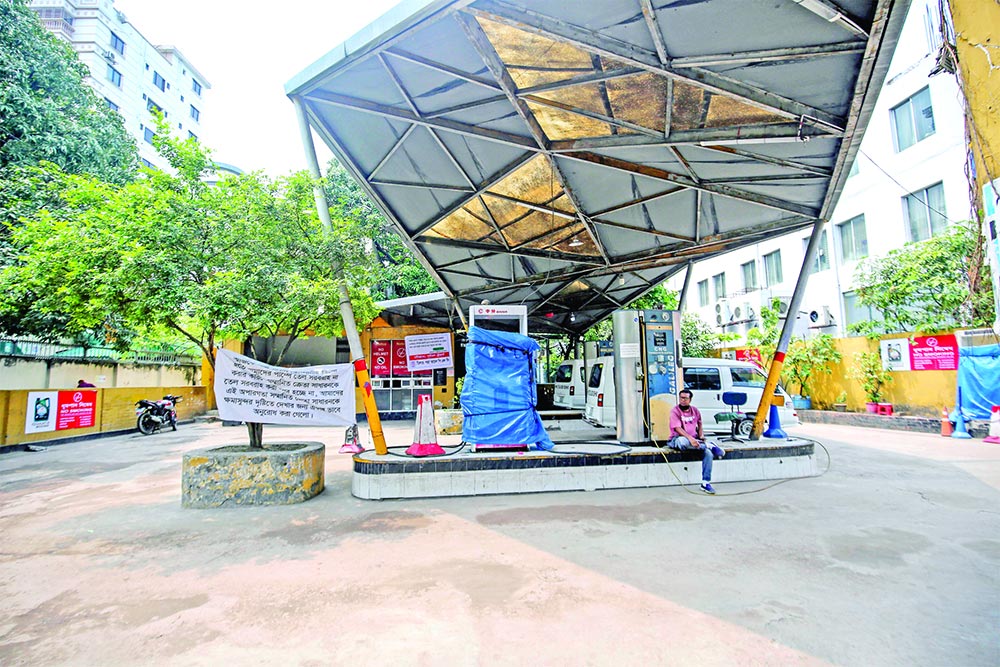 In the wake of US-Israeli war on Iran, the widespread closure and restricted operations of petrol pumps have exposed a complex nexus of retail level supply constraints, regulatory enforcement gaps and demand driven volatility.
A field observation across the High Court area, Motijheel, Malibagh, Shantinagar, Paltan and Mugda on Friday showed most pumps closed, with entrances blocked and 'No Fuel' notices displayed. At operational stations, long queues of vehicles stretched for long distances, with many waiting for hours or returning without fuel.
MAPPING THE FUEL SCENARIO
* Eastern Refinery in Chattogram produces at least 500 tonnes of petrol daily and refines about 200,000 tonnes of crude oil monthly
* Cops conducted 4,824 raids across 64 districts between March 3 and April 1, recovering 372,388 litres
* Domestic petrol output includes around 12,000 tonnes from the Sylhet condensate plant and about 15,000 tonnes from a major private plant, with smaller contributions from three others
* Around 2,198 out of 2,329 pumps serving around 180 million people
At Ramna filling station, queues extended from Matsya Bhaban to Shilpakala Academy, while Moin Motor in Moghbazar suspended petrol and octane sales. In Motijheel, Karim and Sons and Pubali Filling Station operated briefly, but Navana pump stopped supply by 1PM. Abdul Ahad waited one and a half hours in a kilometre long queue only to find the pump empty, reflecting similar scenes across the capital.
Operators blame closures on supply falling far short of sharply increased demand. Syed Sajjadul Karim Kabul of the Bangladesh Petrol Pump Owners Association said, "Depot supply is within limits but insufficient, leaving some pumps dry and others under supplied, increasing costs and losses."
He denied hoarding, citing limited storage and monitoring, warned of worsening conditions if demand persists, and called for army deployment alongside law enforcement.
Sajjadul Karim further said that the mismatch is unprecedented, with 2,198 of 2,329 pumps serving around 180 million people now facing demand spikes from 5,000 to 25,000 litres daily, while some pumps that sold 4,500 litres over three days now sell nearly 10,000 litres in a day. Pumps must suspend sales when stocks fall below 200 to 400 litres to avoid air lock, and government appointed tag officers now control distribution.
Recently, Petrol Pump Owners Association proposed an eight-point plan, including 13-hour closure and capacity based supply, urged the public to avoid rumours and panic-buying, and noted that stocks of 10,500 litres or even 8,000 litres are being rapidly depleted.
The government however, maintains that there is no national shortage. The Bangladesh Petroleum Corporation (BPC) and Energy Department (ED) say supply chains are operational, with about 90 per cent of petrol and octane demand met domestically. The Eastern Refinery in Chattogram produces at least 500 tonnes of petrol daily and refines about 200,000 tonnes of crude oil monthly.
According to Joint Secretary Monir Hossain Chowdhury, "Total stock is 255,018 tonnes, including 122,660 tonnes of diesel, 12,194 tonnes of petrol and 9,210 tonnes of octane, with monthly demand at 350,000 tonnes for diesel and 70,000 tonnes for petrol and octane combined."
Diesel imports include 110,000 tonnes confirmed for April, 60,000 tonnes in the pipeline and about 130,000 tonnes in depots, totalling around 300,000 tonnes or 86 percent of demand. Octane shipments of 25,000 tonnes have arrived with another scheduled, ensuring supply for over one and a half months against a demand of 35,000 tonnes. Domestic petrol output includes around 12,000 tonnes from the Sylhet condensate plant and about 15,000 tonnes from a major private plant, with smaller contributions from three others. In Parliament, State Minister Iqbal Hasan Mahmud said supply has increased, citing 482,000 tonnes of diesel distributed between February 17 and March 29 and stock of 218,000 tonnes, despite global uncertainty.
However, irregularities persist, including repeated purchases, black market sales at up to three times official prices, unauthorised storage and violent incidents. Law enforcement conducted 4,824 raids across 64 districts between March 3 and April 1, recovering 372,388 litres, yet allegations of syndicates creating artificial scarcity remain.
Demands have intensified for legal action, including licence cancellation, administrative takeover of pumps and deployment of the army or Border Guard Bangladesh. Energy expert Professor M Tamim said, "Such crises are driven by panic buying, illegal resale and hoarding, suggesting fuel cards, fixed allocation and limits on multiple sourcing, though individual hoarding is difficult to control."
Administrative disruptions added pressure, as Eid related banking closures delayed pay orders, diesel sales doubled in early March prompting nine days of rationing, and later rose by 10 to 15 percent, straining the government's three depots.
Monir Hossain Chowdhury said, "Panic buying persists despite adequate supply, while the Bangladesh Petrol Pump Owners Association warned on March 22 of possible closures due to inadequate allocation and security concerns."
Overall, the situation reflects a disruption in distribution rather than a supply shortage, driven by demand surges, behavioural factors and enforcement gaps, requiring coordinated legal, administrative and policy responses.

Loading...
Loading...
Also read



Editor : Iqbal Sobhan Chowdhury
Published by the Editor on behalf of the Observer Ltd. from Globe Printers, 24/A, New Eskaton Road, Ramna, Dhaka.
Editorial, News and Commercial Offices : Aziz Bhaban (2nd floor), 93, Motijheel C/A, Dhaka-1000.
Phone: PABX- 41053001-06; Advertisement: 41053012; 01793317829, 01550707291, E-mail: [email protected], [email protected] Online: email: [email protected] 41053014; 01550707297 Advertisement: 01550707296
Published by the Editor on behalf of the Observer Ltd. from Globe Printers, 24/A, New Eskaton Road, Ramna, Dhaka.
Editorial, News and Commercial Offices : Aziz Bhaban (2nd floor), 93, Motijheel C/A, Dhaka-1000.
Phone: PABX- 41053001-06; Advertisement: 41053012; 01793317829, 01550707291, E-mail: [email protected], [email protected] Online: email: [email protected] 41053014; 01550707297 Advertisement: 01550707296


